

Tehran Golestan Palace Damage Triggers UNESCO Warning
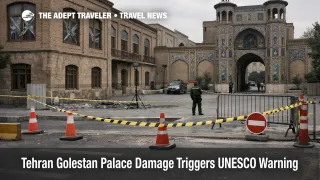
UNESCO says Iran's UNESCO listed Golestan Palace in Tehran was reportedly damaged on March 2, 2026, after debris and shockwaves from a nearby strike hit the site's buffer zone. For travelers, the immediate issue is not only the condition of one landmark, it is the way conflict conditions can abruptly change access rules, operating hours, and safety perimeters around historic districts, museums, and tour corridors, sometimes with little notice. If Tehran is on the itinerary, assume same day plan stability is lower than usual, and build flexibility into tickets, guides, and transfer timing while official updates catch up.
UNESCO also said it has shared the geographic coordinates of World Heritage sites and other nationally significant sites with the parties involved to reduce the risk of further damage, and it reiterated that cultural property is protected under international law, including the 1954 Hague Convention and the 1972 World Heritage Convention. That matters for travelers because when heritage protection becomes part of the active operating picture, you often see tighter cordons, restricted approach routes, and more frequent last minute closures around high profile sites.
Golestan Palace Damage Tehran, What Changed
UNESCO's March 2, 2026 statement said Golestan Palace was reportedly damaged by debris and a shockwave following an airstrike in the site's buffer zone near Arag Square in Tehran. Iranian media reports described damage to elements such as windows and doors, and international reporting has treated the damage as verified by those local reports, not as an on site UNESCO assessment.
Golestan Palace is Tehran's only UNESCO World Heritage site, and UNESCO's listing notes the complex is in the heart of Tehran's historic core, and that the property includes key palace structures that are largely used as museums. In practical travel terms, that combination, central location plus museum function, is exactly what turns a heritage incident into itinerary friction, because it sits inside dense street grids and relies on predictable access, staffing, and visitor management.
Who Faces Disruption in Tehran Right Now
Travelers with fixed time entry plans, guided city tours, or tightly scheduled airport transfers are the most exposed. Even if the palace itself remains open, authorities can impose perimeter controls, reroute traffic, or pause admissions while inspections, debris clearing, or security posture changes play out. That tends to break tours that chain multiple downtown stops, and it can also affect travelers staying in central neighborhoods who expected normal pickup points and normal travel times.
Independent travelers are also more exposed than group travelers when conditions shift fast, because refunds and rebooking are harder when tickets, guides, and transport are booked as separate components. If the trip includes multiple paid reservations in a single day, the second order effect is not just one closure, it is a cascade of missed slots and sunk costs across museums, drivers, and timed experiences.
Finally, travelers transiting the wider region should treat this as another signal that conflict effects are not neatly contained. When airspace, airports, and security conditions change quickly, the ripple reaches beyond one city, and it can feed into rolling schedule changes and constrained rebooking inventory, even for people whose trip is not centered on Iran. For the broader aviation angle, see Iran Strikes Trigger Global Flight Cancellations and Middle East Airspace Closures Ground Gulf Hubs.
What Travelers Should Do Now
Treat Tehran sightseeing as a flexible block, not as a clockwork sequence. Confirm day of opening status with official channels where possible, and if you are using a guide or driver, set a clear fallback plan that swaps in lower risk neighborhoods or indoor sites that are less likely to sit inside a tightened security perimeter. If you already prepaid, document the closure or restriction notice you receive, because that often matters for card disputes and insurance claims.
Decision thresholds matter. If your Tehran day is the only cultural day in a short trip, and you cannot absorb a missed visit, consider shifting the palace visit earlier in the day and keeping afternoon options loose, or moving the palace to a different day entirely if local operators are warning of inspections or access controls. If your trip has slack, waiting for clearer operating patterns can be the better trade, especially if the alternative is getting stuck in a downtown perimeter while transfers and pickups get reshuffled.
Over the next 24 to 72 hours, monitor three things that change the traveler risk picture fastest. First, whether Golestan Palace and nearby museum sites publish confirmed operating status and hours, not just general statements. Second, whether authorities announce, or local operators observe, consistent perimeter rules and approach routes, because stable access is what makes tours reliable again. Third, whether flight schedule changes, or local movement constraints, start affecting your arrival and departure buffers, because that is how a sightseeing issue turns into a missed connection problem.
Why Heritage Site Damage Creates Wider Travel Risk
UNESCO's move to share site coordinates, and its reminder about international legal protections, is a signal that cultural heritage is being treated as a protected asset set inside an active conflict environment, not as a normal tourism sector. For travelers, that translates into a specific mechanism: once a location is flagged as sensitive, the system around it changes, police posture, traffic control, inspections, and staffing, and the tourism product becomes less predictable even if the physical damage is limited.
Golestan Palace's UNESCO listing also explains why the site is operationally complex. It is a walled palace complex in a dense historic core, and the property includes multiple key structures used as museums, which means there are more points of failure, and more reasons to pause access, than at a single building you can view from the street. That is why even "minor" reported damage can create outsized visitor disruption, managers may need to check multiple structures, restrict certain wings, and control crowd flow more tightly.
The broader takeaway is uncomfortable but useful. In conflict conditions, cultural sites do not behave like normal attractions, they behave like infrastructure within a security system. Travelers who plan with that assumption, building time buffers, keeping cancellations refundable where possible, and avoiding brittle same day chains, usually keep more of their trip intact when conditions change.
Sources
- UNESCO expresses concern over the protection of cultural heritage sites amidst escalating violence in the Middle East
- Golestan Palace, UNESCO World Heritage Centre
- UNESCO listed Golestan Palace in Tehran damaged in strikes: Iranian media (AFP via SpaceWar)
- UNESCO expresses concern over the protection of cultural heritage sites in Middle East (Euronews)