

Middle East Airspace Closures Ground Gulf Hubs
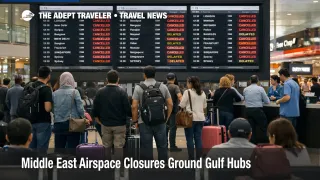
Global itineraries relying on the Gulf stayed fragile on Monday, March 2, 2026, as the conflict centered on Iran continued to drive Middle East airspace closures and airport level shutdowns across key connection hubs. The practical change for travelers is that "some flights" restarting does not mean hubs are reliable again, because airlines are prioritizing repatriation, aircraft repositioning, and clearing stranded transit banks before rebuilding normal schedules.
Emirates said it would operate a limited number of flights Monday evening, while warning travelers not to go to the airport unless notified and noting that earlier bookings are being prioritized. Qatar Airways said its flight operations remain temporarily suspended due to the closure of Qatari airspace, with its next update set for the morning of March 3, 2026, Doha time. Etihad has also been operating select flights, with flight tracking and reporting indicating departures intended to clear stranded passengers, but commercial schedules remain subject to evolving restrictions and security conditions.
Middle East Airspace Closures: What Changed for Travelers
The most important update is that disruption has shifted from a clean "stop" to an uneven restart, where limited departures can coexist with widespread cancellations, closed airspace, and missed connections. That is why travelers can see a flight resume in one direction while their onward connection remains canceled, or while their airline issues rolling updates that change within hours.
For travelers, the decision point is no longer just whether Dubai International Airport (DXB) or Hamad International Airport (DOH) are "open," it is whether the network around them is stable enough to complete a through itinerary without forced overnights. The United Arab Emirates has also said it is covering hosting and accommodation costs for affected and stranded passengers during operational adjustments, a signal that authorities expect material traveler displacement to continue even as limited operations resume.
If you are catching up on the first shutdown phase and Sunday's recovery constraints, start with Middle East Airspace Closures Hit Dubai, Doha Hubs and UAE Airport Recovery Delays Dubai, Abu Dhabi March 1, then treat Monday as a new operational day with different failure modes.
Which Itineraries Are Most Likely to Break
Connecting passengers through the Gulf remain the highest risk group, especially Europe to Asia routings and Africa to Asia routings that were built specifically around Dubai, Doha, or Abu Dhabi banks. When airspace closures force detours or sudden suspensions, the trip can fail even if one segment operates, because longer flight times and delayed arrivals can break minimum connection times and crew duty limits, and because replacement seats for the next bank can be scarce.
Travelers on separate tickets are still the most financially exposed. If the long haul into a hub and the onward flight are on different tickets, you can lose automatic protection and rebooking priority, even when both flights carry the same marketing brand. Baggage is another pressure point, because when passengers are rerouted quickly, bags can lag behind if the original routing no longer matches the passenger's reissued flight.
The ripple is not limited to the Middle East. Airlines and airports far from the region can still see knock on effects when passengers were scheduled to transit through Gulf hubs. Reporting from Indonesia's Bali airport showed cancellations on routes tied to Dubai, Doha, and Abu Dhabi, with thousands of passengers affected by those disruptions, which is the clearest example of how "transit exposure" turns a regional crisis into a global itinerary problem.
What Travelers Should Do Now
Treat this as a resilience planning problem, not a normal delay day. If your trip relies on a Gulf hub connection in the next 72 hours, the cleanest move is to shift onto routings that avoid the region entirely, even if that means longer elapsed travel time, because reliability beats speed when schedules are unstable. If you cannot avoid the region, build buffer into everything, including an overnight you can tolerate and the documentation needed to enter a transit country if you are forced landside.
Use decision thresholds instead of waiting for perfect clarity. Rebook now if you have a hard start, such as a cruise embarkation, a tour departure, a family event, or a timed work commitment, or if you are on separate tickets. Waiting can make sense only if your operating carrier confirms your specific flight is operating, you have flexibility to accept an overnight, and you can absorb a longer reroute without breaking the purpose of the trip.
Monitor the next two updates that tend to move the system. First, watch your operating carrier's service updates and waiver rules, because they determine whether you can change without penalty and whether a reissue can be done quickly. Second, watch civil aviation authority notices for airspace reopening and restrictions, because those determine whether flight plans are allowed to resume at scale, not just as one off departures.
Why the Disruption Spreads Beyond the Gulf
Airline networks depend on predictable corridors and banked connections. When large blocks of airspace close, carriers either cancel or reroute, which stretches flight times, compresses connection windows, and displaces aircraft and crews away from where the next day's schedule expects them to be. The first order effect is cancellations, diversions, and missed connections at hubs. The second order effect is that tomorrow's flights can cancel in Europe, Asia, or Africa because planes and crews are out of position, and because recovery flights are used to rebuild the network rather than serve normal demand.
There is also a capacity squeeze when many carriers divert onto fewer remaining corridors. Even flights that never planned to transit the Gulf can inherit delays if alternate routes become congested and air traffic flow management tightens. For a deeper explainer on why airspace constraints and traffic management become binding limits during shock periods, see U.S. Air Traffic Control Privatization: Reality Check.
Sources
- Gulf carriers resume some flights even as US Israel strikes and Iran retaliation fuel travel chaos
- UAE airlines to resume limited number of flights mainly for repatriations
- Thousands of flights cancelled as Iran conflict upends global air travel
- Operations update, Qatari Airspace closure, March 2, 2026
- GCAA activates operational plans to contain impact of operational changes