

Iran Strikes Trigger Global Flight Cancellations
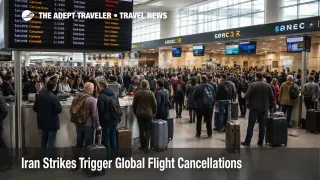
Air travel disruption from the U.S. and Israel attacks on Iran is no longer only a Middle East itinerary problem. The immediate wave of airport shutdowns and airspace closures has triggered global flight cancellations, and the effects are now showing up in Europe and the Americas as aircraft, crews, and maintenance plans fall out of sequence. Travelers with no Middle East segments are being hit through missed aircraft rotations, crew legality limits, longer reroutes, and a rebooking surge that consumes seats on already full long haul networks.
The operational headline is simple: when multiple high volume hubs stop functioning even briefly, the world's airline networks lose their ability to "heal" overnight. That loss is what turns a regional shock into multi day global disruption, even for routes that never approach Iranian airspace. Travelers should plan for rolling schedule changes, higher misconnect risk on tight onward tickets, and longer delays as airlines reposition assets and rebuild banked connections.
What Changed for Global Flight Cancellations
Since February 28, 2026, a growing set of airlines have canceled flights after strikes on Iran and subsequent retaliatory actions led to closures and restrictions across several Middle East airspaces and airports. Major connection flows through Gulf hubs were interrupted, which removed a large pool of onward seats that typically redistribute passengers across Europe, Asia, and North America within 24 to 48 hours. Reuters and AP reporting has described large scale cancellations, limited repatriation flying, and a stop start recovery at key transit airports, rather than a clean resumption of normal schedules.
For travelers outside the region, the practical change is that global networks are now running with gaps. A transatlantic departure from London, England or a long haul arrival into New York, New York can be canceled not because the flight itself is unsafe, but because the inbound aircraft that was supposed to operate it is parked elsewhere, delayed by reroutes, or stranded behind airspace constraints. As cancellations stack, the same disruption also reduces the number of spare aircraft and reserve crews airlines normally use to protect the day's schedule.
Which Travelers in Europe and the Americas Are Most Exposed
The highest exposure group is travelers relying on long haul aircraft rotations that touch major hubs, even if their personal itinerary never approaches the Middle East. Widebody aircraft do not operate like interchangeable buses, they run planned sequences across multiple days, including maintenance checks, crew pairings, and airport gate plans. When a Gulf hub shuts down, a widebody that was scheduled to fly Europe to the Gulf and then continue onward may end up stuck out of position, which can cancel a later Europe to North America flight that depended on that same tail number arriving on time.
European travelers are also exposed because detours around closed or higher risk airspace add block time, and block time is the currency that drives both aircraft utilization and crew legality. A longer routing can push a crew past duty limits, forcing an unplanned crew swap, an intermediate stop, or a cancellation if a replacement crew is not available where the aircraft lands. Airlines can do this safely, but the safety system itself creates visible disruption because legality rules are non negotiable.
In the Americas, the pain often shows up as the second wave. Once aircraft and crews are mispositioned, North American schedules can inherit cancellations and delays through late arriving inbound flights, missed maintenance windows, and crew timeouts that cascade into the next day's departures. Even when flights operate, airports can see compressed departure banks, longer gate holds, and baggage misconnects as the system tries to re sort passengers and aircraft.
What Travelers Should Do Now
Travelers in Europe and the Americas should treat the next 24 to 72 hours as an irregular operations window, even if their route is domestic or transatlantic. The smart play is to reduce fragility: avoid tight connections, avoid last flight of the day pairings when an overnight would break the trip, and consider routing through hubs where your carrier has multiple daily frequencies and partner options. If you are traveling on separate tickets, assume your downstream ticket has no protection, and build buffer time that can absorb a same day cancellation without destroying the rest of the itinerary.
Decision thresholds matter. If your flight is still showing "on time" but your route depends on a specific inbound aircraft, or on a long sequence of earlier flights, rebooking earlier can preserve the trip even if it costs a more expensive fare class. If your carrier has issued a waiver, and you can shift travel by a day, waiting can be rational, but only if you can tolerate the risk of a missed hotel check in, a cruise embarkation, or a paid tour start that will not move with you.
Over the next few days, monitor three signals that tend to predict whether disruption will expand or contract. First, look for whether airlines are operating normal hub "banks" again, not just a handful of special flights. Second, watch for reroute driven schedule padding or technical stops, which can indicate that crews and aircraft are still operating with reduced margin. Third, watch your flight's inbound aircraft history on the day of departure, because a late inbound often becomes a late outbound, and late day delays are more likely to cancel when crews hit duty limits.
How the Disruption Spreads Through Global Air Travel
This is a network problem, not a single route problem. Airlines plan their schedules as connected chains, with aircraft and crews moving through a timed sequence of flights that assumes specific airports remain viable connection points. When airspace closures and airport shutdowns remove those connection points, two things happen at once. First order, flights cancel and passengers strand. Second order, the physical assets that make tomorrow's schedule possible, aircraft, crews, and maintenance capacity, end up in the wrong places.
Aircraft mispositioning is the core mechanism. A widebody that was supposed to be in Paris, France tonight might be parked in a different country tomorrow morning, and that difference can wipe out an entire long haul rotation. Because widebodies are tightly utilized, airlines do not keep large pools of unused spares, especially during peak demand periods. When one aircraft falls out of sequence, multiple downstream flights can be affected before the system is repaired.
Crew mispositioning follows, and it is often harder to fix quickly than aircraft. Pilots and cabin crews are scheduled with legal duty time limits, required rest, and qualification constraints, including aircraft type ratings and route specific requirements. If a crew ends a duty day unexpectedly in the wrong city, the airline cannot simply "assign them another flight" without meeting rest and legality rules. That creates gaps at the exact moment demand for reserve crews spikes.
Reroutes amplify everything. Detouring around restricted airspace increases fuel burn, increases block time, and can require intermediate fuel stops. Longer block times reduce daily aircraft utilization, which means fewer flights can be operated with the same fleet, even if every airport outside the conflict zone remains perfectly normal. As that utilization drops, airlines start making tactical cuts, canceling lower priority frequencies to protect high value long haul routes, or canceling long haul routes to preserve aircraft and crews for the next day's recovery.
Europe's air traffic system adds another multiplier during disruption days, because when demand shifts onto fewer corridors, delays can increase as traffic concentrates, and because ATFM delay is already a known structural issue during constrained periods. That does not cause the initial shock, but it can slow the recovery by stretching already tight turn times and pushing crews closer to their legality ceilings.
Finally, rebooking pressure becomes its own disruption engine. When a major connecting region goes offline, thousands of passengers get pushed onto alternative hubs and direct flights in Europe and North America. That surge fills the remaining seats that would otherwise absorb smaller disruptions, which means a separate, unrelated weather event or staffing issue can suddenly cause larger knock on cancellations because there is no capacity left to re accommodate travelers.
Sources
- Airlines cancel flights after US, Israel strikes Iran
- Thousands of flights cancelled as Iran conflict upends global air travel
- UAE airlines to resume limited number of flights, mainly for repatriations
- Attack on Iran closes Middle East airports and strands travelers
- U.S. and Israel's attack on Iran disrupts commercial flights as airspaces close
- Air traffic control delays in Europe, IATA report (February 2026)
- EUROCONTROL Monthly Network Operations Report (Feb 12, 2026 PDF)