

Great Sitkin Volcano Orange Alert, Aleutians Flights
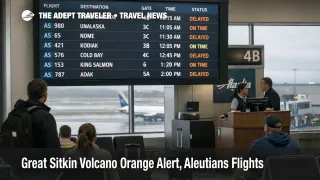
Great Sitkin Volcano in Alaska's Aleutians remains at Aviation Color Code ORANGE and Alert Level WATCH, according to the Alaska Volcano Observatory (AVO) status page and its latest activity update. That matters for travelers because ORANGE is an aviation facing warning state that can push carriers and dispatchers toward more conservative North Pacific routings, altitude changes, and schedule padding, even when there is no dramatic ash headline on the day you fly.
The day to day update from AVO says lava continues to erupt slowly within the summit crater, with low seismicity, and cloudy satellite and webcam conditions recently limiting visual confirmation. The practical travel takeaway is not "the volcano is erupting so flights will cancel," it is that Aleutians airspace is a long corridor with few alternates, and airlines often choose reroutes early when ash risk is uncertain because volcanic ash is treated as a hard engine and airframe hazard.
Great Sitkin Volcano ORANGE: What Changed For Travelers
The new, decision useful fact is the current, official ORANGE and WATCH status, which AVO continues to publish in its daily updates. ORANGE generally means an eruption is likely or occurring with no or minor ash, but it is still the level where aviation planners start thinking in terms of avoidance margins rather than "monitor and ignore."
For travelers, that shows up as small but real schedule effects rather than a neat, single cancellation wave. A flight that is technically operating "normally" can still depart late because it was resequenced behind aircraft that needed longer routings, or because the inbound aircraft arrived late after taking a longer track. First order, you see longer block times, delays, or swaps to keep the day's plan intact. Second order, you see crew legality pressure and rotation knock ons that can quietly turn into later day cancellations when the network runs out of slack.
Which Aleutians Itineraries Face The Most Disruption
The highest exposure sits with travelers relying on the Alaska gateway system to connect onward to smaller communities, and anyone chaining a tight same day connection onto a regional segment with fewer backup frequencies. Travelers connecting through Ted Stevens Anchorage International Airport (ANC) for onward flights are a good example, because Anchorage is a common pivot point for Alaska flying, and delays there can propagate quickly into the rest of the day's schedule when aircraft and crews are already tightly sequenced.
You are also more exposed if you are on routes that already have limited alternates, longer overwater segments, or fewer diversion options. Even when Great Sitkin itself is not on your itinerary, flights that overfly parts of the Aleutians, or that use North Pacific paths that can be tactically adjusted, may be the ones that pick up extra minutes when planning becomes more conservative.
Finally, travelers with fixed start times on arrival, such as tours, medical appointments, cruise embarkation day positioning, or a one night only hotel plan, are the ones who feel small aviation delays as expensive disruptions. The system does not have to "shut down" for your day to break, it only has to slip enough to miss the last workable connection.
What Travelers Should Do Now
Treat the ORANGE status as a buffer signal, not a panic signal. If your itinerary includes same day connections into, out of, or within the Aleutians chain, build extra connection time where you still can. The goal is to avoid being the passenger whose plan fails because of a 30 to 90 minute slip that never becomes a headline.
Use a decision threshold that matches your trip purpose. If you are traveling for something that cannot move, protect it by shifting to earlier departures, adding a buffer night, or avoiding the last flight of the day into a small airport where reaccommodation options are thin. If your trip is flexible, waiting can be rational, but only if you have enough slack that a reroute driven delay does not trigger missed connections and paid changes.
Watch for three kinds of updates in the next 24 to 72 hours. First, AVO activity updates that indicate a change in behavior, especially anything that points to ash production rather than just lava confined to the summit crater. Second, airline advisories that mention volcanic activity, ash, or route changes. Third, your flight's scheduled block time changing between check in and departure day, which can be an early hint that dispatch is padding the plan because of routing constraints.
If you are already inside the 24 hour window, the most practical move is to monitor your airline app for gate time movement and aircraft swaps, and to avoid stacking fragile onward commitments on top of your arrival. The tradeoff is simple, a slightly longer buffer now usually costs less than a forced overnight later.
Why ORANGE Alerts Can Change Airline Routing
The aviation color code is designed around ash risk, because ash is uniquely damaging to jet operations. USGS explains ORANGE as a state where a major eruption is imminent, underway, or suspected, but with limited hazards to aviation because there is no or minor ash emission. Another USGS explainer frames ORANGE as "eruption likely or occurring with no or minor ash," and RED as the level associated with significant ash emissions.
Even when the official definition emphasizes "no or minor ash," airlines often plan conservatively because ash can be intermittent, winds can shift, and detection can be degraded by cloud cover, exactly the limitation AVO has noted in recent daily summaries. When uncertainty rises, the operational preference is usually to route around the risk volume rather than attempt to thread narrow corridors, because the consequence of an ash encounter is not "a rough ride," it is a potential inspection event, sensor damage, and engine risk, which creates downstream rotation and maintenance disruption.
That is why a volcano you never planned to visit can still affect your trip. The Aleutians are not just a destination region, they are also an aviation corridor, and corridor risk is felt as network friction. The traveler facing effect is less about dramatic cancellations, and more about reliability erosion, later departures, fewer clean connections, and a higher chance that the disruption appears indirectly as "late arriving aircraft" or "air traffic constraints."
Sources
- Alaska Volcano Observatory, Great Sitkin Volcano Status Page
- USGS Volcano Notice, Great Sitkin Daily Update, March 1, 2026
- USGS Volcano Notice, Great Sitkin Daily Update, March 2, 2026
- USGS, Alert Level Icons, ORANGE Definition
- USGS Volcano Watch, What Are Volcano Alert Level and Aviation Color Code
- Ethiopia Volcano Ash Cancels Gulf Flights, Hubs Risk
- Mayon Volcano Alert Level 3 Limits Tours, Drives
- Cosmic Rays, Bit Flips, and the Airbus A320 "Icarus" Recall