

Worldwide Caution, Middle East Flights Still Halted
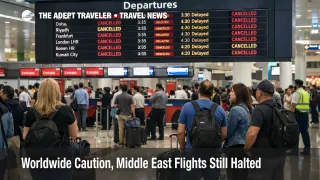
The U.S. Department of State has issued a Worldwide Caution after the launch of U.S. combat operations in Iran, warning that Americans worldwide may face travel disruptions from periodic airspace closures and should follow the latest security alerts from the nearest U.S. embassy or consulate. For travelers, this is no longer just "check your flight," it is a volatility window where routes can reopen, then close again, and airport operations can change faster than airline schedules can update.
This risk is showing up in real itineraries. Major carriers have been cancelling and rerouting flights, and media reporting has described large scale disruption across key Middle East corridors and hub airports. United Airlines, for example, told customers it is cancelling U.S. to Tel Aviv service through March 6 and Dubai service through March 4, citing regional airspace closures. Delta has also posted rolling suspensions for its New York, JFK to Tel Aviv flying as the situation evolves.
Worldwide Caution Airspace Closures: What Changed for Travelers
The practical change is that the U.S. government has put "periodic airspace closures" on the table as a near term operating condition, not a one off shock. That matters because airspace restrictions can force sudden route changes, add hours to long haul sectors, and trigger last minute cancellations when aircraft and crews cannot be repositioned safely or legally.
This is also an update story, because the disruption has moved from the initial stoppage to an unstable mix of closures, partial reopenings, and recovery constraints at major hubs. If you have been tracking the aviation side already, the fastest internal baseline is Worldwide Security Alert Flags Airspace, Hotel Risk, then layer in the hub recovery angle from UAE Airport Recovery Delays Dubai, Abu Dhabi March 1.
Which Travelers Face the Most Disruption Right Now
The highest exposure group is anyone transiting the Gulf hub system, especially travelers who built itineraries around tight, same day connections at Dubai, Abu Dhabi, or Doha. When hubs pause, the first order failure is obvious, canceled departures and missed connections. The second order failure is capacity, once you miss a bank, the next available long haul seat can be a day later.
Cirium has estimated that Emirates, Qatar Airways, and Etihad collectively move about 90,000 transiting passengers per day through their hubs, which helps explain why even a short suspension can strand large numbers of people and overwhelm rebooking queues. Travelers on separate tickets are still the most financially exposed, because misconnect protection depends on ticketing, not on whether the disruption is "your fault."
What Travelers Should Do Now
Treat airport status and your operating carrier's flight status as the gatekeepers, not the schedule you booked. If your flight is still showing "scheduled," confirm that the relevant airspace is open and that your specific flight number is operating before you leave for the airport, because "scheduled" can lag reality during fast moving closures.
Set a decision threshold before you get trapped in the churn. Rebook now if your itinerary depends on a tight connection through a Gulf hub, if you are on separate tickets, or if you have a hard arrival requirement like a cruise embarkation or a timed event. Waiting can save money if waivers expand, but only if you have true date flexibility and you set a deadline to pivot to an alternate routing.
Watch the next 24 to 72 hours for three signals. First, whether airspace closures are narrowing to specific corridors or widening again. Second, whether hub airports restart in full banks or limited waves, which changes misconnect risk even when flights resume. Third, whether your airline publishes a waiver that lets you reroute away from the region without a fare jump. If reroutes change your entry path for Israel, sanity check documents and entry assumptions with Israel Entry Requirements For Tourists In 2026.
Why the Disruption Spreads Beyond the Middle East
Airspace is a hard dependency. When airlines cannot use the shortest safe corridors, block times rise, fuel planning changes, and crews run into duty time limits, which turns a regional closure into a multi day network problem. That is why day two often looks worse than day one, aircraft and crews end up out of position, and the recovery schedule inherits missing pieces even after partial reopenings.
The Worldwide Caution layer matters because it pushes travelers to rely more heavily on embassy and consular security alerts, and it signals that conditions can shift quickly on the ground, not only in the air. The travel decision is less about "will my flight go," and more about how much fragility you can tolerate in your routing and connection plan until airspace and hub operations stabilize.
Sources
- Worldwide Caution (February 28, 2026), U.S. Department of State
- Thousands stranded as U.S.-Israeli strikes on Iran close airspace in the Middle East, CBS News
- Air travel has been thrown into chaos with cancellations, diversions, and airspace closures after strikes on Iran, Business Insider
- Delta pauses flights between New York, JFK and Tel Aviv (TLV), Delta News Hub