

UAE Travel Insurance Questions Surge as Flights Disrupt
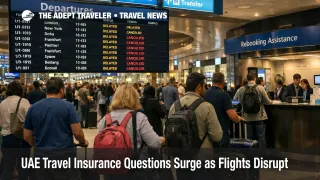
UAE travel insurance coverage questions are spiking as travelers try to understand what their policies will actually pay for when Middle East airspace restrictions break itineraries far beyond the region. Squaremouth says customer service calls about travel to the United Arab Emirates jumped 18 times after the U.S., Iran war began on February 28, 2026, with many callers focused on routes that normally connect through Dubai International Airport (DXB) and Hamad International Airport (DOH). The shift is not just fear of cancellations, it is travelers asking whether a disruption is classified as war or terrorism under their plan, and what that means for reimbursement if they have to rebook, stay longer, or reroute at the last minute.
UAE Travel Insurance Coverage: What Changed For Travelers
Squaremouth's reported 18x call surge is a signal that the biggest traveler risk right now is coverage confusion during irregular operations, not a lack of options in theory. When a hub connection fails, most travelers immediately have to decide between buying an expensive replacement ticket, paying for extra hotel nights, or waiting for an airline to reaccommodate them, and those decisions happen faster than policy language can be interpreted on the fly. Squaremouth says callers are getting unusually specific, asking if the situation qualifies as an act of war or terrorism, whether a new ticket on a different airline can be reimbursed, and whether extended hotel stays are covered.
This is also why the insurance question is increasingly tied to routing strategy. As your own Middle East coverage has tracked, the corridor can look partially open while schedules remain fragile, which keeps long haul connections through the Gulf prone to late changes. For a baseline on the operational side, see Worldwide Caution, Middle East Hubs Still Disrupted and the more recent update Middle East Airspace Reopens, Closures Stay Fluid.
Which Trips Are Driving The Most Insurance Confusion
The highest friction segment is travelers transiting the Gulf on a tight same day connection, especially when they are not actually headed to the Middle East and did not plan for the region to become the failure point. Squaremouth highlighted one example involving a traveler in the Maldives whose layover in Dubai was canceled, and who then needed to understand what parts of her costs were covered. That pattern will repeat anywhere a disrupted hub breaks the timing assumptions of an onward flight, a cruise embarkation, or a pre paid tour start.
Travelers on separate tickets face a second, quieter exposure. Even when an airline disruption is clearly outside a traveler's control, separate tickets can leave them responsible for missed onward flights, and that often forces a new purchase before any claim decision is made. In practice, this is where travelers start asking about missed connection coverage and travel delay coverage, because those benefits can apply even when trip cancellation language becomes murky.
Finally, travelers who bought insurance mainly for trip cancellation are discovering the tradeoff they made. Cancellation and interruption coverage is usually where exclusions for war and military action bite, while delay related benefits may still be usable if the triggering event fits the plan's covered reasons and timing rules. The point is not that everyone is covered, it is that the relevant benefit might be different than the one travelers assumed they were buying.
What Travelers Should Do Before They Rebook Or File A Claim
The first decision is whether you need certainty or flexibility. If your trip purpose cannot tolerate an overnight, a missed cruise departure, a wedding, or a fixed start time, treat this as a rebooking problem first, then an insurance problem. Secure the itinerary that preserves the trip, then preserve your claim documentation, because replacement inventory and call center access usually get worse after each disruption wave.
The second decision is to stop debating policy categories in the abstract and force the conversation into specific benefits. Ask your insurer, or your comparison site, which benefit bucket they think applies to your situation, trip delay, missed connection, trip interruption, or trip cancellation, and what proof they require. Squaremouth's guidance is that while war or military action exclusions commonly apply to trip cancellation and interruption coverage, the downstream domino effects, like delayed flights or missed connections, may still be covered under standard travel delay benefits depending on the plan. That means your claim might hinge on delay documentation, carrier statements, and receipts, not on proving why the conflict happened.
The third decision is whether you should pay for optional flexibility on future trips while volatility remains high. Squaremouth points to add ons like Cancel For Any Reason (CFAR) or Interruption For Any Reason (IFAR) as the most flexible options, but those typically have tighter purchase windows and partial reimbursement rules. If you are already inside the disruption window, buying coverage after the event is public is unlikely to help for that event, so treat upgrades as a forward looking choice, not a rescue move.
If you want a standing explainer readers can return to, link them to your evergreen Travel Insurance page, then keep this story focused on what has changed operationally and how that changes the insurance decision.
Why Coverage Questions Spike When Hubs Become Unreliable
This story is really about system mechanics. When airspace restrictions, airport shutdowns, or carrier suspensions hit a hub, the travel system does not fail like a single canceled flight. First order effects are the obvious ones, canceled departures, diverted arrivals, and missed connections. Second order effects are what generate the insurance confusion, stranded baggage, forced hotel nights, new entry requirements if a reroute creates an unexpected overnight, and replacement tickets purchased under time pressure.
Policy language then collides with timing. Many plans draw hard lines around war, military action, and government ordered closures for cancellation and interruption, while still offering separate delay and missed connection benefits with their own triggering conditions, minimum delay thresholds, and reimbursement caps. That is why Squaremouth is seeing travelers ask detailed benefit questions instead of simply asking, "Am I covered." In this phase, the most useful traveler posture is procedural, confirm your airline's rebooking options, document the disruption, save receipts, and ask the insurer which benefit category they want you to claim under before you spend more money than you have to.
Sources
- Squaremouth Sees 18x Spike in Travel Insurance Inquiries as Middle East Airspace Closures Disrupt Global Routes
- Worldwide Caution, Travel, U.S. Department of State
- Travel Insurance Coverage for Military Action and Airspace Closures in 2026
- Trip Delay Insurance, Coverage Details and Plans
- Missed Connection Insurance, Coverage Details and Plans