

Worldwide Caution, Middle East Hubs Still Disrupted
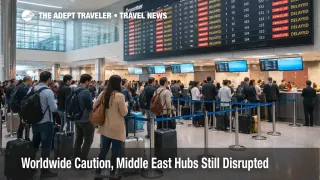
The U.S. State Department's Worldwide Caution security alert is now the traveler reality check, not a headline. The Department of State warned on February 28, 2026 that Americans worldwide, and especially those in the Middle East, should follow security alerts from the nearest U.S. embassy or consulate, and expect periodic airspace closures that can disrupt travel. Over the weekend, those closures and restrictions rippled straight into the world's most important east west connecting banks, with Dubai, United Arab Emirates, Abu Dhabi, United Arab Emirates, and Doha, Qatar routings behaving like irregular operations rather than reliable hubs.
This is an update from the first shock wave because March 2, 2026 is where restart windows and partial resumptions collide with the backlog. Emirates said it suspended all flights to and from Dubai until 11:00 GMT on March 2, and Etihad previously published a suspension window for its Abu Dhabi hub, then told Reuters on March 2 that limited repositioning, cargo, and repatriation flights may operate while scheduled commercial flights remained canceled. For travelers, that mix means you can see some aircraft moving while your ticketed itinerary still fails.
Worldwide Caution Security Alert: What Changed For Travelers
The key change is that "check your flight status" is no longer sufficient planning. A government issued Worldwide Caution tied to periodic airspace closures raises the probability of sudden route changes, late cancellations, and partial reopenings that still cannot move passengers at normal hub volume. That is why the practical risk window is measured in days, not hours, even if an airport announces it is reopening.
Airline analysts are saying the quiet part out loud. Henry Harteveldt, president of Atmosphere Research Group, told ABC News that travelers should prepare for delays or cancellations "for the next few days" as the situation evolves. The decision value here is timing, passengers who act before the next wave of cancellations usually have better choices, lower replacement fares, and more hotel availability.
Which Itineraries Are Most Exposed Right Now
The highest risk segment is anyone transiting the Gulf on a same day connection, especially on itineraries built around tight arrival and departure banks to Europe, South Asia, Southeast Asia, or Africa. When a hub pauses, the first order effect is straightforward, departures cancel and inbound flights divert or hold. The second order effect is what breaks trips after "reopen" headlines, aircraft and crews end up out of position, duty time limits bite, and the rebooking seat map collapses because too many displaced passengers are chasing too few viable routings.
Separate tickets are the real trap. If your inbound and onward flights are on different reservations, the second airline can treat you as a no show even when the disruption is outside your control. That is how a disruption day turns into an expensive last minute purchase, and it is why travelers on a single protected ticket often recover sooner than travelers who stitched together bargains.
If you are trying to understand the system mechanics behind the last 48 hours, the earlier reporting in Middle East Airspace Closures Halt Dubai, Doha Flights and Worldwide Security Alert Flags Airspace, Hotel Risk is the right baseline before you decide whether to reroute or wait.
What Travelers Should Do Now
Treat the next 72 hours, through March 5, 2026, as a volatility window if your routing touches the region. The tradeoff is simple, waiting for a perfect itinerary may save money, but rebooking early often saves the trip. If your trip purpose cannot tolerate an overnight, a missed cruise embarkation, a wedding, a meeting start, or a timed tour, act earlier than check in, because waivers, inventory, and call center access all deteriorate once another cancellation wave strands more passengers.
Set a threshold before you accept a reroute. Rebook now if your itinerary depends on a tight connection through the Gulf, if you are on separate tickets, or if your airline is offering a free change and you can move to a routing that avoids the most constrained airspace. Wait only if you have genuine date flexibility and you can absorb a forced overnight without breaking the purpose of the trip. If you do wait, check your booking directly with the operating carrier, not only through an app, because last minute aircraft swaps and corridor changes can break a flight that still shows "scheduled."
Finally, sanity check documents before you click accept on any reroute that changes countries, adds an overnight, or shifts you to a new transit point. For travelers considering alternate routings through Amman, Jordan, Jordan Entry Requirements For Tourists In 2026 is a fast way to confirm what a sudden itinerary change can do to entry and transit assumptions. If you are currently in Jordan, build extra ground time into airport transfers, Thursdays and Fridays often see demonstrations causing rolling roadblocks and checkpoints in Amman, along the Dead Sea Highway, and near border areas, so add buffer time and avoid last minute cross city moves.
Why Middle East Airspace Closures Cascade Globally
Airspace is a hard dependency, and it fails differently than weather. When multiple adjacent countries close or restrict airspace, airlines cannot use the shortest safe corridors, flight times increase, fuel planning changes, and air traffic management has to meter the remaining lanes. ABC News reported that flights crossing the region may reroute around the conflict, adding hours and cost, and putting additional pressure on controllers in the remaining corridors. That is why you can see knock on delays on trips that never planned to land in the Middle East, the shortest path still mattered.
The reopening phase is also where travelers misread the situation. Even if a hub restarts some departures, airlines and airports still have to unwind parked aircraft, reposition crews, and rebuild gate and baggage flow. Reuters' March 2 reporting on Etihad captures the pattern, limited non commercial movements can resume while scheduled passenger service remains broadly canceled, and travelers should not assume aircraft movement equals passenger recovery. In practical terms, the system may look alive on flight trackers while your itinerary remains brittle.
Sources
- Worldwide Caution, Travel, U.S. Department of State (February 28, 2026)
- Airlines cancel flights after US and Israel strike Iran (February 28, 2026, Reuters)
- Etihad Airways resumes some operations, commercial flights still halted amid Iran conflict (March 2, 2026, Reuters)
- Middle East airports closed, thousands of travelers stranded after attack on Iran (March 1, 2026, ABC News)