

Middle East Airspace Reopens, Closures Stay Fluid
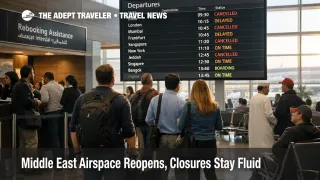
Middle East airspace reopenings are underway on Wednesday, March 4, 2026, but the operational reality is still stop start, not normal service. The important change versus the last 48 hours is that Flightradar24's live update now publishes concrete NOTAM expiry times for several Gulf FIR closures and restrictions, which makes the next decision window easier to plan, even if extensions remain likely. Travelers should treat any "limited operations" language as a throughput cap, not a reliability signal, because corridors can reopen briefly and then tighten again when missile and drone activity triggers short notice airspace controls.
One more practical shift is emerging in evacuation logistics. Oman's airspace is open, and Muscat is being used as a base for evacuation flights, including special movements by European carriers, which is why Muscat International Airport (MCT) is increasingly the hinge point for people trying to leave when nearby hubs cannot run full schedules. This is the core reason "open" does not mean "stable" yet, the system is rebuilding around constrained corridors and prioritized movements, not around published timetables.
Middle East Airspace Reopenings: What Changed
The most decision useful update on March 4 is the set of published NOTAM expiry times for the major closures and partial restrictions that are shaping routings right now. Flightradar24 lists total closure expiries at 400 p.m. UTC on March 4 for Qatar (Doha FIR), Bahrain (Bahrain FIR), and Kuwait (Kuwait FIR), with a partial restriction in Saudi Arabia expiring at 1000 p.m. UTC on March 4, plus a UAE partial closure expiring at 12:00 p.m. UTC on March 4. Several other closures extend deeper into the week in the same dataset, including Iran and Iraq, which is why long haul routings are still being forced into north and south detours even when one Gulf airport restarts a handful of departures.
Separately from airspace access, airline level suspensions and resumptions remain uneven. Qatar Airways is still saying scheduled operations remain temporarily suspended until Qatari airspace is reopened by authorities, with the carrier pointing to a further update on March 6. Meanwhile, some airlines are testing limited returns on specific city pairs, for example Virgin Atlantic said it resumed London Heathrow service to Dubai and Riyadh on March 3, which is meaningful for rebooking, but does not change the underlying corridor risk for through connections.
If you need the earlier baseline on how this disruption phase began, and how Gulf hubs shifted from "stop" to "uneven restart," start with Middle East Airspace Closures Ground Gulf Hubs and State Dept Depart Now Alert Hits Gulf Hub Connections.
Which Itineraries Are Most Likely To Break
The most exposed itineraries are still the ones that rely on a Gulf hub connection bank to make the trip work, especially Europe to Asia, Africa to Asia, and U.S. to South Asia routings built around Doha, Dubai, and Abu Dhabi. The failure mode is not just "a flight cancels," it is that the flight that does operate arrives late into a constrained bank, minimum connection times fail, crews time out, or the onward sector is not permitted to operate at all when corridors tighten again.
Travelers on separate tickets remain the highest risk segment, because protection is procedural, not moral. When the long haul and the onward flight are on different tickets, you can lose automatic reaccommodation priority, and baggage can get stranded when reissues happen faster than the ground system can reroute bags through changing corridors. If your trip has a hard start, for example a cruise embarkation, a tour departure, a medical appointment, a work start date, or a family event, you should assume a same day connection through the Gulf is not a safe plan until closures stop extending and airlines return to broadly published schedules.
The other group that gets surprised is "not going to the Middle East" traffic that overflies it. When large blocks of airspace close, traffic funnels north via the Caucasus and Central Asia, or south via Egypt, Saudi Arabia, and Oman, adding time, increasing fuel planning complexity, and compressing onward connection windows even in Europe and Asia. That is the path by which a regional closure turns into missed connections, hotel nights, and rebooking scarcity thousands of miles away.
What Travelers Should Do Now
Treat March 4 as a corridor management day, not a recovery completion day. If your itinerary depends on a Gulf hub within the next 72 hours, rebook onto a routing that avoids the region entirely if you cannot tolerate an overnight, a forced landside entry, or a diversion to a third country. If you can tolerate disruption, your decision threshold should still be concrete, wait only if your operating carrier confirms your specific flight is operating, you have flexible lodging, and your onward plan can slip without breaking the purpose of the trip.
Use the published NOTAM expiry times as your planning anchors, not as promises. If your departure is inside a few hours of an expiry, assume extension risk is high, and make your decision earlier, because inventory collapses fast once a carrier announces another suspension window. If you are already stranded, prioritize routes that give you multiple onward options from the same airport, rather than a single connection that must work.
For evacuation style routings, Muscat is now a practical gateway when other hubs are constrained, but that comes with a tradeoff, hotel capacity, ground transport congestion, and the need to be document ready for any unexpected border or landside entry. If you might need to transit overland or enter Jordan as part of a contingency plan, confirm entry requirements before you move, especially if you could be forced landside without a long planning window. Jordan Entry Requirements For Tourists In 2026 is the fastest reference to keep you from arriving at a border without the right paperwork.
Why "Open" Still Means Unstable
Airspace reopening in this environment is not binary. The region is operating with a mix of total closures, partial closures, and controlled corridors, plus "Emergency Security Control of Air Traffic" style controls that let authorities open and close availability with short notice. That is why an airport can run a handful of departures and still be a bad connection bet, the airport is not the constraint, the constraint is whether flight plans are permitted through usable corridors, at usable volumes, for long enough to rebuild banks.
The first order impact is visible, cancellations, diversions, and turnbacks across Gulf hubs when corridors tighten. The second order impact is what breaks trips far away, aircraft and crews end up out of position, recovery flights absorb scarce capacity, and the next day's schedule fails in Europe and Asia because the system cannot "snap back" on a normal rotation. That displacement effect is why travelers should bias toward reliability over elapsed time until the closure extensions stop and airlines publish stable, repeatable schedules again.
Finally, the evacuation pattern through Oman is a signal about where operating conditions are most consistently workable right now, not a guarantee of smooth travel. When Muscat becomes the staging point, it is because it sits outside several closures while still being close enough for repositioning and special flights, which helps stranded travelers, but also concentrates demand into a smaller set of seats, hotels, and transport options. Plan like you will need one extra night, and choose routings where you can absorb that without losing the trip.