

DC Ground Stop Risk at Reagan National After 1 p.m.
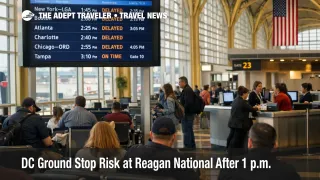
A new FAA planning flag early on March 5, 2026, points to possible traffic management action at Ronald Reagan Washington National Airport (DCA) after 1:00 p.m. ET, including a potential ground stop or delay program. This is not the same as an active ground stop, it is an operational heads up that the FAA may need to meter arrivals and hold departures at origin airports if demand outruns capacity later today. For travelers, the practical risk is missed onward connections across the East Coast corridor, plus knock on delays that can reach later flight banks into Florida and the Midwest.
Reagan National Ground Stop Risk: What Changed
The FAA's NAS status feed lists "AFTER 1300, DCA GROUND STOP OR DELAY PROGRAM POSSIBLE" as a planned risk window for March 5. That language is a planning signal, not a guarantee that a program will start, but it is meaningful because it often precedes real world flow controls when weather, staffing, volume, or runway configuration tightens the arrival rate. In traveler terms, it is the kind of same day flag that breaks tight itineraries even when your departure airport looks fine.
Which Itineraries Are Most Likely To Break
The highest exposure is any itinerary arriving into DCA after early afternoon, especially if you are stacking a tight connection onward to the Northeast, the Carolinas, or Florida. DCA is a compact airport with limited room to absorb arrival surges, so when arrivals are metered, departures often back up behind late inbound aircraft and gate conflicts.
A second exposure group is government and business travel that depends on arriving within a narrow meeting window, because a ground stop or delay program can turn a small schedule slip into a hard miss. If your trip purpose cannot tolerate a multi hour variance, the smarter plan is treating DCA as a high variance node this afternoon and using a different arrival plan.
A third exposure is anyone connecting through Washington area airports later in the day, because even if your itinerary does not touch DCA, aircraft and crew rotations can ripple into Washington Dulles International Airport (IAD) and Baltimore Washington International Thurgood Marshall Airport (BWI) as airlines reposition and recover. For broader system context on why March weather and flow programs have been compounding this week, see Flight Delays and Airport Impacts: March 4 and Central US Storms Threaten Flight Banks March 4 to 7.
What Travelers Should Do Now
Add buffer before you need it. For DCA arrivals after 1:00 p.m. ET, treat sub 90 minute connections as fragile, and avoid building a same day plan that collapses if you land even 60 to 120 minutes late. If you are on separate tickets, act as if you have no protection, because you effectively do.
Set a rebooking threshold before you leave for the airport. Rebook proactively if your first leg is already trending late, if your connection is under 90 minutes, or if you have a hard arrival constraint like a meeting, a cruise embarkation, or a last train. Waiting can make sense if you have multiple later backup flights that still land inside your true arrival window, not just your preferred schedule.
Have a reroute plan that does not depend on DCA. If you need to be in the Washington area today no matter what, look at IAD and BWI as alternates, and price in ground transfer time and variability. If you are already in the Northeast corridor, rail can be a cleaner failure mode than chasing the last seat on a delayed bank.
Why a "Possible" Delay Program Still Matters
A ground stop is the blunt tool, arrivals are paused for a period to prevent the airport from saturating. A delay program is often a metering tool, flights are held at their departure airports and assigned expected departure clearance times so arrivals do not exceed what the destination can handle. That is why you can be delayed at your origin even when your origin weather is fine, the system is protecting the constrained airport.
The first order effect is straightforward, arrivals get spaced out, departures wait on gates and late inbound aircraft, and missed connections spike. The second order effect is what travelers usually feel later, crews time out, aircraft are out of position for evening banks, and disruption spreads to nearby airports and downline cities that were never part of the original constraint. For a deeper structural explainer on why thin buffers make these days feel sharper, see U.S. Air Traffic Control Privatization: Reality Check.