

Flight Delays and Airport Impacts: March 4
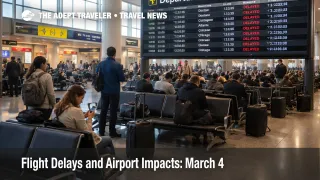
U.S. flight delays March 4 are shaping up as a multi region ceiling and visibility day, with a separate thunderstorm risk that can produce short, sharp traffic management programs. The FAA's daily planning outlook flags low clouds driving delay risk starting this morning in Boston, New York, Philadelphia, Atlanta, and San Francisco, plus low visibility forecast in Detroit and Minneapolis Saint Paul. Thunderstorms are also on the board for Chicago and Dallas, which matters because convective weather tends to force reroutes and arrival rate cuts that break tight connections even when the airport itself never "closes."
The practical consequence is connection reliability risk that compounds through the day. If your itinerary touches the Northeast corridor, Atlanta, or San Francisco early, the first decision is whether you have enough time margin to absorb a ground delay program, a late inbound aircraft, and a tighter turnaround. For afternoon and evening travel through Chicago and Dallas, the decision is whether you can tolerate rolling reroutes, gate holds, and missed banks if storms build near the hubs.
U.S. Flight Delays March 4: What Changed
The core change for March 4, 2026, is the FAA's explicit callout of low clouds affecting multiple high volume hubs starting this morning, paired with a separate thunderstorm risk centered on Chicago and Dallas. That combination is worse for itineraries than a single isolated weather problem because it reduces the system's spare capacity to recover later.
Low clouds and low visibility usually do not cancel an airport's day outright. Instead, they reduce arrival rates and increase spacing, which turns into metering, departure holds, and late inbound aircraft. When that happens across several hubs at once, airlines lose the ability to "catch up" using spare gates, spare crews, and schedule slack.
Which Travelers Are Most Exposed Today
Travelers departing early or connecting through Boston Logan International Airport (BOS), John F. Kennedy International Airport (JFK), LaGuardia Airport (LGA), Newark Liberty International Airport (EWR), Philadelphia International Airport (PHL), Hartsfield Jackson Atlanta International Airport (ATL), and San Francisco International Airport (SFO) have the highest morning exposure because the FAA's outlook puts low clouds on the timeline "starting this morning" in those metro areas.
A second exposure is anyone relying on Detroit Metropolitan Wayne County Airport (DTW) and Minneapolis Saint Paul International Airport (MSP) for mid day connections, because low visibility can quickly translate into arrival rate cuts that ripple into missed banks.
A third exposure is afternoon and evening itineraries touching Chicago O'Hare International Airport (ORD), Chicago Midway International Airport (MDW), Dallas Fort Worth International Airport (DFW), and Dallas Love Field (DAL), where thunderstorms can force tactical reroutes and ground stops that compress same day rebooking options.
What Travelers Should Do Now
Buy time margin on purpose today. If your connection is tight, especially under 90 minutes through the Northeast airports, Atlanta, or San Francisco, the cleanest move is switching to an earlier departure or a longer connection before traffic management programs fully spin up. Once flow programs begin, the same seat inventory gets chased by every displaced passenger at once, and "I will fix it at the airport" becomes expensive.
Set a decision threshold before you leave for the airport. Rebook now if you have a hard arrival constraint, for example a cruise embarkation, a wedding, a paid tour, a last train, or a same day international connection, and your first leg is already trending late or your inbound aircraft is arriving behind schedule. Waiting makes sense only when you have multiple later backups that still land inside your true arrival window, not just your preferred arrival time.
Monitor the right signals, not the noise. Watch your inbound aircraft assignment and crew status in the airline app, then cross check the FAA's daily air traffic outlook if you are traveling later in the day. If you want yesterday's pattern context, read Flight Delays and Airport Impacts: March 3. If you are flying domestically at peak times, also remember that checkpoint variability can still be its own single point of failure under shutdown conditions, see Shutdown Hits TSA Staffing, Airport Lines Less Predictable.
Why These Delays Spread Beyond One Airport
The mechanism today is throughput protection. Low clouds and low visibility reduce the rate at which aircraft can safely land and taxi, so controllers and traffic managers cut arrival rates and increase spacing. First order, that creates arrival delays, gate holds, and aircraft that arrive late for their next departure. Second order, the system pushes some of that delay back to origin airports via metering so destinations do not saturate, which is why a flight can depart late even when conditions at the origin look fine.
Thunderstorms add a different failure mode. Convective weather blocks routes and forces larger detours, and those detours consume airspace capacity and time. When storms sit near a hub complex like Chicago or Dallas, the hub loses its ability to run tight banks reliably, which elevates missed connection risk and drains later rebooking options.
If you want the broader structural context for why staffing, airspace complexity, and modernization choices can make these weather days feel sharper, the evergreen reference is U.S. Air Traffic Control Privatization: Reality Check.