

Eurostar Cancellations Through April 12, Paris Nord Delays
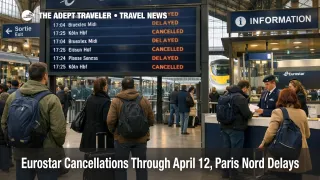
Eurostar has expanded its forward schedule disruption window, warning that operational restrictions are canceling selected trains across its network through Saturday, April 12, 2026. This matters now because the timetable reduction removes "backup" departures that travelers often rely on when flights or local transit break, and Eurostar is simultaneously flagging same day delays on Thursday, March 5, tied to traffic issues at Paris Gare du Nord and on the German network. Eurostar's live updates list March 5 delay advisories, including Paris Gare du Nord to Cologne Hbf services shown as delayed, which raises connection risk for travelers building tight transfers through Paris.
Eurostar Cancellations April 2026, What Changed for Travelers
The key change versus prior coverage is the length and breadth of the cancellation window. Eurostar's live service updates now explicitly include cancellations "between 01/02/2026 and 12/04/2026" due to operational restrictions, alongside other rolling disruption notices. In practice, that means you can see a normal looking itinerary weeks out, then lose specific departures as the operator trims what it can reliably run.
The second change is that March 5 is not only a forward planning story. Eurostar also posted day of delay advisories tied to traffic issues at Paris Gare du Nord and to traffic issues on the German network. Eurostar's live updates show examples like a Paris Gare du Nord to Cologne Hbf train flagged as delayed because of station traffic issues, and another Paris Gare du Nord to Cologne Hbf service delayed due to issues on the German network. For travelers, that combination is the failure mode that breaks trips, fewer trains to rebook onto, and more day of variability on the trains that remain.
Which Travelers Face the Most Disruption
The highest exposure is anyone traveling on the London to Paris, London to Brussels, and London to Amsterdam corridors who is counting on rail as the "self rescue" option when flights disrupt. When capacity is already trimmed, the first order effect is simple, the specific departure you wanted disappears or sells out. The second order effect is harsher, the remaining departures get load packed, and then a modest delay wave turns into missed connections because there is no spare inventory to absorb rebookings.
Travelers routing through Paris, France are the next risk group because Paris Gare du Nord is a timing chokepoint, even small delays can break onward domestic rail, meetings, timed attractions, and hotel check in cutoffs. The March 5 advisories make that risk concrete for today's travel day, not hypothetical.
A third group is travelers on separate tickets, for example Eurostar to an onward rail operator, or Eurostar to a flight. Eurostar's own guidance is that compensation for disrupted connections is typically limited to the Eurostar leg, and you need to pursue SNCF or SNCB claims with those operators directly. That is not a reason to avoid rail, but it is a reason to stop building fragile chains without buffer.
What Travelers Should Do Now
Start by verifying whether your specific train is canceled, not whether "Eurostar is running." Eurostar's disruption notices are train and date specific, so the right workflow is to check your booking in Manage your booking, then recheck close to departure when you are still in a position to change plans. If Eurostar cancels your train, Eurostar says you can claim a refund or exchange your ticket, and the fastest path is usually through Manage your booking when you booked direct.
Choose a decision threshold that forces action. If you must arrive the same day, a practical trigger is when the remaining departures no longer leave you a realistic arrival buffer for what comes next. That is especially true this month because a "rail fallback" can fail quietly, the train is not canceled at the network level, it is just full, or it is no longer operating on your date.
If you are already traveling today, keep your expense expectations realistic. Eurostar's compensation guidance says it may consider reimbursing limited expenses that are a direct result of a delayed or canceled train, such as overnight accommodation, food, and station to accommodation transport, but it also lists scenarios where it will not cover alternative transport by rail, coach, or ferry, including cases where you did not wait for the next available Eurostar train after being told your options within a specified window, or where you refunded your unused Eurostar ticket. If the downside of being stranded is high, treat travel insurance and buffer nights as the primary protection, not after the fact reimbursement.
For readers who want context on how this pattern tends to behave on the Adept side, prior coverage is here: Eurostar Cancellations London Paris Trains Jan 2026 and Gare du Nord Eurostar Delays Jan 14, 2026.
Why This Is Happening, and How the Disruption Spreads
Eurostar is attributing the multi week cancellations to operational restrictions. The important traveler takeaway is not the label, it is the system behavior that follows. When an operator trims the schedule, it is usually protecting reliability by reducing how much rolling stock, crew, and station throughput it has to cover. That makes the network more stable on paper, but it also removes slack. With less slack, any day of disruption, such as station traffic constraints at Paris Gare du Nord, propagates faster into missed connections and sold out rebooking options.
The same mechanism applies to "rail as an air disruption substitute." When flights cancel, travelers flood to rail, but if rail is already running a constrained plan through April 12, the substitution channel is narrower than it looks. The tradeoff becomes clear, rebook earlier onto a remaining train while inventory exists, or wait for conditions to improve and accept a higher risk of sellouts and forced overnight stays. If you are staying in Paris and need a quick orientation for choosing neighborhoods that reduce last mile friction when stations run hot, Paris Travel Guide: The Ultimate 7-10 Day First-Timer's Itinerary is the clean evergreen fallback.