

Lebanon Embassy Support Thins as Beirut Stays Open
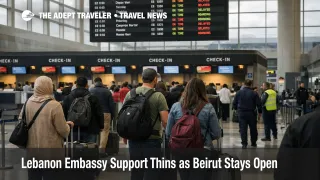
Lebanon embassy support thinned on March 8, 2026, when the U.K. said it had temporarily withdrawn some staff and their dependents from Beirut while keeping the embassy operating as normal. For travelers still in Lebanon, that is a meaningful shift because Beirut Rafic Hariri International Airport (BEY) remains open, but commercial options are limited, airport access still depends on local security conditions, and official advice now leans even harder toward self sufficiency rather than rescue expectations.
The new point is not that the embassy closed. It did not. The point is that the support cushion behind a fragile exit plan is now thinner. FCDO still says British nationals in Lebanon should have a personal emergency plan that does not rely on the U.K. government, while the British Embassy Beirut page still directs travelers to register their presence, use emergency help channels, and apply online for emergency travel documents if needed.
Lebanon Embassy Support: What Changed
What changed since prior Beirut flight coverage is consular posture, not airport status. FCDO's Lebanon advice, updated on March 8, says some staff and dependents were temporarily withdrawn from Beirut, but also says the embassy continues to operate as normal. The same page still says Beirut airport is open and operational, warns that only a limited number of commercial flight options are available from Beirut, and tells travelers not to go to the airport unless their airline has confirmed the reservation.
That makes this a different traveler problem from Beirut Exit Flights Stay Limited on March 8 and Beirut Exit Flights Stay Limited as Lebanon Risk Climbs, which focused on narrow air capacity and airport access risk rather than the depth of embassy support behind those decisions. The airport is still usable in principle, but the U.K. is signaling that travelers should assume less margin for error if documents, medical issues, or a rapid deterioration in local conditions suddenly complicate departure.
Which Travelers Face the Tightest Margin
The most exposed travelers are those who still need embassy help to make a clean exit. That includes people with lost or expired passports, travelers with medical or family emergencies, people moving with children or elderly relatives, and anyone whose route to the airport depends on a neighborhood that could shift from passable to risky with little notice. FCDO now advises against all travel to several Beirut areas and all but essential travel to the rest of Beirut and Mount Lebanon Governorate, while also warning that airstrikes can occur with little or no notice outside the main strike zones.
British travelers should read "operates as normal" narrowly. Confirmed facts show the embassy is still open, contact channels remain active, and emergency travel document services are still published. The reasonable inference is that the embassy can still handle routine emergency consular functions, but may have less spare capacity if many cases hit at once or if movement conditions worsen quickly.
Americans face a parallel signal from Washington. The State Department's Lebanon page still carries a Level 4 "Do Not Travel" warning and notes that non emergency U.S. personnel and family members were ordered out on February 23. A March 9 U.S. Embassy alert says commercial flights are currently offered by Middle East Airlines from Beirut, urges Americans to strongly consider departing if they believe it is safe, and says the embassy has resumed only limited emergency passport services while routine consular services remain suspended.
What Travelers Should Do Now
For most leisure travelers, short stay visitors, and anyone without a compelling reason to remain, the practical threshold is getting lower for waiting and higher for leaving. If you already have a confirmed seat out of Beirut, valid documents, and a route to the airport you judge can be reached safely, the logic now favors using that option rather than holding out for a cleaner market or broader airline recovery.
If your documents are not in order, act before your travel window becomes urgent. British nationals should register their presence with FCDO, confirm how to reach the embassy in an emergency, and start any emergency travel document process immediately if a passport issue exists. U.S. citizens should enroll in STEP, watch embassy alerts closely, and treat emergency passport help as limited, not walk in routine service.
Over the next 24 to 72 hours, monitor three things more than headlines. First, whether your airline confirms your booking and still operates the flight. Second, whether local conditions along the airport corridor remain workable at the time you would actually travel. Third, whether your embassy posture changes again, because another staffing pullback or service reduction would make a delayed departure plan more brittle. That is where Lebanon embassy support matters most, not as a headline on its own, but as a stress test for how much outside help you can realistically count on if your exit stops being straightforward.
Why a Thinner Embassy Cushion Matters
Embassy staffing matters because travel disruption in Lebanon is not just an airline problem. It is a layered system problem. First order, fewer staff can mean less slack when travelers need document help, emergency guidance, or case handling under time pressure. Second order, weaker confidence in official backup can push more travelers to self evacuate sooner, which can tighten remaining Beirut seats, raise hotel extension pressure, and make airport runs more crowded and more time sensitive even if the airport itself stays open. That second order effect is an inference, but it follows directly from the combination of limited commercial capacity, live security warnings, and government advice telling travelers to have plans that do not depend on official rescue.
That is also why the phrase "operate as normal" should not be overread. It means the British Embassy Beirut is still functioning, not that Lebanon has returned to a normal assistance environment. The U.K. still tells Britons to register their presence, the embassy still prioritizes emergencies, and the broader Lebanon security picture remains severe enough that both London and Washington are warning against normal travel. In plain language, Beirut is still open, but the buffer around a bad travel day is thinner than it was a week ago.
Sources
- Lebanon travel advice, GOV.UK
- Foreign Office travel advice updates, GOV.UK
- British Embassy Beirut, GOV.UK
- Lebanon International Travel Information, U.S. Department of State
- Security Alert: Lebanon, Update 1 (March 9, 2026), OSAC / U.S. Embassy Beirut
- Beirut Exit Flights Stay Limited on March 8, Adept Traveler
- Beirut Exit Flights Stay Limited as Lebanon Risk Climbs, Adept Traveler