

Beirut Exit Flights Stay Limited on March 8
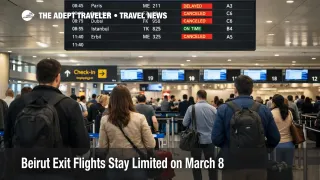
Beirut exit flights are still available on March 8, 2026, but only in a narrow, unstable way. The U.K. Foreign, Commonwealth & Development Office, or FCDO, says there are only limited commercial flight options from Beirut Airport, says travelers whose presence in Lebanon is not essential may wish to consider leaving if they judge they can access those options safely, and warns passengers not to go to the airport unless their airline has confirmed the reservation. Beirut Rafic Hariri International Airport (BEY) remains open and operational, but the same advisory also says airport access depends on local security conditions that can change quickly.
That is why Beirut still belongs in the slate. This is not a closed airport story, but it is not a normal gateway story either. Travelers already in Lebanon should treat BEY as a last chance commercial exit platform, not as a routine airport where showing up early and hoping to fix things at the counter is a reasonable fallback. That is the key operational difference from a normal disruption day, and it is also the practical reason this remains materially useful on March 8.
Beirut Exit Flights: What Changed for Travelers
The core traveler decision has not improved since March 7, and that is exactly why this still matters. FCDO guidance remains explicit that only limited commercial options are available from Beirut Airport and that travelers should keep departure plans under review, but only attempt an airport move if they believe they can reach the airport safely and already have an airline confirmed booking. That keeps Beirut in a live but conditional category, where the airport is functioning enough to support some departures, but not reliably enough for speculative airport runs.
The airport's own live information supports that middle ground. On March 8, BEY's official flight page showed active arrivals and departures, but also a mix of delays and cancellations, including delayed Middle East Airlines service from Paris and Dubai and cancellations on some Baghdad, Erbil, and Emirates services from Dubai. That is what a constrained exit gateway looks like in practice. Flights exist, but schedule resilience is weak, and the operating picture can break unevenly by route and carrier.
This also gives the story a sharper update angle than broader Lebanon risk coverage. The real question is no longer only whether Lebanon is riskier than it was in late February. The March 8 question is whether Beirut still works as a same day exit play. The answer is yes for some travelers, but only if the booking, the airport access plan, and the timing all hold together at once.
Which Travelers Face the Most Beirut Airport Risk
Travelers already in Beirut, Lebanon, or nearby secure areas with a confirmed same day or near term ticket are in the strongest position to use Beirut commercially. They have the shortest ground movement, the fewest moving parts, and the best chance of turning a live reservation into an actual departure before local conditions change. Travelers who are farther away, who still need to buy or confirm a seat, or whose onward trip depends on a tight connection face much higher exposure.
The difference matters because the weakest point in this chain is not only airline inventory. It is airport access. FCDO says BEY is open and operational, but also says travelers should check the local security situation before going, remain alert because conditions can change quickly, and understand that travel within or out of Lebanon is at their own risk. In other words, an airport that is technically open does not automatically function as a dependable departure point for every traveler in country.
That makes Beirut a worse commercial exit platform than cleaner fallback options in the region where the airport itself may be operating more normally. Travelers comparing Beirut with an overland move or a later outbound from another hub should think in layers. First comes the road move. Then the terminal and check in process. Then the actual flight. If any one of those layers is weak, the whole exit attempt can fail and turn into an extra hotel night, a missed onward ticket, or a rushed plan change toward another route such as Jordan or Cyprus. Related Adept context includes Beirut Exit Flights Stay Limited as Lebanon Risk Climbs and Amman Exit Flights Make Jordan a Cleaner Exit Point.
What Travelers Should Do Before Any Beirut Airport Move
The immediate move is simple. Do not go to the airport without direct airline confirmation that your reservation is valid and operating. In Beirut's current environment, a booking reference by itself is not enough if the carrier has not clearly confirmed the flight. Travelers should also check the local security picture before leaving, keep documents and any onward visa needs ready, and build more buffer than they would on a normal departure day.
The next decision threshold is whether your trip can tolerate failure at the road stage or the airport stage. If you are trying to protect a critical onward long haul ticket, a visa timed entry, a medical need, or a one chance family or business trip, waiting for perfect clarity may cost more than moving early on a confirmed seat. But if your plan depends on showing up at BEY to negotiate a new ticket, fix a broken reservation, or salvage a tight connection, Beirut is a bad place to take that gamble right now. The airport is operating, but not with enough slack to assume a normal recovery path if the first plan breaks.
Over the next 24 to 72 hours, travelers should monitor three things together, airline status on their specific route, FCDO updates on Lebanon, and the local security picture affecting the road to the airport. Watch for the pattern, not just one signal. A live departure board does not solve a bad ground move, and a calm road window does not guarantee the flight will still be there by check in. In Beirut right now, the safest decision is usually the one that turns those three conditions into a single verified go signal before you move.
Why Beirut Is Still a Live Market, Not a Closed One
The mechanism here is straightforward. Lebanon is under a heightened security advisory after conflict escalation since March 2, 2026, and that has created a split system. The airport remains open, some flights still operate, and commercial departure is still possible. At the same time, limited airline options, route specific cancellations, and uncertain local access mean the gateway no longer behaves like a normal hub with predictable fallback options.
That split creates both first order and second order effects for travelers. First order, some people can still leave from BEY on commercial flights. Second order, everyone else competing for those same narrow options faces higher hotel extension costs, harder rebooking, and more pressure to consider land and regional fallback exits if the airport run fails. This is why Beirut should not be described as shut, but it also should not be described as functioning normally. It is best understood as a conditional escape valve, one that works only when booking status, road access, and airport operations line up at the same time.