

Beirut Exit Flights Stay Limited as Lebanon Risk Climbs
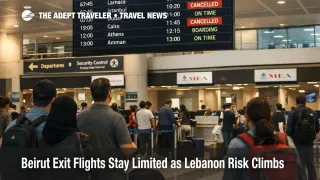
Beirut is still usable as a commercial exit point, but only in a narrow and unstable sense. The U.K. Foreign, Commonwealth & Development Office, or FCDO, updated its Lebanon advice on March 5, 2026, telling travelers in Lebanon to register their presence, warning that only a limited number of commercial flights are available from Beirut Airport, and stressing that people should not head to the airport unless their airline has confirmed the reservation. The practical change from earlier Lebanon coverage is that this is no longer just a broad security warning. It is now a movement decision, because the airport is open, some flights are still operating, and the road to use them can become unsafe or impractical with little warning.
Beirut exit flights matter because they create a last chance commercial path that is neither fully shut nor reliably normal. For travelers already in Lebanon, the high level move is simple. Treat Beirut as a conditional departure platform, not as a routine airport. That means staying put unless you have a confirmed seat, current local security information, and a route to Beirut Rafic Hariri International Airport (BEY) that still looks viable when it is time to move.
Beirut Exit Flights: What Changed
The core update is official and specific. FCDO now says travelers in Lebanon should register their presence with the U.K. government, keep departure plans under review, and consider leaving if their presence is not essential, but only if they judge they can access the limited commercial options from Beirut safely. It also says not to travel to the airport unless the airline has confirmed the booking. That is a more operational message than a generic advisory, because it turns the decision into a confirmed seat plus safe access test, not a hopeful airport run.
The airport itself supports that middle ground. Beirut Airport's official site shows active arrivals and departures, but also visible cancellations on some services, which is exactly what a constrained exit platform looks like in practice. The airport is functioning, but not with the kind of schedule resilience that lets travelers assume a normal rebooking environment if something goes wrong on the road or at check in.
This also sharpens the change since prior coverage. Earlier Lebanon reporting focused on embassy posture and rising trip risk. The March 7 problem is narrower and more urgent, because Beirut is now best understood as a limited commercial escape valve. Some people can still leave by air, but only under tighter timing and confirmation rules than travelers would use in a normal irregular operations day. For earlier context, see Beirut Embassy Drawdown Raises Lebanon Travel Risk.
Which Travelers Face the Most Risk
Beirut is a weaker exit platform than Amman Exit Flights Make Jordan a Cleaner Exit Point because Amman's current value is that the airport remains open with daily departures and without the same explicit warning that airport access itself can turn quickly. Beirut's limiting factor is not only the number of flights. It is the fact that the access route to the airport is part of the risk calculation.
It is also a weaker platform than Muscat Relief Flights Become Qatar Airways Exit Route for travelers who can safely reposition, because Muscat's role has been as a controlled relief hub with a clearer "get there, then fly out" logic. Beirut is more fragile. A traveler can have a valid ticket and still fail the plan if local conditions deteriorate, if evacuation warnings shift traffic patterns, or if the airport road becomes too uncertain to justify moving.
The travelers with the highest exposure are those trying to preserve same day departures, separate ticket onward journeys, or expensive long haul connections that are hard to replace. They are depending on too many links holding at once, hotel checkout timing, surface movement to the airport, the flight still operating, and enough schedule integrity to avoid an overnight miss. Travelers already in a secure hotel, with a confirmed booking and a short, low friction trip to the airport, are in the best position to use Beirut commercially. Travelers farther away, without a confirmed seat, or with a fragile onward itinerary, face a much higher chance that the airport being open will not translate into a successful departure.
For travelers considering a switch to Jordan instead, document risk becomes the next gate. Adept's guide, Jordan Entry Requirements For Tourists In 2026, is worth checking before treating Amman as an automatic fallback.
What Travelers Should Do Now
Do not move toward the airport on speculation. The clean threshold is confirmation first, movement second. If your airline has not confirmed the reservation, or if your ground route depends on rapidly changing neighborhoods, checkpoints, or uncertain transfer availability, staying put is usually the safer decision. In this environment, an unnecessary trip to the airport can burn money, time, and a stable shelter position without materially improving your odds of leaving.
Rebook now rather than wait if your current plan depends on a same day chain with no slack. That includes travelers trying to reach the airport from outside Beirut, travelers holding separate tickets, and travelers whose onward trip includes a last flight of the day or a hard deadline such as a cruise embarkation, work assignment, or family emergency. In those cases, the tradeoff usually favors one extra hotel night or a reroute to a cleaner platform over defending a brittle itinerary that can fail from one access disruption.
Over the next 24 to 72 hours, monitor three things together, not one at a time. First, watch whether your airline is still operating the booked flight. Second, check the local security situation immediately before departure for the airport, because FCDO explicitly says access depends on conditions that can change quickly. Third, keep an alternate plan alive, whether that means a later Beirut departure, a shelter in place extension, or a pivot to a different exit point such as Amman or Muscat. The right move is not "leave at all costs." It is "leave only when the full path still works."
Why Lebanon Is Different From a Normal Open Airport Story
The mechanism here is what makes Beirut different. In a normal disruption, the airport is the main problem, cancellations, delays, or reduced inventory. In Lebanon right now, the airport is only one layer. FCDO says conflict has escalated since March 2, 2026, with increased airstrikes, rocket attacks, evacuation warnings, and mass movement from affected areas. It also says the dynamic nature of the conflict means strikes can occur outside the most obvious zones and that local conditions can change quickly. That turns airport access into a separate operational risk, not just a transfer detail.
First order, that means fewer travelers should self dispatch to Beirut Airport without a protected booking. Second order, it pushes more people into defensive behavior, extra hotel nights, delayed checkouts, backup transfer bookings, and renewed interest in alternative gateways such as Cyprus, Jordan, or Oman. Once that substitution starts, even a still open airport can feel tighter, because demand rises for every working seat, every safe ride, and every room close enough to support a short notice departure. Beirut is therefore not closed, but it is also not an airport travelers should treat as stable just because the terminal remains operational.
The main traveler mistake would be confusing "open" with "usable on demand." Beirut is usable only when four things line up at once, a confirmed reservation, a currently operating flight, a safe path to the airport, and enough margin that one small disruption does not collapse the whole exit. Travelers who can satisfy all four may still be able to leave commercially. Travelers who cannot should treat shelter, reroute, or delay as the more realistic choice.