

Lufthansa Europe Hub Lift Grows as Gulf Routes Stay Tight
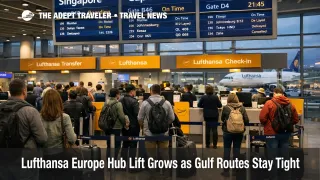
Lufthansa Group is now doing more than canceling or suspending Middle East flying. It is actively adding replacement long haul capacity through Europe, which gives stranded or displaced travelers a more usable fallback than waiting for Gulf hubs to normalize. On March 10, Lufthansa and Reuters said added flying includes Munich to Singapore, Frankfurt to Cape Town, and Frankfurt to Riyadh, while Austrian Airlines has already added extra Vienna to Bangkok flying. For travelers, the practical shift is that Frankfurt, Munich, and Vienna are becoming relief valves for demand that would normally move through Dubai, Doha, or other stressed Gulf hubs.
The new detail since prior coverage is that the substitute capacity is no longer theoretical. Lufthansa's public business update lists extra Munich to Singapore sectors on March 15, 16, 22, and 23, plus an added Frankfurt to Cape Town round trip on March 12 and 13. Reuters also reported Frankfurt to Riyadh among the routes getting extra lift, although Lufthansa's public schedule page had not yet published the specific Riyadh dates in the version reviewed for this article. On the Austrian side, Lufthansa's March schedule page lists extra Vienna to Bangkok and Bangkok to Vienna sectors across March 7 to March 29, while Reuters summarized that as 10 special flights between Vienna and Bangkok.
Europe Hub Reroute Flights: What Changed
What changed on March 10 is that Europe based hubs are starting to absorb displaced long haul demand in measurable ways. Lufthansa says the added frequencies were pushed into the schedule at short notice because of the current Middle East situation, and Reuters tied that move to severe restrictions at key hubs such as Dubai and Doha. That matters because many disrupted travelers do not need a perfect original routing, they need a workable bridge back onto a stable long haul bank. If Gulf connections remain unreliable, Europe hub reroute flights become more valuable even when the fare is higher or the itinerary is longer.
Which Travelers Benefit Most From the Added Lift
The travelers helped most are people who were relying on Gulf one stop connectivity to Asia, Africa, or parts of the Middle East, especially those with high consequence onward plans. Singapore and Bangkok matter because they can reconnect passengers into broader Asia networks, while Cape Town gives Lufthansa a direct Europe to southern Africa option that avoids the Gulf system entirely. Riyadh is a more mixed case, because it still depends on Saudi Arabia rather than bypassing the region altogether, but extra Frankfurt lift can still help travelers whose original paths through Gulf hubs have broken. This also creates a clearer alternative for travelers who were already rebuilding around Europe after Gulf Airlines Delay Restart Until March 5 and Oman Air Cuts Nine Muscat Routes Through March 15.
What Travelers Should Do Now
If you are rebooking, stop treating Frankfurt Airport (FRA), Munich Airport (MUC), and Vienna International Airport (VIE) as secondary options. They are now part of the actual relief network. Rebook early if you have a hard start, such as a cruise, safari, work trip, or timed tour, and your original itinerary depended on Dubai or Doha bank connectivity. Waiting may still make sense if your ticket is protected and your carrier has published a credible restart, but the tradeoff is that replacement long haul seats can disappear quickly once displaced demand concentrates on a few functioning hubs.
Also separate "a hub is open" from "a hub is useful." The Gulf problem has not only been airport closure, it has been bank integrity, meaning timed arrivals and departures no longer line up cleanly enough to support normal connection flows. Europe hub reroute flights help because they restore some long haul lift outside that stressed system. Over the next 24 to 72 hours, watch for more Lufthansa Group schedule additions, especially if the carrier publishes the exact Frankfurt to Riyadh dates on its public schedule page, and expect Frankfurt, Munich, and Vienna hotel and rebooking pressure to stay elevated while the Gulf recovery remains uneven.
Why European Hubs Are Becoming Relief Valves
The mechanism is straightforward. When carriers lose workable Gulf connectivity, they can either leave demand stranded or redeploy aircraft onto routes where they still control the operating environment. Reuters reported Lufthansa had already shifted capacity away from 10 canceled Middle Eastern destinations and toward markets such as Singapore and Bangkok, and its March 10 updates show that process continuing in specific city pairs. As a result, the first order effect is more seats on selected Europe to Asia and Africa routes. The second order effect is broader, because those extra flights can reduce spillover into sold out rebooking banks, ease some overnight hotel demand, and pull connecting traffic toward European hubs instead of forcing everyone into the same Gulf bottlenecks.
For travelers, the takeaway is not that Europe has replaced the Gulf. It has not. The takeaway is that Lufthansa Group is now providing a visible substitute path for some of the demand shock, and that makes Europe hub reroute flights one of the more practical fallback options available right now. Travelers with fragile itineraries should act on confirmed seat availability, not on generic restart headlines.
Sources
- The Lufthansa Group airlines expand flight offer to and from Asia and Africa in March 2026
- Lufthansa group offers extra Asia flights due to high demand
- Lufthansa adds more flights to Asia, Africa as Middle East war reshapes air travel
- Gulf Airlines Delay Restart Until March 5
- Oman Air Cuts Nine Muscat Routes Through March 15