

Gulf Airlines Delay Restart Until March 5
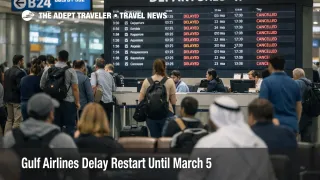
Gulf carriers are converging on Thursday, March 5, 2026 as the earliest point where anything resembling a broader commercial restart might begin, but travelers should treat Wednesday, March 4 as a recovery day dominated by exceptional flights, repositioning, and partial schedules, not a true return to normal connections through the Gulf. Qatar's airspace remains closed, and Qatar Airways says its scheduled operations are still suspended until the Qatar Civil Aviation Authority announces a safe reopening. In the UAE, Etihad is still holding back scheduled commercial flying until 200 p.m. local time on March 5, while allowing only limited flights under special approvals. Dubai's picture is even less "restart ready" for most passengers, because Emirates says all scheduled flights to and from Dubai remain suspended until 1159 p.m. UAE time on March 7.
Gulf Airlines Restart March 5, What Changed For Travelers
The practical change since the prior 48 hour window is that airline guidance is now more explicit about timing, and the timing is later than many travelers expected. Instead of "watch for resumptions," the message travelers are getting from the region's biggest operators is closer to "plan for at least one more night of disruption," and for some itineraries, several more. That matters most for passengers who were counting on Gulf hubs for long haul connectivity, because a hub only works when banks of arrivals and departures line up. A handful of relief flights can move people, but they do not rebuild the connective tissue of hundreds of timed onward links.
For March 4 specifically, expect a split reality across the Gulf. Qatar is the hard stop, because the state's aviation authority has maintained a temporary air traffic suspension in Qatari airspace, and Qatar Airways continues to hold scheduled flying. In the UAE, authorities and airlines are permitting limited operations, but those are being run as controlled exceptions, not open, predictable schedules. Dubai Airports and airline sites have also been telling travelers not to come to the airport unless their airline has contacted them, which is a strong signal that terminal flow is being managed around specific manifests, not walk up rebooking hope.
Who Should Treat Gulf Connections As High Risk Through March 5
The highest risk group is anyone trying to connect through Hamad International Airport (DOH) in Doha, Qatar, because even a "ticketed" itinerary cannot operate when the airspace is closed. The next tier is Dubai International Airport (DXB) connections that rely on Emirates, because Emirates' own travel update places scheduled flying on hold until late March 7, which means many March 4 and March 5 itineraries will not be salvageable as originally ticketed. Travelers connecting via Zayed International Airport (AUH) in Abu Dhabi face a similar, but narrower, bottleneck, because Etihad is pausing scheduled commercial flights until 2:00 p.m. on March 5, and running only limited flights subject to approvals.
Another high risk group is anyone with a time sensitive hard start, such as a cruise embarkation, a tour departure, a wedding, a work start, or a paid, non refundable hotel sequence. Even if you can get out on a relief flight, the odds that your onward legs line up cleanly are low while airlines are prioritizing stranded passenger clearance and aircraft, plus crew repositioning. Finally, travelers booking new routings today should assume inventory compression, because when Gulf connectivity drops, seats get funneled into fewer alternate corridors and prices can jump quickly, especially on "escape valves" like Cairo, Egypt, Jeddah, Saudi Arabia, and Muscat, Oman.
What Travelers Should Do Now
Treat March 4 as an execution day, not an information day. If your airline says do not come to the airport unless contacted, follow that instruction, and spend your effort on getting a confirmed, reissued itinerary, plus a written record of any waivers or duty of care promises. If you are ticketed through Doha, assume you will need a plan that does not depend on DOH until Qatar's aviation authority reopens the airspace, because Qatar Airways is explicitly tying resumption to that decision.
Set a clear decision threshold for when you stop waiting. Rebook away from Gulf hubs now if you must be on the ground elsewhere by Friday morning, March 6, 2026, or if your itinerary contains a non movable anchor like a ship departure. Waiting can make sense if you are on a single ticket, you have flexible dates, and you can absorb a rolling 48 to 72 hour delay without breaking the purpose of the trip, but only if your airline is actively contacting eligible passengers for limited flights. If you are stranded in the UAE or Qatar and worried about lodging costs, check whether local hotel extension support applies, because both UAE and Qatar authorities have been involved in hotel extension guidance during this disruption, which can reduce the financial pressure to make a bad routing choice.
Why A "Restart" Still Does Not Mean Stable Connections
Even when a corridor reopens, airlines cannot instantly run their published timetables. Aircraft are out of position, crews are out of legal duty windows, and airports process uneven waves of disrupted passengers who need rebooking, baggage resolution, and re accommodation. That is why limited repatriation flights can coexist with a longer pause in scheduled commercial flying, and it is why a stated "earliest restart" date should be read as the beginning of ramp up, not the end of disruption.
The second order effects are what travelers outside the region will feel most. When Gulf hubs stop behaving like hubs, long haul traffic between Europe and Asia gets rerouted onto fewer paths, raising load factors and reducing same day rescue options. As a result, misconnects multiply, airline rebooking desks clog, and fares rise on the remaining routings that can still move passengers across continents. The clean takeaway for March 4 and March 5 is that "open" and "operating" are not synonyms. Your decision tool is not airport status, it is your specific flight status, issued ticket changes, and whether the carrier is accepting transfer passengers for onward segments that are actually operating.
Sources
- Travel Updates
- UAE Airlines Continue Limited Operations as Regular Flights Remain Disrupted
- Qatar Airways Service Update: 04 March 2026
- QCAA Temporarily Suspends Air Traffic in Qatar Airspace
- Operational Updates & Airline Information
- Airline, Travel Industries Scramble With Fallout From Middle East Conflict
- UAE Resumes Limited Flights Amid Travel Chaos Across Middle East
- UAE, Qatar Cover Hotels for Stranded Airspace Closures