

Oman Air Cuts Nine Muscat Routes Through March 15
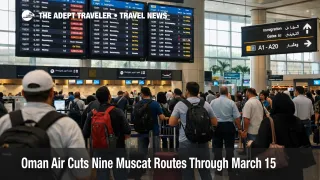
Oman Air Muscat route suspensions are now materially narrowing one of the region's more workable fallback hubs. Oman Air said flights to and from nine destinations, Amman, Dubai, Bahrain, Doha, Dammam, Kuwait, Copenhagen, Baghdad, and Khasab, are canceled from Monday, March 9, 2026 through Sunday, March 15, 2026, while the carrier says it has added extra flights elsewhere to help affected passengers. For travelers, that changes Muscat, Oman from a broad reroute idea into a more selective one. You can still use Muscat International Airport (MCT) this week, but only if your onward plan fits the routes still operating, and only if you can secure seats before the remaining network tightens further.
The practical update versus earlier Muscat coverage is that the airport itself is still operating, but Oman Air's own network is no longer wide enough to treat Muscat as a catch all bridge out of the Gulf. Reuters reported Muscat International Airport said it continues to welcome commercial traffic and denied claims it was broadly shutting out private jet activity, which matters because the bottleneck here is increasingly airline network selectivity and seat pressure, not a total airport shutdown.
Oman Air Muscat Route Suspensions, What Changed
What changed on March 9 is not that Muscat stopped working, it is that Oman Air cut off nine specific city pairs at once. The suspended routes remove access to Amman, Jordan, Dubai, United Arab Emirates, Manama, Bahrain, Doha, Qatar, Dammam, Saudi Arabia, Kuwait City, Kuwait, Copenhagen, Denmark, Baghdad, Iraq, and Khasab, Oman through March 15. That list matters because it hits both short haul Gulf circulation and one meaningful Europe link, which reduces Muscat's value for travelers who were using Oman as a bridge rather than as a final destination.
The most important loss is network flexibility. When a fallback hub works, it gives stranded passengers multiple ways out, direct flights, short onward hops, and at least one or two longer haul links that can reconnect them to Europe, India, or the United Kingdom. This week, Muscat is still open, but Oman Air is signaling that its usable map is narrower, and that passengers should keep checking schedules because more ad hoc capacity may be added rather than published as a normal restored timetable.
That also means the nine suspensions should not be read as an isolated Oman Air problem. They sit inside a broader regional system where carriers are still reacting to airspace closures, selective corridors, and irregular recovery patterns. Adept's earlier reporting, Muscat Evacuation Flights Become Gulf Exit Hub, explained why Muscat had become useful in the first place, and Middle East Airspace Closures Raise Asia Europe Fares remains relevant because fewer functioning Gulf connections still push travelers into a smaller pool of seats across the wider network.
Which Travelers Can Still Use Muscat Effectively
Muscat still works best for travelers whose trip can end in Oman, or whose onward plan relies on a route family that remains open and has enough frequency to absorb disruption. In practical terms, that usually means people who already have lodging in Muscat, people who can wait a day or two for the next workable departure, and passengers whose final destination can be rebuilt through India, Europe, or the United Kingdom without depending on one of the nine canceled city pairs. Muscat is still a node, but it is no longer a broad reconnect machine.
The highest risk group is travelers who were counting on Muscat for a fast same day handoff into the Gulf. If your exit logic depended on Dubai, Doha, Bahrain, Kuwait, Dammam, or Amman, the hub is now much less useful, because those short sectors are exactly the ones that normally help travelers rebuild regional itineraries cheaply and quickly. Once those links disappear, Muscat starts behaving less like a bridge and more like a holding point.
A second exposed group is passengers using mixed tickets or third party bookings. When one carrier cuts a regional leg but the rest of the itinerary sits elsewhere, the failure mode is not always a clean protected reissue. It can become a manual rebuild, plus an extra hotel night, plus an expensive surface transfer from the United Arab Emirates if you were planning to use Oman as the final exit point. Reuters' reporting on Muscat also matters here because it shows commercial operations are still flowing, which can make the airport look available even when the network underneath it is much less forgiving.
What Travelers Should Do Now
Start with the route map, not the airport status page. If your itinerary needs one of the nine suspended destinations before March 16, rebook now rather than waiting for a same week restoration that Oman Air has not announced. The correct decision threshold is simple, if Muscat only helps you after an additional canceled regional hop, it is not really helping. In that case, rebuild around a nonstop or a single protected connection that avoids the suspended Oman Air city pairs entirely.
If Muscat is still your best usable point, lock down the whole chain before you move. That means confirmed air seats, confirmed hotel nights if needed, and confirmed ground transport, especially if you are approaching Oman overland from the United Arab Emirates. The second order problem here is concentration. When one fallback node stays open while nearby route options shrink, remaining seats, rooms, and transfers tighten quickly, even without a full airport closure. That is where a theoretically open hub becomes an operational bottleneck.
Over the next 24 to 72 hours, watch three things. First, whether Oman Air shortens or extends the March 15 window. Second, whether the carrier identifies which routes are receiving added capacity, because that determines whether Muscat still works as an organized exit path or only as a narrow one. Third, whether broader Gulf airspace conditions improve enough to restore the short regional sectors that make Muscat useful for fast repositioning. Until those points change, the safer assumption is that Muscat remains usable, but selectively, and at rising cost if you wait too long.
Why Muscat Is Still Usable, but Less Powerful
The mechanism is straightforward. A fallback hub is valuable when two conditions hold at the same time, the airport is functioning, and the network around it is broad enough to redistribute disrupted passengers. Muscat still appears to satisfy the first condition. Reuters says the airport continues to facilitate commercial flying, and The National reported Oman Air is still operating from Muscat while adding some extra flights for affected travelers. The problem is the second condition. Nine route suspensions remove exactly the kind of short and medium haul links that make a hub flexible under stress.
That is why this change matters beyond Oman itself. First order, passengers lose access to specific destinations. Second order, the remaining Muscat network takes more displaced demand, which can drive up fares, consume same day inventory, and force extra hotel nights while travelers wait for a workable departure. The same broader pattern is already visible across the region, where limited reopenings and selective corridors improve movement for some passengers without rebuilding normal hub connectivity. Muscat still works this week, but only for travelers whose plans fit the narrower network that is left.
Sources
- Oman Air post on X, March 8, 2026
- Middle East flight updates: Global airlines that have cancelled, suspended and added routes, The National
- Oman's Muscat airport denies limiting private jets after reports, Reuters
- Muscat Evacuation Flights Become Gulf Exit Hub, The Adept Traveler
- Middle East Airspace Closures Raise Asia Europe Fares, The Adept Traveler