

Finnair Doha, Dubai Freeze Runs to March 29
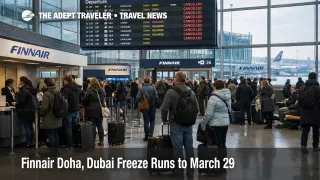
Finnair has turned a short disruption into a longer planning problem. The airline says all Doha and Dubai flights from February 28 through March 29, 2026, are canceled, and it is also avoiding the airspace of Iraq, Iran, Syria, and Israel. That removes a clean Helsinki to Gulf bridge for nearly a month, especially for travelers from Finland and Northern Europe who were using Helsinki Airport (HEL) as a short northern connection point into the Gulf or beyond. The practical move now is to stop assuming a quick Finnair restart will save late March itineraries, because the carrier itself says alternative flights are limited and filling quickly.
The new value in this story is carrier specific. Earlier Adept coverage has focused on Europe based relief capacity and broader fare pressure as Gulf disruption spills into other corridors, but Finnair's March 29 extension adds a distinct Nordic exposure layer. It matters because once a Helsinki based one stop option disappears, travelers do not just lose a flight, they lose a routing logic that was efficient for Scandinavia, Finland, the Baltics, and some Northern Europe trips headed toward the Gulf or into longer onward chains. In plain language, this is not only a Gulf story, it is now a Northern Europe network story too.
Finnair Doha Dubai Suspension: What Changed
What changed is duration and certainty. Finnair's current notice says every Doha and Dubai flight in the February 28 to March 29 window is canceled, and that affected passengers may not be rerouted to those cities at all because commercial alternatives are scarce. The carrier says customers who cannot be rerouted should apply for a refund, while passengers already mid trip are told to contact customer service for alternatives. That shifts this from a wait and see interruption into a real trip repair problem for anyone whose plans still depended on Finnair restoring Gulf flying before the end of March.
The timing also matters because it overlaps with a wider period of Middle East airspace stress. EASA has issued a conflict zone bulletin covering high risk airspace across a broad part of the region, including Bahrain, Iran, Iraq, Jordan, Kuwait, Oman, Qatar, Saudi Arabia's Jeddah FIR, the United Arab Emirates, Israel, and Lebanon. Finnair's own restrictions are narrower than that full list, but the airline's decision to keep suspending Doha and Dubai while also avoiding multiple surrounding airspaces shows that the problem is bigger than one airport pair.
Which Travelers Lose the Most Utility
The biggest losers are travelers who were using Helsinki as a fast, orderly one stop bridge. That includes Finland origin passengers, travelers from nearby Nordic and Baltic markets feeding into Helsinki, and anyone whose itinerary valued a shorter northern connection over a longer rebuild through Central or Western Europe. Finnair has not published a broad substitute map that restores the same utility, and the carrier explicitly warns that alternative flights are very limited and fill quickly. That means the lost value is not just seat count, it is the loss of a relatively clean connection structure.
Ticketing pattern now matters almost as much as destination. Travelers on a single Finnair booking at least remain inside the airline's disruption process, which includes rebooking attempts, one free date change within plus or minus 14 days, or a refund where rerouting is not possible. Travelers who built their own trip across separate tickets are in a weaker position, because even if Finnair resolves its own canceled segment, the onward hotel, tour, regional flight, or long haul connection may not be protected. That is where second order damage shows up, missed onward banks, extra hotel nights, and more expensive last minute repairs.
There is also a broader market effect. Adept's March 10 reporting showed Lufthansa Group adding extra lift through Frankfurt Airport (FRA), Munich Airport (MUC), and Vienna International Airport (VIE), while separate Adept coverage showed Asia to Europe replacement fares spiking on some non Gulf alternatives as disrupted demand crowded into the remaining workable corridors. In other words, Finnair's withdrawal does not happen in isolation, it pushes more passengers into an already stressed rerouting market. Lufthansa Europe Hub Lift Grows as Gulf Routes Stay Tight and Asia Europe Bypass Fares Spike on Replacement Routes are useful context because they show where some of that displaced demand is already going.
What Travelers Should Do Now
If your trip still depends on Finnair getting you to Doha or Dubai before March 30, rework it now, not after another notification cycle. Finnair is already saying rerouting may not be possible to those cities, and that available alternatives are limited. That is your decision threshold. If the Gulf stop is essential, such as for a cruise, work assignment, safari, or protected long haul onward itinerary, waiting for a perfect like for like fix is the riskier move.
If your original logic was simply "Northern Europe to Asia or the Middle East with one stop," shift your search behavior away from Helsinki as the assumed bridge and toward whatever confirmed inventory exists through European relief hubs or other non Gulf corridors. That does not guarantee cheaper tickets, because replacement fares have already been running hot on some Asia to Europe flows, but it gives you a better chance of preserving the trip than betting on scarce Gulf restoration. Travelers on separate tickets should also protect the entire chain, not just the canceled Finnair sector, because the real cost often appears in the unprotected pieces around it.
Over the next 24 to 72 hours, watch three things. First, whether Finnair changes the March 29 endpoint. Second, whether Europe based carriers add more relief capacity outside the Gulf system. Third, whether usable fares hold on those replacement corridors. A route being technically open is no longer enough. The real question is whether it still has enough seats, timing integrity, and onward connection value to function as a reliable bridge.
Why the Disruption Spreads Beyond Helsinki
The mechanism is straightforward. Finnair is not only suspending two destination pairs, it is also stripping out a routing option that helped travelers avoid longer detours through busier parts of Europe. Once that bridge disappears, demand does not vanish, it spills into substitute hubs and substitute carriers. First order, Helsinki origin and connecting passengers lose Doha and Dubai. Second order, displaced travelers concentrate into fewer workable alternatives, which can raise fares, lengthen journeys, and make schedule recovery weaker for everyone else chasing the same remaining seats.
The airspace layer makes recovery harder. EASA's conflict zone bulletin shows why carriers are not treating this as a narrow airport issue, and Finnair's own list of avoided airspaces shows that even airlines still flying some regional sectors are operating inside a wider safety constraint. That is why the next few weeks are better understood as a network compression story than a simple city pair cancellation story. When usable airspace shrinks, schedule design, backup routing, crew planning, and misconnect recovery all get worse at the same time.
For travelers, the takeaway is blunt. Finnair's Doha and Dubai suspension now runs long enough to break the assumption that Northern Europe still has a convenient Gulf bridge through Helsinki later this month. The route may return after March 29, but right now the smart move is to plan around what is actually published, not what you hope will reopen.
Sources
- Temporary suspension of our Doha and Dubai flights
- Temporary suspension of our Doha and Dubai flights | Finnair United States
- Airspace of the Middle East and Persian Gulf | EASA
- Airlines cancel flights as Middle East conflict escalates
- Lufthansa Europe Hub Lift Grows as Gulf Routes Stay Tight
- Asia Europe Bypass Fares Spike on Replacement Routes