

Australia Fuel Reserve Move Flags Regional Travel Risk
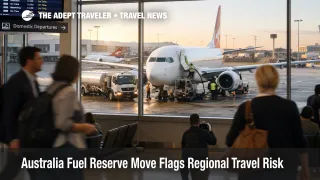
Australia fuel travel risk moved from abstract to operational on March 13, 2026, when Canberra released petrol and diesel from emergency reserves and loosened fuel standards to steer more supply toward shortage areas. The immediate traveler takeaway is that this is still a developing risk story, not a confirmed airport shutdown story, but it now has enough official action behind it to matter for regional itineraries, long road transfers, and flights that depend on thinner fuel and logistics buffers.
What changed since earlier fuel security chatter is that the Australian government is no longer talking only about resilience in theory. It has taken concrete steps because regional shortages and distribution stress are already real, even while ministers say expected ships are still arriving and Australia is not in a nationwide runout scenario.
The Australia fuel travel risk story is now about operating cushion. Travelers do not need to assume Sydney Airport (SYD) or regional airports are about to stop functioning, but they should stop assuming normal slack in regional transport chains.
Australia Fuel Travel Risk: What Changed
The government's March 12 and March 13 actions did two things. First, it temporarily eased fuel quality standards for 60 days, a move Reuters and Minister Chris Bowen said should add about 100 million litres a month of extra petrol supply, with the redirected volumes prioritized for shortage regions. Second, it allowed the release of up to 20 percent of the baseline minimum stockholding obligation, roughly 762 million litres of petrol and diesel, to counter supply chain disruption and local shortages in many parts of regional Australia.
That does not prove a broad aviation failure. In fact, officials said expected ships are still reaching Australian ports, and Reuters reported Australia had about 36 days of petrol, 34 days of diesel, and 32 days of jet fuel in reserve as of early March, the highest level in more than a decade, though still below the International Energy Agency's 90 day benchmark. The useful reading for travelers is narrower. The country is trying to protect margins before a logistics problem becomes a movement problem.
Aviation deserves attention because the cushion is thinner than it looks. Reuters reported on March 12 that Sydney Airport chief executive Scott Charlton warned about jet fuel supplies, saying the hub consumes nearly 40 percent of Australia's aviation fuel and holds roughly 25 to 30 days of supply in pipelines and storage. His point was not that Sydney was shutting down, but that reliability depends on imports, shipping lanes, refining capacity, and geopolitical stability.
Which Travelers Face the Most Exposure
The most exposed travelers are not necessarily the ones flying through the biggest hubs. They are the ones whose trips rely on regional road fuel availability, long self drive legs, remote lodge transfers, small airport links, fishing or outback charters, and thin recovery options if one segment slips. ABC reported that some regional retailers had started rationing fuel or limiting sales, while some towns, farmers, and transport companies said they had been cut off completely.
That exposure matters most in itineraries where one delay breaks the rest of the trip. Think same day airport to regional transfer chains, fly drive holidays with long distances between fuel stops, remote resort arrivals, or domestic connections where the fallback is not another flight in two hours, but another seat tomorrow, or later. The risk is still uneven, which is why this remains a watchlist story rather than a blanket warning. Metropolitan trips with short urban transfers still look more resilient than regional circuits that depend on the spot market or stretched distribution routes.
There is also a difference between price pain and operational pain. Higher fares or fuel costs are annoying, but the thresholds that would turn this into a harder traveler disruption story are more concrete, regional flight cuts, fuel rationing that reaches airport operators or charter bases, tanker fueling becoming common enough to affect schedules, or public notices from carriers and airports about reduced flexibility. Reuters already showed the broader pattern in the region when Air New Zealand said it would cut about 5 percent of capacity through early May because the fuel shock was disrupting travel far from the Middle East.
What Travelers Should Do Now
For trips inside Australia over the next several days, the practical move is to add buffer, not panic. Travelers with regional itineraries should avoid tight same day joins between flights, long road transfers, and fixed check in times. If your plan depends on reaching a remote property or regional airport after dark, earlier departures and a backup overnight near the gateway city are more sensible than trusting normal timing. That is especially true where rental car fuel availability, charter departures, or long coach legs matter more than the mainline flight itself.
The clearest rebook threshold is whether your itinerary depends on a regional segment with little redundancy. If missing one flight, bus, ferry, or lodge transfer would collapse the whole trip, it is worth moving to a more forgiving sequence now. If your trip is mainly Sydney, Melbourne, or another major city with short urban transfers and flexible timing, waiting is still reasonable, because the current evidence points to tighter conditions, not a systemwide stop.
Over the next 24 to 72 hours, watch for three signals. First, more reports of regional rationing or spot market strain. Second, any airline or airport guidance about jet fuel, tanker fueling, or reduced schedules. Third, whether the story stays confined to regional distribution pressure, or starts showing up in actual aviation service cuts. Adept travelers already saw how quickly fuel stress became an airport level story in Cuba Jet Fuel Shortage Clouds March Travel Plans, while the wider geopolitical trigger is part of the same global shock that drove Middle East Airspace Closures Ground Gulf Hubs.
Why This Is Happening, and How It Could Spread
The mechanism is straightforward. Australia still has fuel in the system, but officials are trying to ease the mismatch between where fuel is held, where demand has spiked, and how fast it can move through a long domestic supply chain. That is why Bowen's office emphasized distribution pressure, regional shortages, and the time it takes for fuel to move from storage to where it is needed.
For travelers, first order effects would show up as slower or less predictable ground mobility in affected regions, limited flexibility for transport operators, and possibly thinner schedules on routes that are already marginal. Second order effects are where trips actually break, missed onward flights because a road transfer slips, late lodge arrivals, compressed touring windows, more expensive one way repositioning, and fewer fallback seats if airlines start protecting fuel or trimming frequencies. That is why this is a meaningful destination story even before a major airport runs short.
The next escalation point is aviation specific. Reuters reported that Sydney Airport's chief warned that the country no longer refines aviation fuel at scale and depends on imported supply. If that import reliability worsens, the story shifts from regional road strain into a more serious aviation reliability piece. Until then, the right frame is caution under uncertainty. Australia is not closed, but its transport cushion is thinner than travelers should assume.
Sources
- Securing more fuel for Australia's regions
- Australia releases petrol and diesel from emergency reserves
- Australia to temporarily ease fuel standards to boost supply
- Air New Zealand to cut flights as fuel price surge wreaks havoc on travel
- War in the Middle East already making Australia's fuel struggles the toughest in decades
- We need sovereign SAF production, says Sydney Airport boss