

Glasgow Central High Level Closure Disrupts Weekend Rail
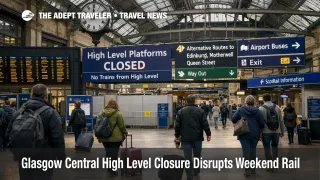
Glasgow Central rail disruption remains a live weekend transport problem, not a one day station incident. National Rail says Glasgow Central high level will stay shut through at least the end of Sunday, March 15, 2026, after a fire in a nearby building, even as low level ScotRail services have resumed. That split matters because it restores some cross city movement while leaving the main intercity and suburban high level hub out of service. Travelers should rebuild plans around substitute stations and longer transfers now, especially if a trip depends on Glasgow Airport, a ferry connection, or a same day onward rail leg.
This is also a change from Adept Traveler's earlier same day closure coverage. The original story was a full station failure with no reopening estimate, but the weekend version is more uneven and easier to misread, because some services are back and some are still badly broken. Low level reopening helps local movement, but it does not restore the high level station functions that feed long distance UK rail and many west of Scotland routes. Travelers who assume "Glasgow Central is open again" risk building itineraries on the wrong layer of the network. For background on the initial closure, see Glasgow Central Closure Disrupts UK Rail March 9.
Glasgow Central Rail Disruption, What Changed
The high level closure is now clearly a weekend wide operating pattern, not just an emergency pause. National Rail lists Avanti West Coast, Caledonian Sleeper, and CrossCountry among the affected operators, with Avanti services starting and ending at Motherwell, Caledonian Sleeper shifted to Edinburgh, and CrossCountry revised to run to Edinburgh instead of Glasgow Central. National Rail also says tickets are being accepted on alternative routes, including ScotRail between Edinburgh and Glasgow Queen Street, and between Glasgow Central low level area stations and Motherwell, plus LNER and TransPennine Express on some substitute corridors.
For ScotRail passengers, the impact is broader than one long distance terminal. ScotRail says no high level services are operating to or from Glasgow Central, and its suspended route list includes Edinburgh to Glasgow Central via Shotts or Carstairs, the Cathcart Circle, Paisley Canal, Newton, Barrhead, Neilston, East Kilbride, and Ardrossan South Beach or Harbour. Other westbound services are being cut back or partially restored through alternative endpoints such as Paisley Gilmour Street, Motherwell, Barrhead, Kilwinning, or Kilmarnock, which means many travelers can still move, but not in the simple one seat pattern they originally booked.
Which Travelers Face the Most Disruption
The most exposed travelers are not only Glasgow commuters. The bigger risk sits with people using Glasgow Central as a transfer hinge, especially those combining suburban ScotRail legs with Avanti or CrossCountry, or anyone trying to protect a flight, a ferry, or a timed Highlands connection. Once the hub function breaks, a trip that looks intact on paper can fail on the interchange, because substitute stations add walking, bus transfers, and crowding risk.
Airport access is one of the clearest second order problems. Glasgow Airport says the nearest rail station is Paisley Gilmour Street, with the McGill's 757 bus onward to the terminal, while the Glasgow Airport Express 500 also links the airport directly with Glasgow city centre near both Queen Street and Glasgow Central. In practice, that means travelers headed to Glasgow Airport should think in layers, first getting onto a working rail corridor or city centre bus, then making the airport connection, rather than assuming the old Glasgow Central to airport sequence still works cleanly.
The closure also lands on a weekend when Scotland connections can already be thin at the edges. That is why this story now overlaps with ferry and leisure travel even if the fire itself is urban. A late rail handoff in Glasgow can still spill into missed sailings or forced hotel changes, which is the same broader fragility Adept Traveler flagged in Scottish Island Ferries Stay Fragile Through March 14.
What Travelers Should Do Before Monday
The practical move is to stop routing through Glasgow Central high level unless an operator explicitly says your train is restored there. If you are traveling between Scotland and London, check whether your service now starts at Motherwell or Edinburgh. If your trip is west of Glasgow, verify whether your train now begins at Paisley Gilmour Street, Barrhead, Kilwinning, or another substitute point. If your plan relies on a same day flight, build more buffer than usual and treat any rail to air handoff as fragile until the high level station reopens.
For rebooking decisions, the threshold is simple. Keep the trip if you can complete it with one clear substitute station and enough slack to absorb a missed local connection. Rework it if the itinerary needs multiple unprotected handoffs, especially rail to airport, rail to ferry, or late evening rail into a less frequent onward service. Families, travelers with heavy bags, and anyone needing step free certainty should lean earlier toward buses, taxis, or a revised departure point, because a technically possible reroute is not always a practical one.
The main recovery signal to watch before Monday is not just whether "Glasgow Central is open." Travelers need to see high level services restored as scheduled origins and destinations in operator journey planners, not merely low level service continuity or ticket acceptance workarounds. Until then, the station is only partially back, and weekend plans should treat the high level closure as the real operating condition.
Why the Disruption Spreads Beyond One Station
The mechanism here is straightforward. Glasgow Central is not just a station entrance, it is a high volume interchange where suburban, regional, Anglo Scottish, and sleeper flows meet. When the high level platforms close, the network does not simply lose one stop. It loses a distribution point that normally lets travelers move between city centre Glasgow, southwest Scotland, England bound rail, and airport or ferry connections with relatively little friction.
That is why low level reopening only solves part of the problem. It brings back some through movement under the city, but it does not restore the higher value interchange work the station normally performs for longer distance and high level suburban routes. As a result, the first order effect is canceled or cut back rail service, while the second order effect is pressure on Queen Street, Motherwell, Paisley Gilmour Street, station link transfers, airport buses, taxis, and overnight accommodation for travelers who miss the last workable connection.