

Pakistan Gilgit Baltistan Unrest Hits Trip Planning
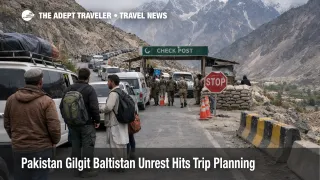
Pakistan just became a more practical disruption story for trekkers and overland planners, not because the country shut its airspace, but because the U.K. Foreign, Commonwealth & Development Office, or FCDO, raised Gilgit Baltistan to all but essential travel on March 12, 2026, citing unrest, protests, intermittent movement restrictions, and mobile and internet outages. The same update also warns that protests may persist in major cities, that curfews and road restrictions can appear at short notice, and that Karachi Jinnah International Airport (KHI) sits under heightened security concern. For travelers, that changes the decision from "can I still go?" to "can my road, signal, and rescue chain survive a bad day?"
The new advice matters because Gilgit Baltistan trips usually depend on fragile sequencing. A trek, jeep transfer, domestic flight, and hotel handoff can all look workable until one protest closure or service blackout breaks the chain. The nut here is simple: Gilgit Baltistan travel planning now carries a higher risk of failed road access, failed communications, and failed joins, especially for travelers moving north from Islamabad, Pakistan, toward Skardu, Gilgit, or the Karakoram corridor.
Gilgit Baltistan Travel Planning Just Got Harder
What changed on March 12 is precision. The FCDO did not simply repeat a generic Pakistan caution. It singled out Gilgit Baltistan for all but essential travel, while also warning that protests may continue in major cities, road access restrictions and curfews can be imposed at short notice, and travelers should be especially careful around Karachi, Skardu, Lahore, and Islamabad. It separately says mobile data and internet connectivity may be cut without warning during unrest, and that major road networks in and around cities may be shut or blocked.
That is a bigger operational problem than a normal advisory bump. In a mountain trip, the first order effect is obvious, your vehicle, guide, or domestic connection may simply not move when planned. The second order effect is harsher, because once phones and data drop, it becomes much harder to confirm driver location, rebook a missed domestic leg, notify a trekking operator, or coordinate help if a party is delayed on a long road segment. That is exactly the kind of failure that turns a manageable delay into a broken itinerary.
Which Pakistan Itineraries Face the Most Exposure
The most exposed trips are the ones that stack multiple northern legs with little slack. That includes trekkers heading for Skardu or Gilgit, travelers trying to combine a domestic flight with a same day road transfer, and overland itineraries that depend on the Karakoram Highway. The FCDO already advises against all travel on the Karakoram Highway stretch between Mansehra and Chilas via Battagram, Besham City, Dasu, and Sazin up to the junction with the N15, while now also advising against all but essential travel to Gilgit Baltistan itself. That means the classic southern approach into the region was already weak before the March 12 escalation made the destination side weaker too.
Independent travelers are also more exposed than tightly supported groups. When communications are cut, a strong operator with local drivers, hotel contacts, and alternate routing options can sometimes salvage a plan that a self booked traveler cannot. Even then, northern Pakistan remains a place where one broken link can force a full reschedule. Recent reporting on unrest in Gilgit and Skardu suggests authorities have already used curfews and military deployments in the region, which helps explain why transport conditions can harden faster than published schedules do.
What Travelers Should Do Now
For departures in the next 72 hours, postponement is the cleanest answer unless the trip is essential and locally supported. A "go anyway" decision only makes sense if your operator is still confirming current road conditions, your overnight stops are rechecked, and your trip does not depend on a single domestic flight or one long transfer arriving on time. Travelers without strong local support should treat the advisory as a practical stop sign, not just a legal insurance note. The FCDO explicitly warns that insurance can be invalidated if you travel against its advice.
For travelers already in Pakistan, Islamabad International Airport (ISB) is the more sensible staging point than Karachi for most northern replans, not because it is risk free, but because the fresh FCDO airport specific warning is aimed at Karachi and because Islamabad remains a functioning national gateway with live flight status and published schedules. Air remains a hedge, not a guarantee. Pakistan's airport system is still operating, but a published flight or active airport page does not solve a protest blocked road, a curfew, or a mobile outage on the ground.
The main postponement threshold is straightforward. Delay the trip if you cannot tolerate a missed trek join, if your operator cannot confirm current local movement conditions, if your group needs constant mobile coverage for safety, or if your route depends on the Karakoram approach with no extra day built in. Keep monitoring if you are still weeks out, have a flexible operator contract, and can wait for signs that protests, outages, and movement controls are easing. Travelers also need to watch the wider regional backdrop, because Pakistan is dealing with security spillover beyond the north, not just a local tourism issue. For broader corridor context, Adept readers can compare Middle East Airspace Closures Ground Gulf Hubs and UAE Airport Access Tightens for Stranded Travelers.
Why the Disruption Spreads Beyond One Advisory
The mechanism is not complicated. Gilgit Baltistan is an adventure region reached through long mountain roads, thin transport networks, and limited redundancy. Britannica describes the Karakoram Highway as a rugged Islamabad linked corridor through some of Asia's most inaccessible terrain, which is exactly why protests and checkpoints hit harder there than they would in a dense urban corridor with many alternates. When unrest collides with that geography, the result is not just slower travel, it is a much higher chance that there is no clean fallback at all.
That is also why outages matter so much. A mobile blackout in a city is inconvenient. A mobile blackout tied to a mountain transfer, trek briefing, or rescue handoff can become a safety issue. The FCDO's latest update does not prove every route is shut, and Pakistan's airports are not under a blanket closure. But it does confirm the conditions that make remote travel fail, protest risk, intermittent restrictions, short notice curfews, and communications loss. For now, that is enough to move Gilgit Baltistan from adventurous to operationally unstable.
Sources
- Pakistan Travel Advice, GOV.UK
- Safety and Security, Pakistan Travel Advice, GOV.UK
- Karakoram Highway, Britannica
- Military called to northern Pakistan region after deadly Iran protests, Reuters
- Pakistan deploys troops and imposes curfew after deadly protests over US-Israeli strikes on Iran, AP News
- Islamabad International Airport, Pakistan Airports Authority
- Flight Schedule, Pakistan Airports Authority
- Middle East Airspace Closures Ground Gulf Hubs, Adept Traveler
- UAE Airport Access Tightens for Stranded Travelers, Adept Traveler