

UAE Airport Access Tightens for Stranded Travelers
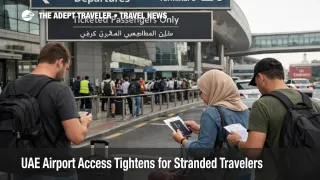
UAE airport access tightened again on March 12, 2026, and that changes the exit math for stranded travelers in Dubai, Abu Dhabi, and nearby emirates. The new U.S. Mission security alert says some airports are restricted to confirmed travelers only, warns passengers not to go to the airport without a confirmed ticket and airline instruction, and says land exits to Oman and Saudi Arabia remain open but congested and visa dependent. Travelers who were still treating the UAE like a normal show up early, fix it at the counter market need to switch to a document first plan before they move.
This is an operational step up from the March 11 support posture story, not just another restatement of regional risk. The earlier issue was thinner consular and government support. The March 12 change is more practical and more immediate, because it affects whether you can even get into the airport zone without a usable booking and carrier instruction. In plain language, the UAE is still an exit point, but it is no longer a place where improvisation works well. The traveler problem has shifted from finding a theoretical route out to proving you are ready to travel before you start moving.
UAE Airport Access: What Changed
The key change is that airport access itself is now part of the bottleneck. The U.S. Mission alert says access to some airports is restricted to confirmed travelers only, while Emirates separately tells customers not to go to the airport unless they hold a confirmed booking and, for limited flights, only transit travelers with an operating onward connection will be accepted. That matters because the old fallback, go to Dubai International Airport (DXB) or Zayed International Airport (AUH), queue up, and hope to sort it out in person, is much less workable now.
This also clarifies what "still open" does and does not mean. The UAE remains under a U.S. Level 3, Reconsider Travel advisory, not a blanket shutdown, and the State Department still says Americans should have a plan to depart that does not depend on U.S. government help. But open airports and limited airline schedules are no longer enough by themselves. A traveler now needs a confirmed air seat, active airline communication, and a plan that survives airport access controls before leaving the hotel. That is the same broader logic Adept flagged in UAE Support Conditions Harden for Stranded Travelers, but the March 12 alert makes the airport access problem explicit.
Which UAE Exit Plans Are Now Most Exposed
The most exposed travelers are the ones still relying on same day airport problem solving. That includes passengers on canceled itineraries who do not yet have a replacement ticket, people on separate tickets trying to rebuild a long haul chain in real time, and travelers whose through connection only works if every leg operates on schedule. Once airport entry is limited to confirmed travelers, the first order effect is obvious, fewer people can use the terminal as a live rebooking space. The second order effect is harsher, because every failed attempt can spill into extra hotel nights, more expensive replacement fares, and higher odds of missing a tour, cruise embarkation, or onward land segment even if the long haul gets fixed later.
Road exits look more useful under these rules, but they are not friction free. The same March 12 U.S. Mission alert says land exits to Oman and Saudi Arabia remain open, while also warning that congestion continues and visas may be required. That means the road option now works best for travelers who already know they can legally enter the next country and who have a credible onward plan from the other side, not for people trying to improvise a border run under pressure. Adept's earlier UAE Oman Border Crossings Offer Overland Exit story is still relevant, but the threshold for using that fallback is now higher because airport access has tightened while border queues remain a drag.
What Stranded Travelers Should Do Now
Start with a hard document check before you leave for either the airport or a land border. For an air exit, that means a confirmed ticket, direct airline notice or verified flight status, passport validity, any destination visa or transit permission you need, and proof that your onward connection is actually operating if Dubai is only a bridge point. For a land exit, add entry eligibility for Oman or Saudi Arabia, any onward flight confirmation from the other side, and enough buffer to absorb border congestion without breaking the next segment.
The main decision threshold is simple. Wait in place only if you already hold a usable confirmed seat, your airline is actively sending updates, and the next 24 hours still offer a realistic departure path from the UAE. Shift to a road or alternate airport plan when you do not have a cleared air option, your booking remains unresolved, or your trip has a hard timing point such as a cruise join, family emergency, visa deadline, or nonrefundable onward departure that cannot tolerate another missed day. Travelers booked on separate tickets should lean toward earlier action, because a partial fix on one segment often does not protect the rest of the trip.
Over the next 24 to 72 hours, monitor three things, airline operating updates, airport access language, and land border conditions. Emirates is still running a reduced schedule and says customers should check status and email notifications before going to the airport. Broader corridor risk also still matters, because limited resumptions are not the same thing as stable Gulf hub reliability. For that backdrop, Middle East Airspace Reopens, Closures Stay Fluid remains the right context piece.
Why UAE Airport Access Tightened
The mechanism is straightforward. The UAE is still handling commercial travel, but the region remains under armed conflict and aviation stress, with the State Department citing ongoing drone and missile threats, significant disruptions to commercial flights, and an FAA caution notice for U.S. operators in the Middle East, including the UAE. In that environment, authorities and airlines are trying to reduce non traveling footfall at airports while preserving limited capacity for passengers who already have a confirmed path out.
That is why airport access rules matter more than they would in a normal disruption. In a routine storm or airline outage, showing up early can sometimes help because agents, counters, and standby logic still operate inside a mostly normal terminal system. In the UAE right now, the system is doing the opposite. It is filtering access first, then moving confirmed travelers through a constrained operation. As a result, the smartest self rescue plan is no longer "get to the airport and negotiate," it is "assemble the documents, prove eligibility, then move once the route is real."
Sources
- Security Alert: U.S. Mission to the United Arab Emirates, March 12, 2026
- Security Alert, U.S. Embassy Abu Dhabi, United Arab Emirates, March 11, 2026
- United Arab Emirates Travel Advisory, U.S. Department of State
- Travel Updates, Emirates
- UAE Support Conditions Harden for Stranded Travelers
- UAE Oman Border Crossings Offer Overland Exit
- Middle East Airspace Reopens, Closures Stay Fluid