

Portsmouth Harbour Rail Disruption Hits Weekend Sailings
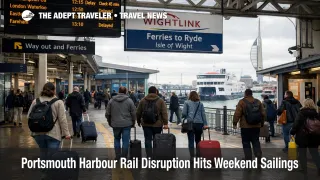
The Portsmouth Harbour rail disruption is now a full weekend transfer problem, not just a local delay. National Rail says disruption to South Western Railway services between Southampton Central or Havant and Portsmouth Harbour is expected through the end of Sunday, March 15, 2026, because a defective track near Hilsea is forcing trains to run under a speed restriction. For travelers, that shifts the story from commuter inconvenience to missed ferry links, weaker cruise and port transfer reliability, and tighter same day sailing risk into Portsmouth and onward to the Isle of Wight. The practical move is to stop planning this corridor as a normal rail arrival and start building backup time, or a road fallback, before you leave.
Put simply, what changed since earlier UK transport coverage is the duration and the operating pattern. National Rail now says the reduced speed operation will last through Sunday, and warns that cancellations and alterations will affect journeys in the Portsmouth area while further works take place to restore the line to normal speed. That matters because Portsmouth Harbour sits at the end of a chain, rail station, ferry terminal, port access point, and city gateway, so even moderate delays spread into missed connections faster than they do on a typical urban line.
Portsmouth Harbour Rail Disruption, What Changed
The core weakness is the Hilsea approach into Portsmouth. National Rail says a defective track near Hilsea is forcing a speed restriction, with South Western Railway services between Southampton Central or Havant and Portsmouth Harbour liable to revision or delays of up to 45 minutes. The published affected routes also show exposure stretching beyond purely local trips, including services from London Waterloo via Eastleigh, Guildford, Woking, Winchester, and Southampton toward Portsmouth stations.
For Sunday, March 15, 2026, the risk is broader than a simple late running train. National Rail says cancellations and alterations will affect journeys in the Portsmouth area while planning continues, and South Western Railway's March engineering page already shows a familiar fallback pattern in this corridor, services terminating at Fareham or Havant, with buses onward toward Portsmouth. That combination is what makes this a weekend traveler issue, because rail replacement or local bus substitution can still get people moving, but it usually breaks the timing assumptions behind ferry check ins, cruise pre nights, and fixed port pickup windows.
Which Travelers Face the Most Disruption
The most exposed travelers are foot passengers making rail to ferry handoffs at Portsmouth Harbour. Wightlink's Portsmouth Harbour to Ryde Pier Head FastCat crossing takes about 22 minutes and connects directly with the rail station environment, which is exactly why a slow or revised rail approach matters so much. A late inbound train can compress the whole chain, station arrival, terminal walk, boarding cutoff, and onward Island Line timing on the other side.
Cruise passengers and anyone joining ships from Portsmouth should treat the corridor even more cautiously. Unlike a leisure rail trip, a same day sailing often has a hard cutoff that does not care why you were late. A 30 to 45 minute rail delay can become much larger once travelers hit replacement buses, taxi queues, or heavier road traffic around the port. The same logic applies to event traffic, naval visits, and weekend city breaks that depend on a clean arrival into Portsmouth Harbour rather than a looser arrival somewhere else in Hampshire. The main risk is not that travel becomes impossible, it is that the itinerary loses resilience.
Isle of Wight travelers have a second layer of exposure because Portsmouth is not the only Solent crossing option. Hovertravel's Southsea to Ryde service runs separately, with crossings under 10 minutes and a HoverBus link from main rail and coach stations, but using it as a fallback usually means changing terminals and ground transport assumptions rather than stepping straight across the platform. That can save a trip, but it is not a frictionless substitute for a missed Portsmouth Harbour handoff.
What Travelers Should Do Now
Travelers with same day sailings should not aim for the last reasonable train. On this corridor, the safer decision threshold is to arrive in Portsmouth the night before if the sailing is expensive, inflexible, or long haul connected. If you are already committed to same day travel on Sunday, March 15, 2026, check the live National Rail journey planner before departure, assume the weakest segment is the Hilsea approach into Portsmouth, and price a taxi or car service backup early rather than after services bunch up. National Rail is also allowing no extra cost acceptance on selected Southern and Great Western Railway services, plus a long list of local bus routes that can bridge parts of the corridor.
For ferry passengers, the right tactic depends on how fixed the crossing is. If your itinerary is flexible, waiting for rail recovery may still be cheaper than jumping into a taxi. If the sailing is tied to accommodation, a tour, or a same day return, the tradeoff changes, because protecting the crossing usually matters more than saving the ground transport cost. Portsmouth Harbour to Ryde Pier Head remains the cleanest foot passenger ferry link when you can still reach it in time, while Southsea Hoverport can work as a fallback only if you leave enough margin to reposition across the city.
Watch for three signals over the next 24 to 48 hours. First, whether National Rail removes the Sunday disruption warning or sharpens it into specific cancellation patterns. Second, whether South Western Railway journey planners harden into more bus replacement segments around Fareham, Havant, or Portsmouth. Third, whether your ferry operator keeps normal boarding patterns, because even when sailings operate, a late rail arrival can still fail at the terminal gate. Travelers who need a more resilient southern England plan can also review Adept's earlier coverage in UK Snow Warnings Disrupt Rail and Ferries Feb 3 and Isle of Wight Hovercraft Suspended, Solent Crossing.
Why the Disruption Spreads Through Travel
Rail disruption around Portsmouth is unusually consequential because the corridor serves more than one end market at once. It handles local commuting, longer distance arrivals from London and Hampshire, ferry connections to the Isle of Wight, and port access into a city where travelers often cannot simply walk to the next available transport mode without losing time. Once a defective track forces reduced speed at Hilsea, the first order effect is slower or revised train operation. The second order effect is that every dependent handoff, local bus, taxi, ferry, port pickup, hotel arrival, becomes less reliable at the same time.
That is why the official ticket acceptance list matters. National Rail is not only pointing travelers to rail alternatives such as Southern and Great Western Railway, it is also naming local bus options including routes through Southampton, Fareham, Cosham, Hilsea, Portsmouth city centre, and Portsmouth Harbour. In plain language, the system is trying to preserve movement by spreading travelers across substitute modes. That helps avoid a full stop, but it also lengthens journeys and makes same day, hard cutoff itineraries much more fragile than the raw "up to 45 minutes" delay figure suggests.
Sources
- National Rail, Disruption to South Western Railway Services Between Southampton Central / Havant and Portsmouth Harbour Expected Until the End of Sunday 15 March
- National Rail, Status and Disruptions
- South Western Railway, Planned Improvements, March 2026 Works
- Wightlink, Portsmouth Harbour, Ryde Pier Head FastCat Port Information
- Hovertravel, Portsmouth to Ryde Timetables