

Senate Blocks DHS Bill, TSA Shutdown Strain Grows
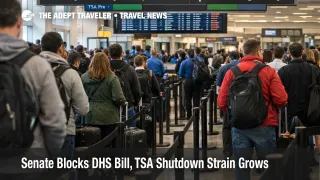
The Senate failed on March 12, 2026 to advance a House passed Homeland Security funding bill, leaving the partial Department of Homeland Security shutdown in place and keeping Transportation Security Administration officers unpaid as spring travel demand builds. For travelers, the practical issue is not Washington process on its own. It is that another failed funding push keeps airport screening staffing under pressure at the point millions of people are heading into spring break trips. The immediate decision is simple, arrive earlier than usual, avoid tight airport timelines, and expect checkpoint performance to vary more by airport and even by hour than on a normal travel day.
This is the material change from Adept Traveler's earlier shutdown coverage. The debate is no longer just about a looming pay cliff. The Senate has now failed to move a House bill on March 12, which means the operational strain on TSA continues instead of easing before the weekend travel push.
TSA Shutdown Strain: What Changed for Travelers
What changed on March 12 was the Senate vote itself. According to the U.S. Senate Daily Press, cloture on the motion to proceed to H.R. 7147 failed 51 to 46, with 60 votes required. Reuters reported that the failed vote left the Homeland Security funding lapse unresolved and pushed the Senate into adjournment until Monday.
That matters because TSA is one of the most visible travel facing parts of DHS. Reuters reported that more than 300 TSA officers have quit during the shutdown, and roughly 50,000 screeners have been working without pay. Earlier this week, the administration restored Global Entry, which should help some arriving international passengers, but that does not fix outbound checkpoint staffing at domestic security lines. TSA Shutdown Strain Deepens at U.S. Airports and U.S. Global Entry Restarts as Shutdown Drags On provide the most relevant recent context.
Which Travelers Face the Most Disruption
The most exposed travelers are people flying out of large or already stressed airports, especially those traveling on morning banks, spring break departures, or same day connections where a long security line can break the rest of the itinerary. Reuters reported earlier this week that security waits hit about 3.5 hours at Houston's William P. Hobby Airport (HOU), while checkpoint closures were reported in Philadelphia and long lines also surfaced in New Orleans.
The risk is not evenly spread. Some airports are absorbing the strain better than others, but internal TSA statistics reviewed by CBS News showed particularly high callout rates at John F. Kennedy International Airport (JFK), about 21 percent on average during the shutdown, with other major airports also running well above the normal 2 percent level. That means travelers should think less in terms of a nationwide airport shutdown and more in terms of uneven local failure points, where one weak checkpoint operation can trigger missed bags, missed boarding windows, and forced rebooking costs.
What Travelers Should Do Now
Travelers flying this weekend or early next week should build more buffer than usual before departure, especially at large hubs and leisure airports seeing spring break traffic. In practical terms, that means treating published airport minimums as too optimistic if your trip depends on one narrow connection, one checked bag cutoff, or one inflexible departure such as a cruise embarkation, tour join, or international long haul segment.
The main decision threshold is whether a missed flight would be expensive enough to justify extra caution now. If the answer is yes, shift to an earlier airport arrival, move to an earlier departure bank if you still can, or avoid self built tight connections. If your airport has already reported long waits or unusual staffing stress, the safer move is to protect the itinerary first and worry about convenience second. Waiting for Washington to resolve the impasse is not a useful traveler strategy for departures over the next several days, because the Senate is not due back until Monday.
Travelers should also watch for airport specific guidance rather than assuming national conditions tell the whole story. Reuters noted that airports have started stepping in with support for unpaid TSA workers, and conditions can change quickly from one checkpoint to the next. The right signal to monitor is not political rhetoric. It is local airport alerts, checkpoint wait times, airline app notifications, and whether your airport has recently posted early arrival advice.
Why the Airport Impact Keeps Spreading
The mechanism is straightforward. TSA screening depends on enough officers showing up to keep multiple lanes open at the right times. When officers work without pay for weeks, attrition rises, callouts rise, and staffing becomes less predictable. First order, that reduces screening throughput. Second order, it pushes travelers into longer queues, compresses boarding windows, increases missed flights, and can also force airports and airlines to absorb more rebooking, customer service, and ground side congestion.
This is also happening at a bad point in the calendar. Reuters reported that U.S. airlines expect roughly 171 million passengers from March 1 through April 30, 2026. In a heavy demand environment like that, even modest staffing losses can create outsized operational effects because security is an upstream choke point for the entire airport day. A delayed screening flow does not just slow one traveler. It can distort boarding, aircraft turns, crew timing, concession demand, curbside traffic, and onward connection reliability.
Sources
- US Senate fails to end standoff over funding Homeland Security, airport screening
- Thursday, March 12, 2026, U.S. Senate Daily Press
- US restarts Global Entry program amid industry pressure
- Security lines hit three hours at some US airports as TSA absences rise
- TSA officer callouts spike amid partial government shutdown
- TSA absences double during shutdown, 300 officers quit, as some airports see longer security lines