

TSA Shutdown Strain Deepens at U.S. Airports
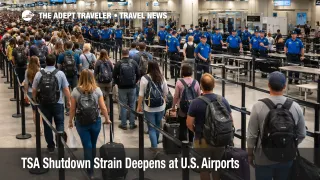
The shutdown impact on U.S. airport screening has moved beyond a staffing warning and into a broader reliability problem. Transportation Security Administration callouts have climbed well above normal levels during the Department of Homeland Security funding lapse, more than 300 employees have left the agency, and some large hubs are now dealing with a thinner margin for handling peak departure banks. For travelers, that means the same airport can feel manageable one hour and badly backed up the next. Anyone flying in the next several days should build more time into the airport phase of the trip, especially at large connecting hubs and spring break gateways.
The practical change since earlier coverage is that the staffing strain now looks more entrenched. The problem is no longer just that officers are working with reduced or missed pay, it is that higher absences and departures are starting to make checkpoint performance less predictable across multiple airports at once.
TSA Shutdown Airport Lines: What Changed
What changed is the scale and persistence of the staffing problem. ABC News, citing TSA data, reported on March 11 that unscheduled absences have more than doubled during the shutdown, with the national callout rate rising from about 2 percent to 6.16 percent, while more than 300 TSA officers have left the agency since the shutdown began on February 14, 2026. Reuters has also reported that some airports have already seen security lines stretch to hours at points during the shutdown, especially as spring break demand ramps up. That combination matters more than either fact alone, because a modest staffing loss can become a serious throughput problem once passenger volume rises at the same time.
This also changes the traveler calculation from simple inconvenience to itinerary risk. A slow checkpoint can now break the trip before the first flight even leaves, particularly for travelers with checked bags, families moving through standard screening, and anyone depending on a morning departure bank where missed flights can be hard to recover later in the day.
Which Travelers Face the Most Disruption
The most exposed travelers are those departing from large hubs that are already showing elevated callout rates, including New York John F. Kennedy International Airport (JFK), Hartsfield Jackson Atlanta International Airport (ATL), Houston's major airports, Louis Armstrong New Orleans International Airport (MSY), and Pittsburgh International Airport (PIT). ABC's reported airport level data showed especially high averages at JFK, Atlanta, Houston, New Orleans, and Pittsburgh, which suggests the strain is not isolated to one region or one airport type. Travelers at those airports should treat normal screening assumptions as less reliable than usual.
Spring break travelers are exposed in a different way. Leisure peaks create dense departure waves, more checked bags, more occasional flyers, and more families moving slowly through checkpoints. That means even a temporary staffing dip can spread faster through the system than it would in a quieter travel week. The same is true for people on cruise joins, tours, weddings, and other timed trips where a missed first leg can collapse a larger plan.
International travelers also need to separate two different airport functions. Global Entry has now restarted, which should help approved travelers reenter the United States more quickly after international trips, as covered in U.S. Global Entry Restarts as Shutdown Drags On. But that does not solve the domestic checkpoint problem on departure. Global Entry can reduce arrival side friction for enrolled travelers, while outbound TSA screening can still remain volatile at the same airport.
What Travelers Should Do Now
Travelers should treat the airport phase as the unstable part of the itinerary and protect it first. For flights over the next several days, especially from large hubs and spring break airports, arriving three hours early for domestic departures is a reasonable baseline when baggage drop, family travel, or rental car returns are involved. For international departures, extra buffer still makes sense because the issue is not just screening time, it is the risk that a sudden staffing gap or lane closure changes the pace after you arrive.
The rebooking threshold depends on what a missed first leg would cost. If the trip includes a cruise embarkation, a nonrefundable tour, a wedding, or a same day long haul connection, protecting the first airport segment matters more than squeezing the schedule. A more expensive but earlier flight, an airport hotel the night before, or a departure from a less strained airport can be the smarter move if the itinerary has little slack. Travelers with more flexibility can wait, but they should avoid assuming that yesterday's line length predicts tomorrow morning's experience.
Over the next 24 to 72 hours, the next key variable is whether missed pay continues to push callouts and departures higher. That is the risk Adept already flagged in U.S. Shutdown Pushes TSA to a March 13 Pay Cliff. Travelers should watch airline alerts, airport social feeds, and same day checkpoint conditions before leaving for the airport, not just the flight status page. A flight can still show on time while the real failure point is the security queue.
Why the Disruption Spreads Through Travel
The mechanism is straightforward. TSA throughput depends on enough officers being available to keep lanes open, staff bag screening, handle secondary checks, and absorb short spikes in passenger volume. When absences rise, airports can still function, but the buffer disappears. That makes the system more sensitive to ordinary pressure points like a busy morning bank, bad weather recovery, a late arriving busload of passengers, or a temporary equipment issue. The result is not always a full shutdown style collapse, but a more erratic airport where conditions swing quickly.
That is why the effects spread beyond the checkpoint itself. First order, travelers spend longer in line and face a higher chance of missing departure cutoffs. Second order, missed flights create downstream pressure on later flights, customer service desks, airport hotels, rental car returns, cruise transfers, and ground transport timing. A family that misses a morning departure may not just lose a seat, it may lose the rest of a timed itinerary. This is also why a restarted trusted traveler tool like Global Entry is useful but incomplete. It fixes one part of the chain, while the departure side still depends on frontline screening labor that remains under shutdown pressure.
Sources
- TSA officer callouts spike amid partial government shutdown as more than 300 leave agency
- Security lines hit three hours at some US airports as TSA absences rise
- US restarts Global Entry program amid industry pressure
- Travel Industry Applauds Global Entry Reopening, Calls for Immediate Support for TSA Officers