

Cuba Travel Crisis Adds Protests, Paris Flight Cut
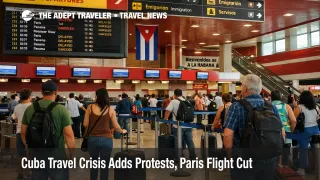
Cuba's travel crisis is no longer just an airport fuel story. On March 13, the U.K. Foreign, Commonwealth & Development Office updated its Cuba advice to add recent protests, repeat that severe fuel and power shortages are affecting transport, medical care, communications, and basic services, and confirm that Terminal 2 at José Martí International Airport (HAV) in Havana is closed with flights diverted to Terminal 3. It also says Air France will suspend flights between Paris and Havana from March 29 to June 14, with the last Havana to Paris departure scheduled for March 28. For travelers, that creates two separate decision windows, one for people already in Cuba dealing with degraded ground conditions now, and another for Europe linked itineraries that lose a nonstop option at the end of March.
This is the clearest escalation since we covered Cuba Fuel Shortages Hit Airport Operations, Tourism and, earlier, Cuba Jet Fuel Shortage Clouds March Travel Plans. The new value is not more vague warning language. It is that an official government advisory now ties recent protests to the same trip planning problem as airport fuel shortages and infrastructure stress, while also naming a specific Europe route suspension window that starts on March 29.
Cuba Travel Crisis: What Changed At Havana
The immediate operational picture in Havana is still centered on airport access and reliability. FCDO says all of Cuba's international airports are without aviation fuel, that Terminal 2 at José Martí International Airport has closed, and that flights using that facility have been diverted to Terminal 3. It also says some airlines, including all Canadian airlines and LATAM, have suspended flights to and from Cuba, with others still reviewing routes. That matters because HAV is the island's main international gateway, and terminal changes layered onto thinner airline service make same day plans less forgiving.
What changed since prior coverage is that travelers now have to account for protest risk as part of the same trip equation. FCDO says recent protests in Cuba have so far remained peaceful, but warns they can escalate and tells travelers to avoid large gatherings, monitor media, and follow local authority advice. In practice, that does not mean Havana is closed. It means a trip already weakened by fuel rationing, public service cutbacks, and airport strain now has one more variable that can disrupt movement, timing, and on the ground confidence with little warning.
Which Travelers Face The Most Exposure
The most exposed travelers are the ones who need Cuba to work like a precise, normal destination. That includes short stays, separate tickets, same day onward flights, cruise embarkations, guided tours with fixed joins, and resort itineraries built around a rigid airport transfer chain. Travelers coming from Europe, or relying on Paris as their cleanest long haul bridge into or out of Cuba, also face a sharper planning problem because Air France says its Paris to Havana service will stop from March 28 on the Paris side and resume June 15.
Travelers already in Cuba face a different exposure profile. FCDO says severe and worsening infrastructure disruption is affecting reliable transport, medical care, communications, and basic services, while authorities have introduced fuel rationing and scaled back public services. First order, that can show up as slower airport processing, weaker road transport reliability, and harder hotel logistics. Second order, it can break exit plans, compress rebooking options, and make a missed transfer or canceled sector harder to recover from than it would be in a better supplied destination.
The least exposed travelers are the ones with slack in the system. Nonstop passengers still on operating carriers, travelers with refundable rooms, those who can add a buffer night before an international departure, and anyone who can reroute without depending on a same day chain are in a much stronger position. That was already true when the fuel crisis first widened in February and early March. It is more true now because the protest variable makes local movement harder to treat as routine.
What Travelers Should Do Now
For trips happening now, or in the next several days, the threshold is simple. Keep the trip only if your airline is still operating, your hotel and transfer provider can confirm service in writing, and your schedule can absorb delay without breaking the rest of the itinerary. Restructure or postpone if you are relying on tight turnarounds, informal transport, limited medicine access, fragile communications, or a same day outbound international link. Travelers already in Cuba should also treat document validity, battery charge, fuel access, cash access, and an alternate departure plan as live operational needs, not backup items.
For Europe linked travel after March 29, the decision point is more concrete. If your routing depended on the Paris to Havana nonstop, you should not wait for the airport situation in Cuba alone to improve. You should look now at alternate gateways and protected routings, because FCDO says Air France will suspend the route through June 14, and AP reported the airline had already been refueling in the Bahamas before concluding the operation was no longer workable in current conditions.
Over the next 24 to 72 hours, watch three signals. First, whether official advisories soften or harden their language on protests and movement disruption. Second, whether more carriers extend suspensions or continue reviewing Cuban routes. Third, whether Havana's terminal setup normalizes, because as long as Terminal 2 remains closed and flight options stay thinner, Cuba travel crisis planning should be built around flexibility, not optimism.
Why The Cuba Travel Crisis Keeps Spreading
The mechanism is broader than one airline canceling one route. When aviation fuel is unavailable at destination airports, carriers have only a few options, they can tanker fuel in, add technical stops, reduce service, or suspend service altogether. AP reported Air France had been refueling in the Bahamas on return trips before deciding to suspend Paris to Havana flights. That is a good example of how a fuel shortage moves from airport operations into network decisions. The workaround can exist for a while, but once it stops making operational sense, the schedule disappears.
On the ground, the same crisis spreads through the traveler experience in layers. FCDO says fuel shortages and power outages are already affecting transport, healthcare, communications, and basic services, while authorities have scaled back public services and made temporary changes to transport and tourism operations. Add recent protests to that environment, and the issue becomes whole trip reliability. The first order effect is degraded access and weaker service certainty. The second order effect is that exit options, hotel operations, medical support, and rebooking resilience all get more brittle at the same time.
That is why this story deserves a second article. The March 13 update changes the traveler decision from "Can Cuba's airports fuel flights?" to "Can this full itinerary still survive a destination level reliability squeeze that now includes protest risk and a dated Paris pullout?" For many travelers, especially those tied to March 29 through mid June Europe connections, that is the point where leaving, postponing, or simplifying the trip becomes the smarter call.
Sources
- Cuba travel advice, GOV.UK
- Air France will suspend flights to Havana in a new blow to Cuba's tourism sector, AP News, March 4, 2026
- Canadian airlines suspend Cuba flights as island set to run out of jet fuel, Reuters, February 9, 2026
- Cuba says airlines can no longer refuel on the island as US blockade deepens energy crisis, AP News, February 9, 2026
- Cuba Fuel Shortages Hit Airport Operations, Tourism
- Cuba Jet Fuel Shortage Clouds March Travel Plans