

Gulf Cruise Cancellations Hit Europe Departures
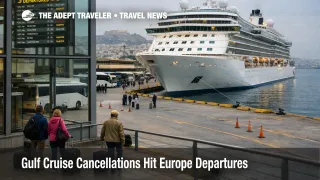
Gulf cruise cancellations have moved into a new phase. The story is no longer only about passengers stuck onboard or ships waiting for a safe way out of the region. It is now about a wider cancellation wave that is cutting remaining Arabian Gulf sailings and, in Celestyal's case, already spilling into March Mediterranean departures in Europe as repositioning plans slip. For booked guests, the practical question is no longer just how ships leave the Gulf. It is whether the spring cruise they thought was safely outside the crisis zone is still tied to a vessel that cannot get there on time.
This is the material change from earlier stranded-ship coverage. Celestyal said on March 9 that it canceled the March 20 and March 23 Iconic Aegean sailings on Celestyal Discovery while it finalizes operational arrangements for the ship's repositioning to the Mediterranean ahead of the summer season. MSC said the remaining three winter cruises from Dubai are now officially canceled. Trade reporting also says TUI Cruises has now canceled Mein Schiff 4 sailings through March 23, 2026, and Mein Schiff 5 sailings through March 12, 2026, after the ships remained trapped in the Gulf.
Gulf Cruise Cancellations, What Changed for Travelers
What changed is that the disruption has crossed from a regional operations problem into a deployment problem. Celestyal's update is the clearest proof because it explicitly links Gulf disruption to canceled March 20 and March 23 Greece sailings on Celestyal Discovery. That means a traveler booked on a near-term Mediterranean cruise now has to care about events in the Gulf even if their own embarkation port is in Greece, not Dubai, United Arab Emirates, or Doha, Qatar.
MSC's official update is narrower but still important. The line said the remaining three winter cruises from Dubai are canceled, which effectively ends the rest of that near-term Gulf program for MSC Euribia. TUI's position, as reported by Cruise Industry News, points the same way, with Mein Schiff 4 canceled through March 23 and Mein Schiff 5 through March 12. Operator by operator, the common pattern is that ships have not repositioned on schedule, and schedules outside the Gulf are now starting to absorb the delay.
Which Booked Guests Face the Most Risk
The most exposed travelers are not only those still booked on Gulf itineraries. They are also guests on immediate follow-on sailings that depend on a ship leaving the region, crossing into the Mediterranean, and starting a new seasonal program with almost no slack. Celestyal guests on the canceled March 20 and March 23 departures are already in that category, and travelers on later March sailings should keep watching for any further timetable changes if repositioning remains unresolved.
Cruise passengers with bundled airfare, hotel nights, and transfers have more to lose than cruise-only guests. Once a sailing disappears, the first order effect is obvious, the cruise itself is gone. The second order effects are where costs and friction build, because nonrefundable flights, pre-cruise hotels, port transfers, and privately booked shore plans do not always unwind automatically with the cruise line's cancellation notice. That is especially true for Europe departures where travelers may assume the regional war story no longer applies to them. In reality, the ship deployment chain still does.
Booked guests should also separate brand handling from geography. A Gulf cancellation does not automatically mean every Mediterranean sailing is at risk, and a Europe departure does not automatically mean safety conditions at the embarkation port are the problem. The exposure depends on whether that exact ship has repositioned, whether the operator has published replacement plans, and whether your cruise sits in the first few departures after the intended move. Earlier Adept coverage on U.S. Middle East Rescue Flights Become Main Exit Lane and UAE Border Congestion Complicates Overland Exits also shows how hard it has been for the region's broader transport system to normalize cleanly.
What Travelers Should Do Now
If your sailing has already been canceled, stop treating the cruise refund as the whole problem. Confirm whether airfare, hotel nights, airport transfers, travel insurance deadlines, and any visa or entry timing issues now need separate action. Celestyal says affected guests on the canceled March 20 and March 23 departures can choose a full refund or future cruise credit through their original travel provider. MSC says impacted guests are being contacted. That means the next move is administrative and fast, get the official cancellation record, then use it to unwind the rest of the trip.
If your sailing is still on the books but it sits immediately after a disrupted repositioning, lean toward active monitoring rather than passive waiting. Check the operator's travel update page, look at the exact ship assignment, and watch whether the vessel has actually left the Gulf or remains subject to further operational arrangements. The main decision threshold is timing. If you are within a few days of final payment deadlines for hotels or air, or you need to position long haul into Europe, you should be much less relaxed than a guest whose trip is later in the season.
Over the next 24 to 72 hours, watch for three things. First, whether any line expands cancellations beyond the currently published windows. Second, whether a cruise line rebooks guests onto another ship or simply offers refund and credit options. Third, whether Europe startup dates hold once ships begin repositioning. If those answers stay vague, the safer play is to avoid adding more nonrefundable trip elements until the ship movement problem is clearly resolved.
Why the Disruption Is Spreading Beyond the Gulf
The mechanism is straightforward. Cruise lines sell seasons, not isolated voyages. A ship finishing winter in the Gulf is often supposed to reposition directly into a Mediterranean spring program. When conflict, closures, or military guidance interrupt that exit, the damage does not stop with the stranded sailing. It pushes forward into the next deployment cycle, which is exactly what Celestyal has now acknowledged in its cancellation of March 20 and March 23 Mediterranean departures.
This is also why the operator by operator details matter more than a generic Gulf headline. MSC's official language points to the end of the remaining Dubai winter season. TUI's reported cancellations show different ships and different cutoffs. Celestyal is the clearest sign that Europe programs are now feeling the strain directly. Travelers should read this as a fleet-positioning story, not just a regional security story. The first order effect is canceled sailings. The second order effect is pressure on spring embarkation timing, air packages, hotel demand near embarkation ports, and the cost of rebuilding trips at short notice.
Sources
- Travel Updates | Celestyal Cruises
- Update MSC Euribia in Dubai | MSC Cruises
- Arabian Gulf Update: Cruise Lines Cancel Remaining Sailings in the Region | Cruise Industry News
- TUI Cruises Completes Evacuations from the Middle East | Cruise Industry News
- Celestyal, Aroya Announce Cruise Cancellations Amid War | Seatrade Cruise News