

U.S. Middle East Rescue Flights Become Main Exit Lane
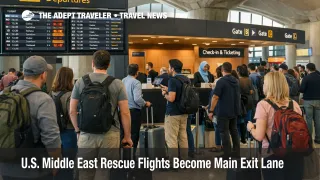
U.S. Middle East rescue flights have become the clearest organized exit channel for some stranded travelers, because the State Department says it has now arranged nearly 50 charter flights since the war with Iran began, even as officials say demand is easing and many Americans are still leaving on commercial tickets. That is the material change from earlier March 11 to 12 coverage focused on airline suspensions and airport access. The decision is no longer just which carrier might restart first. It is whether waiting for normal commercial recovery still makes sense, or whether a government managed departure is now the cleaner way out.
The practical map is still uneven. Reuters reported on March 5 that the State Department was facilitating charter flights from the United Arab Emirates, Saudi Arabia, and Jordan for U.S. citizens who needed help. At the same time, the department opened a crisis intake form for Americans in Kuwait, Bahrain, the United Arab Emirates, Qatar, Saudi Arabia, and Israel, so the government's managed channel is wider than the actual charter origin list publicly confirmed so far. In Israel specifically, U.S. Embassy alerts said Ben Gurion Airport was closed on March 2, and later said limited commercial options were operating out of Taba and Sharm al Sheikh, Egypt, which effectively turns some Israel departures into overland to Egypt first, then air onward.
Travelers should treat this as a managed outbound system, not a normal booking market. The first move is procedural. Register through the State Department crisis intake form if you are a U.S. citizen in one of the covered countries, enroll in STEP, monitor embassy alerts, and keep your passport, booking references, and onward U.S. or third country plans ready. State and embassy notices are also pushing travelers toward the 24/7 task force phone lines, and recent alerts in the UAE explicitly told Americans not to submit the intake form twice.
U.S. Middle East Rescue Flights, What Changed
What changed is not just the number of flights. It is the role those flights now play in traveler decision making. Reuters reported on March 12 that nearly 50 charters had been organized since February 28, and that demand was easing because more travelers were choosing commercial options where those were available. AP separately reported that the State Department authorized up to $40 million for evacuation flights and that Secretary of State Marco Rubio waived the usual repayment requirement, which removes one of the biggest frictions that often makes government assisted departures feel like a last resort.
That matters because normal recovery is still patchy. Some commercial corridors are reopening, but not evenly, and not with the kind of reliability most stranded long haul passengers need. Adept's own recent coverage already showed this pattern in the Gulf, where airports could be technically open while schedules stayed thin, airport access remained controlled, and travelers were told not to go to the terminal without confirmed documentation, including in earlier UAE disruption coverage such as Dubai Airport Flights Halted After March 7 Blast and Air Canada Extends Dubai, Tel Aviv Suspensions.
Which Travelers Should Lean Toward Charter, Commercial, Or Overland
The travelers most likely to benefit from the State channel are those in countries where the U.S. has opened the crisis intake form, those facing repeated commercial cancellations, and those whose next workable exit depends on official coordination rather than an open retail fare search. That includes people in Israel dealing with airport closure effects, travelers in Jordan or the Gulf whose commercial options are technically back but still thin, and anyone whose risk rises sharply if they spend multiple more nights waiting for airline recovery.
The documentation threshold is straightforward, even if seat assignment is not. You should assume you need a valid U.S. passport, embassy registration through STEP where possible, and the crisis intake form if your location is covered. Keep evidence of your current location, your contact details, your original itinerary, and any visa or entry permissions for the country you may transit next. In Israel and some surrounding corridors, overland exit may also require checking land border operating conditions before moving, because the exit plan may be road first and flight second.
The overland option is not a generic backup. It works only when the corridor itself is functioning and the onward airport still has capacity. That is why travelers should stop thinking in terms of "leave the country somehow" and instead think in linked segments, border crossing, airport access, confirmed onward seat, and overnight capacity if one segment slips. Jordan remains under a Level 3 advisory updated March 2, with the State Department citing armed conflict risks and significant commercial flight disruption, so even one of the cleaner overland ideas still carries operational risk.
What Travelers Should Do Now
Choose the U.S. charter channel if you are in a covered country, your commercial options have already failed more than once, your trip depends on a reliable outbound seat rather than a preferred routing, or your hotel, visa, or cash buffer is running thin. That is especially true if you are traveling with children, older relatives, prescription dependencies, or a complex onward itinerary in Europe or North America that is already breaking apart.
Lean toward commercial rebooking if you are already in a functioning hub, you have a confirmed seat on a carrier that is actually operating, you can absorb one more overnight, and you have flexibility on destination, baggage, or rerouting. State officials themselves said demand for charters is easing partly because some travelers preferred commercial flying for destination choice and luggage flexibility. That is a real advantage, but only if the flight is real, ticketed, and supported by a carrier that is no longer running on emergency changes.
Use overland exit only when you can verify all three links, the crossing is open, the receiving airport is functioning, and you have an onward seat or a defensible hotel buffer on the far side. In Israel, the embassy's March 5 notice pointing travelers toward limited flights from Taba and Sharm al Sheikh was useful, but only because it tied the road move to an actual outbound air option. A road transfer without that confirmed next leg is just moving the uncertainty.
Over the next 24 to 72 hours, monitor three things, not one. Watch embassy alerts for charter and intake guidance, watch your specific airline for actual operating status rather than schedule displays, and watch ground conditions around the airport or border you would use. The first order problem is still getting out. The second order problem is what happens once thousands of people chase a narrower set of workable exits, hotel inventory tightens, ground transport surges, and long haul rebooking queues in Europe and North America absorb another wave of disrupted passengers.
Why the Exit System Now Works This Way
The mechanism is simple. Normal airline recovery has not returned as one clean switch. Instead, the region is operating through a mix of airport restrictions, partial route resumptions, security alerts, repatriation flying, and selective commercial restores. In that environment, a government managed channel becomes valuable because it bundles information, eligibility screening, and seat allocation into one process for travelers who no longer have a functioning retail market around them.
This also explains why demand for charters can ease before the crisis fully clears. Once some commercial flying returns, travelers with money, status, flexibility, or lighter baggage often peel back into the open market. That leaves the charter system to carry the harder cases, people in weaker corridors, people who cannot risk another failed departure, and people whose viable path home now runs through embassy coordination. The result is that U.S. Middle East rescue flights are not replacing commercial travel everywhere. They are becoming the main exit lane exactly where commercial recovery is still too thin or too unstable to trust.
Sources
- US has arranged nearly 50 charter flights from Middle East amid Iran strikes, State Dept says
- State Department allows up to $40M to be used for evacuation flights for Americans in Mideast
- US charter flight repatriating Americans from Middle East, State Department says
- Thousands of Americans evacuated from Middle East on charter flights, State Department says
- Israel, The West Bank and Gaza Travel Advisory
- Jordan Travel Advisory
- Worldwide Caution
- Middle East Airspace Closures Ground Gulf Hubs
- Dubai Airport Flights Halted After March 7 Blast
- Air Canada Extends Dubai, Tel Aviv Suspensions