

UAE Border Congestion Complicates Overland Exits
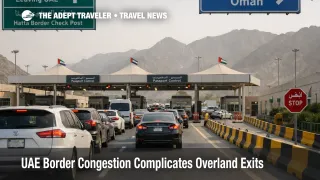
UAE border congestion is now a separate travel risk, not just an airport side inconvenience. On March 13, 2026, the U.S. mission said there are reports of congestion at border crossings and warned that both Oman and Saudi Arabia continue to enforce visa requirements, which means a last minute road exit from Dubai, United Arab Emirates, or Abu Dhabi, United Arab Emirates, can fail even if a traveler finds a seat from the other side. What changed since UAE Airport Access Tightens for Stranded Travelers is that the weak point is now the land border layer itself, where queues, document checks, and entry eligibility can break the plan before the onward flight even starts. Travelers considering a road move should treat the border as a full travel day, not a quick transfer, and should only go once the visa, vehicle, and onward booking chain is already locked.
The nut of it is simple. UAE border congestion now matters because the fallback route out of the country is no longer just about getting to Oman or Saudi Arabia, it is about surviving a border process that can consume enough time and certainty to wreck the next ticket.
UAE Border Congestion: What Changed for Travelers
The new operational fact is that official U.S. guidance now explicitly flags congestion at crossings while also reminding travelers that Oman and Saudi Arabia still enforce their own entry rules. That is a meaningful shift from earlier UAE coverage, where the main problem was airport access, confirmed ticket checks, and unstable flight recovery. Road exit is still possible, but it is no longer a clean improvisation play for stranded travelers trying to outrun airline uncertainty by car.
For Dubai based travelers, the most obvious Oman route is still the Hatta, UAE, to Al Wajajah, Oman, corridor. For Abu Dhabi based travelers, the Al Ain side crossings remain more practical in pure geography terms, and Adept's earlier UAE Oman Border Crossings Offer Overland Exit identified Hatta, Khatma Malaha, and Khatm Al Shikla as named fallback crossings from earlier official guidance. The Saudi side is more concentrated, with the main overland lane from the UAE running west through Al Ghuwaifat, UAE, to Al Batha, Saudi Arabia, on the road toward the Eastern Province and Riyadh.
That geography matters because same day escape plans often assume border formalities are a predictable road stop. They are not. Even when the crossing is open, the onward airport may still be several hours away, and any delay at the checkpoint can roll straight into a missed departure, extra hotel night, or a new walk up fare. In practical terms, a ticket from Muscat International Airport (MCT), Oman, or a Saudi gateway only helps if the whole land segment still has enough slack to absorb slow processing.
Which Road Exit Plans Are Most Exposed
The most exposed group is travelers trying to build a same day border run around a flight they bought on a separate ticket. That structure leaves little protection if the car transfer slips, the border queue stalls, or a document issue stops entry. It is even weaker for families, travelers with medical needs, or anyone carrying a complicated onward chain such as a Europe or North America long haul departure that does not have many backup frequencies.
The visa mistake travelers keep underestimating is assuming "open border" means "friction free entry." Oman's Foreign Ministry says U.S. citizens are in the first country group eligible for visa free entry, but the same page also says visitors must hold a passport valid for at least six months, plus a return ticket, confirmed hotel reservation, health insurance, and sufficient funds, while the 14 day stay cannot be extended or converted. That means Oman can work well for some travelers, but only if they can satisfy the full arrival conditions, not just show up at the booth.
Saudi Arabia is less forgiving as a spontaneous fallback for many travelers. Saudi's official tourist visa system says the United States is on the list of permitted countries for the eVisa, and that the eVisa is a multi entry authorization for short stays, but it also says applicants need a valid passport with at least six months remaining and that holding an eVisa still does not guarantee entry, which remains subject to conditions on arrival and officer discretion. In plain language, Saudi can be a viable road exit for eligible travelers who have completed the paperwork, but it is a poor same hour pivot for anyone who still needs to sort out visa status while already under time pressure.
A second layer of exposure is destination risk after the crossing. Saudi Arabia's March 13, 2026, U.S. advisory still says commercial flights are operating but significantly disrupted, and that the U.S. government's ability to provide emergency services is limited due to safety risks. So even a successful Saudi road crossing does not automatically deliver a clean onward exit. It only moves the traveler into a different, still disrupted air market.
What Travelers Should Do Before Leaving by Road
Start with a document audit, not a hotel checkout. Before getting in a car, travelers should confirm passport validity, destination entry eligibility, whether an Oman or Saudi visa is already approved if required, whether the driver and vehicle documents are acceptable for the route, and whether the onward flight from the other side is actually ticketed and still operating. If any one of those pieces is soft, the road plan is still too speculative.
The right transfer buffer is larger than many people want to hear. For an Oman departure, travelers should think in terms of a full day buffer between the road move and the international flight unless they are already very close to the border and have strong visibility on queue conditions. For Saudi departures, the safer assumption is an even longer buffer because the crossing is farther from Dubai and Abu Dhabi, the drive itself is longer, and the onward disruption picture is not clean. A same day border run only makes sense when the traveler already has verified entry rights, a robust driver plan, and enough slack to lose several hours without losing the flight.
The decision threshold is straightforward. Waiting in the UAE still makes more sense if you already hold a usable confirmed seat, your airline is communicating clearly, and the next 24 hours offer a plausible airport departure path. Road exit makes more sense when you do not have a reliable commercial option from the UAE, your trip has a hard timing point that cannot absorb another day of drift, and the full border to airport chain on the Oman or Saudi side is already secured. Travelers comparing that choice should review UAE Airport Access Tightens for Stranded Travelers and keep Middle East Airspace Reopens, Closures Stay Fluid in mind, because partial recovery is still not the same as normal Gulf hub reliability.
Why the Border Problem Spreads Beyond the Border
The mechanism here is simple. Once airport access tightens and flight recovery stays uneven, travelers start substituting road exits for air exits. That pushes more demand onto a smaller set of land corridors, especially the Dubai to Oman lane and the UAE to Saudi corridor. Border infrastructure then becomes the new choke point, and border friction behaves differently from airport disruption because a passenger cannot usually refresh the plan on the fly once they are already in transit by road.
First order, the traveler loses time at the crossing. Second order, that lost time ripples outward into missed flights, more expensive private transfers, extra hotel nights, and harder insurance conversations if the reroute was self arranged and built on separate bookings. That is why the road option still has value, but only as a controlled, documented move, not as a panic escape. The border is now part of the ticketing problem, not just the drive.
Sources
- U.S. Mission to the United Arab Emirates, March 13, 2026
- United Arab Emirates Travel Advisory, U.S. Department of State
- Entry Visas, Foreign Ministry of Oman
- Saudi eVisa Terms and Conditions, Visit Saudi
- Saudi Arabia International Travel Information, U.S. Department of State
- UAE Airport Access Tightens for Stranded Travelers
- UAE Oman Border Crossings Offer Overland Exit
- Middle East Airspace Reopens, Closures Stay Fluid