

Delta Midwest Weather Waiver Hits MSP Feeder Routes
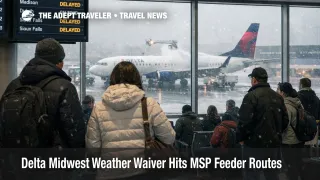
Delta's March 14 to 15 Midwest waiver has turned Sunday, March 15, into a planning day for Upper Midwest flyers, not just a wait and see weather day. The airline's advisory covers Minneapolis, Milwaukee, Madison, Green Bay, Des Moines, Omaha, Sioux Falls, and a long list of smaller regional stations, while allowing eligible travelers to rebook and start new travel by March 22 without a change fee, with fare differences waived in qualifying cases. For travelers, the practical issue is that smaller spoke airports usually fail first, and once those feeder flights slip or cancel, the damage spreads into hub connections, missed onward banks, and weaker same day recovery options.
That matters even more on March 15 because the weather footprint is not a simple single airport snow story. National Weather Service offices across Minnesota, Wisconsin, and Iowa were warning of blizzard conditions, freezing rain, heavy snow, strong winds, and very dangerous to impossible travel in parts of the region into Monday, with the worst impacts broad enough to hit both the drive to the airport and the flight schedule itself.
The Delta Midwest weather waiver is useful only if travelers act before the weakest link breaks. If your trip depends on a regional first leg into Minneapolis, St. Paul International Airport (MSP), or another hub connection later in the day, rebooking early can save the itinerary in ways waiting often cannot.
Delta Midwest Weather Waiver: What Changed for March 15
What changed is that Delta moved beyond generic storm caution and put a large Upper Midwest waiver in place for travel on March 14 and March 15, covering airports from Minneapolis and Milwaukee to smaller stations such as Brainerd, Rhinelander, Watertown, and Wausau. Eligible customers with tickets issued on or before March 13 can rebook through March 22, and Delta also said it was proactively canceling flights at affected Midwest airports, including its Minneapolis hub, ahead of the worst conditions.
For March 15 flyers, that is the real shift. This is no longer only a forecast problem. It is an active airline recovery problem forming before the full day's operation is complete. In southern Minnesota, the National Weather Service warned of blizzard conditions late Sunday into Monday, while Wisconsin offices warned of freezing rain, near blizzard conditions, several inches of snow in the south, much higher totals farther north, and wind gusts strong enough to cut visibility sharply. In parts of Iowa, the weather service said travel could become very dangerous or impossible at times as snow, wind, and drifting intensified.
Which Travelers Face the Most Disruption
The most exposed travelers are not necessarily the ones starting at the biggest airport. They are the ones beginning on a smaller feeder route and depending on one clean connection through MSP or another banked hub. A traveler leaving Sioux Falls, South Dakota, Madison, Wisconsin, Green Bay, Wisconsin, or Des Moines, Iowa, has less slack than someone already originating at a large hub with multiple later departures. Once the spoke flight misses its slot, the hub may still be operating, but the itinerary is already broken.
Spring break timing makes that more expensive. If the missed connection sits at the front of a beach, cruise, family, or event trip, a small regional cancellation can turn into an extra hotel night, a rental car pivot, or a forced next day departure at much higher fares. Adept's recent Flight Delays and Airport Impacts: March 14 and U.S. Shutdown Risk Raises Spring Break Airport Strain both matter here, because weather disruption is landing on top of a March system that already has less room for recovery at busy airports.
There is also a different risk split between hub travelers and spoke travelers. At MSP, the main problem is bank compression, inbound aircraft arriving late, and a thinner same day recovery menu once the first wave slips. At smaller stations, the problem is more basic, whether the first segment operates at all, and whether the road to the airport is reliable enough to make a marginal flight worth chasing. When weather offices are using language like avoid travel, dangerous travel, or impossible travel, the airport is only one part of the decision.
What Travelers Should Do Now
The immediate move is to decide whether protecting the trip matters more than preserving the original schedule. If you are booked on a feeder flight into MSP or another connection bank later on March 15, and you still have access to Delta's waiver, the safer play is to rebook earlier, move to a nonstop, or shift the whole trip to Monday or later if the trip purpose allows. Waiting makes more sense only if your itinerary is nonstop, your destination is flexible, and missing the day would not be costly.
Driving or overnighting becomes the better option at a fairly clear threshold. If your regional first leg has only one or two realistic departures, if your connection is the last practical bank of the day, or if local road conditions are already poor enough that getting to the airport is its own gamble, stop treating the ticket as the only plan. An overnight near the hub, or even a controlled drive to a larger airport when roads remain workable, can be cheaper than absorbing a missed hub bank and a distressed rebooking later. That tradeoff gets stronger for cruise embarkations, tours, weddings, and other hard start trips.
Over the next 24 hours, watch three things. First, whether Delta expands cancellations beyond the initial set it announced on March 13. Second, whether local weather offices keep escalating from advisory language into broader avoid travel messaging near your origin airport. Third, whether your inbound aircraft and first segment remain on time in the airline app, because once the feeder leg moves off schedule, the rest of the day usually gets harder, not easier. For bigger system context, U.S. Air Traffic Control Privatization: Reality Check is worth reading alongside this waiver story, because it explains why a constrained network has less resilience when several pressure points stack together.
Why Smaller Spokes Break the Day First
The mechanism is simple. Big hubs get the attention, but regional spokes often determine whether the rest of the itinerary survives. Delta's waiver map includes many smaller Upper Midwest airports because those stations are exposed to the same snow, ice, and wind pattern, but they usually have fewer daily flights, less spare aircraft capacity, and fewer easy reaccommodation paths than a hub. When one feeder cancels, passengers do not just arrive late. They miss the flight bank the whole ticket was built around.
Weather is also not hitting every place in the same way. Southern Minnesota is dealing with blizzard risk and blowing snow. Southern Wisconsin faces a mix of snow, freezing rain, strong winds, and near blizzard conditions in some areas. Northern and central Wisconsin face heavier snow and whiteout risk, while parts of Iowa are seeing snow, very strong winds, and significant drifting. That mix matters because ice can slow airport access and turn times, while wind and snow reduce visibility, runway efficiency, and the reliability of short regional operations.
The first order effect is late or canceled departures from smaller cities. The second order effect is what travelers actually feel, missed connections at MSP, fewer open seats on later banks, pricier last minute hotel stays, and next day disruption spilling into Monday even for people who never fly through the worst weather core. That is why the Delta Midwest weather waiver matters now. It gives travelers one of the few chances to move before the spoke failure becomes a hub failure.
Sources
- Midwest Winter Weather, Delta Air Lines
- Delta cancels flights ahead of winter weather in Midwest, affected customers encouraged to move flights at no charge
- Blizzard Conditions Expected Late Sunday Afternoon into Monday Across Southern Minnesota
- Area Forecast Discussion, NWS Milwaukee/Sullivan, WI, issued March 15, 2026
- Weather Story, NWS Green Bay, WI
- WWA Summary for All Issued by ARX