

U.S. Shutdown Risk Raises Spring Break Airport Strain
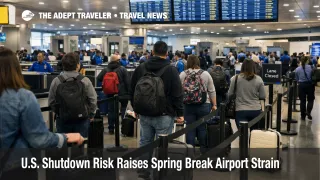
The U.S. shutdown warning has become a spring break operations story, not just a Washington funding fight. Reuters reported on March 5 that airline and travel groups now see a real risk that the ongoing partial shutdown could snarl air traffic as the busiest March travel surge approaches, with about 50,000 TSA airport security screeners working without pay and industry leaders warning that the first full zero paycheck on March 13 could become the real stress point. Travelers flying over the next week should not assume the system has to collapse before their trip gets harder. The more likely problem is a slower, uneven slide into longer security lines, tighter check in timing, and less recovery room when weather or a late inbound flight goes wrong.
U.S. shutdown airport delays are most likely to show up first as variability, not a dramatic nationwide stoppage. That matters because spring break demand is already heavy. Airlines for America says U.S. airlines expect 171 million passengers from March 1 through April 30, 2026, with roughly 2.8 million passengers and about 26,000 daily passenger flights, which means even small staffing gaps at a checkpoint or federal inspection point can spread quickly through the day's flight banks.
U.S. Shutdown Airport Delays: What Changed
What changed since earlier shutdown coverage is the tone and timing. This is no longer only an industry push to protect TSA pay in principle. Reuters reported on March 5 that airline and travel groups are now explicitly warning of near term operational harm as spring break ramps up, while U.S. Travel and other industry groups launched a new "Pay Federal Aviation Workers" campaign the same day. That shift matters because it ties the shutdown directly to immediate traveler pain points, not just long term policy debate.
The first visible failure point is usually the checkpoint, because that is where staffing stress becomes public fastest. Fewer available officers can mean fewer open lanes, slower bag and ID processing, and longer queues that build in bursts around morning and midday peaks. The second failure point is the cut line travelers do not see, check in and bag drop timing. When security lines stretch, passengers who would normally be "fine" can miss a checked bag cutoff, reach the gate after boarding closes, or lose a connection that looked safe when they booked it. That is why airport strain often feels worse than the raw delay numbers suggest.
A related issue is that the shutdown is already reducing some efficiency tools. Airlines for America says DHS suspended Global Entry processing on February 21, and DHS later said that as of 6:00 a.m. on February 22, U.S. Customs and Border Protection halted Global Entry arrival processing as part of emergency shutdown measures. That does not directly slow every domestic departure, but it removes one buffer on the arrivals side and can add pressure where international passengers are trying to clear the airport and reconnect.
Which Travelers Face the Most Spring Break Risk
The most exposed travelers are not necessarily the ones flying through the biggest hubs, they are the ones with the least slack in the itinerary. A family trying to make a once a year beach trip with checked bags, a college traveler on a low cost carrier with one daily nonstop, or a passenger connecting from a smaller city into a banked hub all have less room for a slow checkpoint or a short rolling delay. If the first segment slips, the rest of the trip can unravel quickly, especially where later same day options are limited.
International arrivals are exposed in a different way. With Global Entry paused, returning passengers should expect standard processing on arrival, which can turn a legal but tight onward domestic connection into a bad bet. Travelers who normally rely on expedited entry should treat that buffer as gone until DHS restores the program. Adept has already covered that split in Global Entry Paused, TSA PreCheck Stays On in Shutdown, and the operational logic still holds.
The next group to watch is travelers flying during peak spring break windows at airports already expecting heavy volume. Houston's airports, for example, are preparing for about 2.2 million travelers from March 5 through March 16, a useful reminder that the shutdown is colliding with a calendar driven surge, not an ordinary travel week. In that kind of environment, a modest staffing wobble can be enough to turn "get there two hours early" from generic advice into the difference between making the trip and missing it.
What Travelers Should Do Now
For the next week, the practical play is to buy time before you leave home, not after the line has already formed. For domestic flights, travelers should lean toward arriving earlier than their normal habit, especially if they are checking bags, traveling in a group, or flying during early morning departure banks. For international departures, the case for extra buffer is stronger because a slow checkpoint is only one part of the airport process. If your trip has a hard start, such as a cruise embarkation, wedding, tour, or conference, the safer move is to protect the front end of the itinerary now rather than trust same day recovery.
Decision thresholds matter. If you have a tight domestic connection on one ticket and there is a later flight to the same destination, keeping the trip may still be rational. If you are connecting from an international arrival, flying on separate tickets, or depending on the last flight of the day, the threshold to rebook into a longer connection or an earlier departure should be much lower. Travelers who have not looked at their airline's same day change rules yet should do that before they leave for the airport, because a plan is more useful when it exists before the first disruption hits.
Over the next several days, watch three things, not one. First, monitor whether the shutdown continues past the March 13 zero paycheck point cited by industry groups. Second, watch for airport specific signs such as longer published checkpoint waits, slower bag drop, or reports of fewer open lanes. Third, watch for interacting stressors like weather, because a strained airport system handles ordinary disruptions worse than a fully staffed one. Adept's earlier US Shutdown: TSA Pay Protection Campaign Presses Congress piece covered the policy push, but the traveler decision now is more practical, add time, avoid fragile connections, and do not mistake a still operating airport for a low risk itinerary.
Why the Shutdown Spreads Through Travel
The mechanism is simple, even if the visible effects are uneven. TSA officers, CBP personnel, and other essential aviation workers may keep reporting to work during a shutdown, but unpaid work increases the risk of call outs, attrition, morale damage, and staffing gaps. Acting TSA leadership warned lawmakers in February that the agency was trying to prepare surge staffing for March, April, and May, while also noting that around 1,110 transportation security officers left TSA in October and November 2025 after the last 43 day shutdown, more than 25 percent above the same period in 2024. That does not guarantee a repeat at the same scale, but it explains why the industry is warning before the worst lines appear.
The second order effects matter because they are what travelers actually feel. A slower checkpoint means passengers reach gates later and airlines hold fewer recovery options in reserve. A paused Global Entry program means some international arrivals take longer to clear, which can break onward connections and crowd rebooking desks. A slightly weaker staffing posture also means weather or a late inbound flight can do more damage than it would in a fully funded, fully staffed system. In other words, the shutdown does not need to create a headline grabbing crisis to make spring break trips less reliable. It only needs to remove enough slack from a busy system that normal friction starts cascading.
Sources
- Airline and travel groups warn of risks to air traffic as partial shutdown persists
- U.S. Airlines Prepare for Record Number of Passengers this Spring Amid Government Shutdown
- America's Leading Travel Organizations Launch "Pay Federal Aviation Workers" Campaign
- 1 Week into Democrats' Shutdown, DHS Implements Emergency Measures to Conserve Resources and Protect Homeland Security Missions
- TSA officers get fraction of pay as government shutdown drags