

Flight Delays and Airport Impacts: March 14
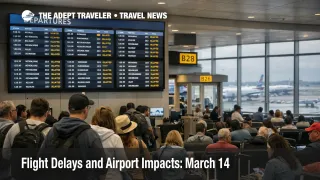
The U.S. flight picture on Saturday, March 14, is more of a targeted delay day than a systemwide meltdown. The FAA's public daily report page was still showing Friday's March 13 outlook as of Saturday, but the FAA's March 14 operations advisory pointed to wind in Boston, New York, Philadelphia, and Denver, low visibility at San Francisco, and snow or low visibility at Minneapolis, with a possible LaGuardia ground stop later in the day. For travelers, that means the biggest risk is not blanket cancellations at every major hub. It is uneven delay pockets, especially in New York, plus knock on schedule compression if conditions worsen into the afternoon and evening.
As of the FAA's latest airport status updates available during reporting, most major airports on the watch list were still operating with only minor general delays, but John F. Kennedy International Airport (JFK) was already showing 16 to 30 minute departure delays that were increasing because of traffic management initiatives. Travelers flying this afternoon should treat that as the clearest live warning sign in the national system right now, especially if they are connecting through the New York metro area or banking on a tight same day onward flight.
March 14 Flight Delays: What Changed
What changed on March 14 is that the FAA's live planning shifted from Friday's broad high wind warning into a more specific Saturday operations picture. The March 14 advisory flagged terminal constraints at Boston Logan International Airport (BOS), the New York terminal area, Philadelphia International Airport (PHL), and Denver International Airport (DEN) because of wind, Minneapolis, St. Paul International Airport (MSP) because of snow and low visibility, Austin Bergstrom International Airport (AUS) and San Antonio International Airport (SAT) because of low ceilings, and San Francisco International Airport (SFO) because of low visibility. It also said a ground stop or delay program was possible at DEN after 300 p.m. UTC, at SFO after 330 p.m. UTC, and at LaGuardia Airport (LGA) after 7:00 p.m. UTC.
That matters because the FAA is not signaling one dominant failure point. It is signaling multiple smaller constraints that can compound across the day. New York is especially important because even when Newark Liberty International Airport (EWR) and LaGuardia are still posting only minor general delays, the region's airspace is dense enough that a modest traffic management initiative at JFK can bleed into connection planning and aircraft rotations. JFK was already showing gate hold and taxi delays of 16 to 30 minutes and increasing, while BOS, EWR, PHL, DEN, and MSP were still reporting only delays of 15 minutes or less in the FAA status system.
Which Travelers Face the Most Airport Impact
The most exposed travelers on Saturday are people connecting through the New York metro system, travelers heading to or from Denver and San Francisco later in the day, and anyone with spring break style itineraries that depend on one clean connection rather than a long buffer. The FAA advisory also showed active flow constraints tied to Florida traffic, Caribbean snowbird flows, and ski country volume, which means leisure demand is already part of the operational picture, not just weather.
There is also a second tier of exposure that matters even if your departure airport looks normal. A delay day like this spreads first through traffic management, gate holds, and spacing programs, then into missed inbound aircraft turns, tighter crew sequencing, and weaker rebooking options later in the afternoon. That is why the live FAA airport status pages can still look fairly calm while the national advisory language points to a rougher operating day ahead. In practical terms, travelers on the first flight out are in a better position than travelers departing after midday, and travelers with nonstop itineraries are in a better position than those relying on a single hub connection.
Washington area travelers are in a different category today. Friday evening's Potomac TRACON chemical odor event temporarily halted traffic at Ronald Reagan Washington National Airport (DCA), Washington Dulles International Airport (IAD), Baltimore/Washington International Thurgood Marshall Airport (BWI), and Richmond International Airport (RIC), but the FAA lifted the stop after the overheated circuit board was replaced. By Saturday, IAD and BWI were back to only minor general delays in the FAA status system, so the March 14 decision issue is residual recovery risk for some aircraft and crews, not an ongoing regionwide shutdown.
What Travelers Should Do Now
For travelers flying on March 14, the immediate move is to protect the parts of the trip that are hardest to recover. Check your inbound aircraft if your airline app shows it, arrive early enough that a slower check in or checkpoint does not become the real reason you miss the flight, and be more skeptical than usual about short connections through JFK, LaGuardia, Denver, or San Francisco. If you are connecting in New York, the safest adjustment is to give yourself more time on the ground rather than assume a 20 minute delay stays a 20 minute delay.
The rebook versus wait decision is fairly straightforward today. Wait if your flight is nonstop, your airport is still showing only minor general delays, and you have schedule flexibility at the destination. Rebook earlier, or switch to a nonstop, if you are connecting through a constrained hub late in the day, need to reach a cruise embarkation, tour join, wedding, or other hard time commitment, or see your first delay stack onto a late inbound aircraft. Travelers at JFK should take the warning more seriously than travelers at BOS, EWR, ORD, PHL, DEN, or MSP right now, because JFK is the only major airport in the FAA status pages already showing a clear 16 to 30 minute and increasing departure delay signal.
Over the next several hours, watch for three things. First, whether the FAA converts its planned programs into active ground stops or delay programs at LaGuardia, Denver, or San Francisco. Second, whether New York delays spread from JFK to the wider metro system. Third, whether spring break volume and the ongoing DHS funding strain create slower airport processing even where runway operations stay mostly intact. Adept readers following this trend should also see Senate Blocks DHS Bill, TSA Shutdown Strain Grows and the earlier context piece U.S. Shutdown Risk Raises Spring Break Airport Strain, because today's weather and traffic programs are landing on top of an already tighter airport operating cushion.
Why These Delays Spread Even When Most Airports Look Normal
The key mechanism on March 14 is traffic management, not mass closure. The FAA advisory points to wind, low visibility, snow, and high leisure volume as the inputs. Once those constraints reduce spacing efficiency at one hub or in one major terminal area, the system reacts by slowing departures at origin airports, holding aircraft at gates, and metering arrivals in the air. That protects safety, but it also creates the traveler experience of a normal looking terminal with a growing number of flights that are just late enough to break connections and compress later aircraft turns.
This is why a day with many airports still reporting only delays of 15 minutes or less can still produce real trip friction. First order, the affected airport loses throughput. Second order, inbound aircraft reach their next assignment late, crews lose slack, and airlines have fewer clean recovery options for passengers who miss onward flights. The same logic applies to Friday's Washington disruption. The original problem was an odor event at a radar approach control facility, but the real traveler consequence was hours of downstream disruption after the stop itself was lifted. On March 14, weather and traffic programs are the trigger instead of a facility incident, but the spread pattern is similar.
Sources
- FAA Daily Air Traffic Report
- FAA Current Operations Plan Advisory, March 14, 2026
- FAA Airport Status, John F. Kennedy International Airport (JFK)
- FAA Airport Status, LaGuardia Airport (LGA)
- FAA Airport Status, Newark Liberty International Airport (EWR)
- FAA Airport Status, Boston Logan International Airport (BOS)
- FAA Airport Status, Philadelphia International Airport (PHL)
- FAA Airport Status, Denver International Airport (DEN)
- FAA Airport Status, Minneapolis, St. Paul International Airport (MSP)
- Reuters, FAA lifts D.C. area ground stop after odor event
- AP, chemical smell halts flights at four D.C. area airports