

Türkiye Protests Slow Istanbul, Ankara Transfers
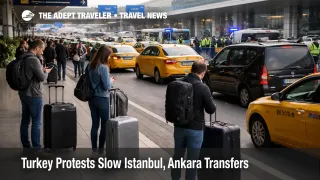
Türkiye protest transport delays have become a real itinerary problem, not just a background security warning. The U.K. Foreign, Commonwealth & Development Office says regular demonstrations are taking place in Istanbul and other cities across Türkiye, that some can become violent, that police have used tear gas and water cannons, and that local transport routes may be disrupted, especially around diplomatic missions in Ankara and Istanbul. For travelers, that shifts the decision from general caution to route planning, because airport runs, hotel pickups, guided tours, and evening plans can all fail without the airport itself ever closing.
The practical takeaway is straightforward. Travelers moving through Istanbul, Türkiye, or Ankara, Türkiye, over the next several days should avoid narrow transfer buffers, treat appointments near diplomatic districts as fragile, and keep a same day fallback for airport and city center moves. The main risk is not nationwide paralysis. It is localized congestion, rerouting, and police controls that make normal road times unreliable at exactly the moment a traveler needs them to hold.
Türkiye protest transport delays now matter because official advice ties the protest pattern directly to movement. That is the part that breaks trips. A traveler does not need to join or even see a demonstration to miss a flight or a timed reservation if a single corridor tightens around a diplomatic mission, a security perimeter, or a crowd management zone.
Türkiye Protest Transport Delays: What Changed
What changed is the precision of the warning. FCDO is not just saying protests happen in Türkiye. It says regular demonstrations are currently taking place in Istanbul and other cities, that they may become violent, that police responses have included tear gas and water cannons, and that local transport routes may be disrupted, especially around diplomatic missions in Ankara and Istanbul. That turns a broad safety note into an operational transport story for visitors using cars, taxis, hotel transfers, and guided road based touring.
The time window also matters. Türkiye's main FCDO page was updated on March 1, 2026, and remained current on March 15, 2026, so this is not stale archive language. It sits inside a wider regional risk environment that FCDO says has already led to travel disruption, which makes surface transport reliability more important for travelers trying to protect onward flights or multi stop itineraries.
Which Travelers Face the Most Disruption
The most exposed travelers in Istanbul are those relying on road moves into or out of consular districts, those with fixed hour museum or tour bookings after a hotel pickup, and anyone trying to stack a city day onto a same day airport transfer. FCDO's warning does not name every affected street, so travelers should not assume citywide shutdown. But it does identify diplomatic mission areas as the main pressure points, and official consular locations show why that matters. The British Consulate General sits in Tepebaşı, Beyoğlu, while the U.S. Consulate General is in İstinye, Sarıyer, two very different parts of Istanbul's road network that can complicate cross city movement when security posture tightens.
In Ankara, the clearest exposure is around the embassy district in Çankaya, where official foreign mission sites place the U.S. Embassy and the Israeli Embassy. That matters less for leisure sightseeing than for visa, consular, business, and driver based trips that depend on predictable access to central government and diplomatic zones. A traveler can still be nowhere near a protest and lose time if police management, diversions, or crowd controls tighten around those approaches.
The traveler types most likely to get caught out are same day arrivals with prepaid transfers, cruise or tour passengers using fixed coach schedules, business travelers with appointment windows, and short stay visitors who assume Istanbul or Ankara can absorb one more stop before departure. That assumption is the real failure point. When protest risk is localized, itineraries fail one segment at a time. A late car becomes a late hotel arrival, then a missed dinner booking, then a tighter airport run the next morning.
What Travelers Should Do Now
For airport moves, treat normal timing as outdated on any day with visible demonstrations, heavier police presence, or local alerts around diplomatic areas. In Istanbul, that means being more cautious with transfers between central hotel zones and either Istanbul Airport (IST) or Sabiha Gökçen International Airport (SAW). In Ankara, it means protecting the road leg to Ankara Esenboğa Airport (ESB) if your day also includes time in central districts. Leave earlier than usual, confirm your driver's planned route before departure, and avoid building one last appointment into the same travel block as an airport run.
The decision threshold is simple. If your itinerary depends on one car journey happening at a fixed hour, add buffer or break the sequence. Travelers with early departures should seriously consider overnighting closer to the airport instead of trusting a full city crossing the same day. Travelers with consular, business, or guided tour appointments near diplomatic areas should plan an arrival window, not an arrival minute. That is the difference between a manageable slowdown and a broken day.
The next thing to monitor is not just whether protests continue, but whether official advisories become more location specific. Right now, the public warning is useful because it identifies the type of exposure, diplomatic mission zones and local transport disruption, but it does not map every affected corridor. That means travelers should watch local authority updates, their airline or transfer operator, and mission alerts on the day of movement, especially before leaving for the airport or a fixed time appointment. Related Adept coverage such as Metro Manila Protests Raise Airport Timing Risk, Rome, Milan Protests Snarl Weekend Transfers, and Istanbul Victory Day Closures Hit Vatan Street, Aug 24, 30 shows the same basic rule, trips usually break on the ground before they break in the air.
Why The Disruption Spreads Through Travel
The mechanism is simple. Demonstrations do not need to close an airport, a station, or a hotel to damage a trip. They only need to slow the roads that connect those assets. Once police establish security perimeters, meter traffic, block turning movements, or reroute vehicles around a diplomatic site, travel time becomes less predictable. That uncertainty spreads outward fast in big cities because the same road network also carries airport transfers, tour coaches, ride hail pickups, dinner traffic, and hotel arrivals.
That is why the second order effects matter more than the headline. First order, one corridor slows. Second order, a traveler misses check in, loses a timed tour slot, pays for an extra hotel night, or has to rewrite a whole evening because the city center move took twice as long as expected. Türkiye protest transport delays are therefore less about whether protests exist, and more about whether your itinerary can survive one broken surface segment. The safest response is not panic. It is wider buffers, fewer same day dependencies, and better attention to the exact district you need to enter before you set out.