

Rome, Milan Protests Snarl Weekend Transfers
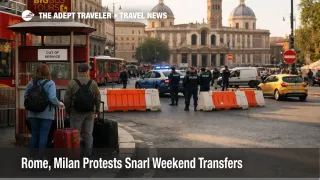
Rome and Milan just became a more practical weekend mobility story for travelers, not because Italy issued a broad national disruption warning, but because the U.S. mission in Italy flagged demonstrations for March 14 and 15, 2026, and Rome already has visible tourism and road impacts. In Rome, the embassy alert specifically tells people to avoid Piazza della Repubblica, Via Cavour, Piazza di Santa Maria Maggiore, Via Merulana, and Piazza di Porta San Giovanni, while Big Bus Tours Rome says stops at Termini Railway Station and Basilica Santa Maria Maggiore will close from 200 p.m. on March 14 and Circo Massimo will close from 130 p.m. to 5:30 p.m. on March 15 because of protest related road closures. Travelers moving through central Rome this weekend should build extra buffer, avoid fixed road pickups inside the protest footprint, and keep station and hotel arrival plans flexible.
The practical difference from a generic demonstration watch is that this one already has transport teeth. Rome's affected streets sit on the seam between tourist heavy districts, Roma Termini, the Santa Maria Maggiore area, and routes that many drivers use to reach hotels, tours, and onward station connections. Milan is less specific in the public detail now available, but the U.S. Consulate says it is aware of planned demonstrations on March 14 and 15, and Milan's city mobility page separately shows a Saturday march assembling at 2:30 p.m. around Corso Sempione and Piazza Firenze, which is enough for travelers to treat central cross town surface movements as less reliable than normal.
Rome Milan Protest Travel: What Changed
What changed since prior Italy protest coverage is that Rome now has named corridors and confirmed tourism service cuts, not just a vague safety advisory. The Rome alert covers a chain from Piazza della Repubblica down Via Cavour, around Santa Maria Maggiore, through Via Merulana, and toward Piazza di Porta San Giovanni. That matters because the corridor touches major hotel zones, bus tour routing, and one of the city's biggest rail arrival areas. Big Bus closures are especially useful as a reality check, they show authorities and operators already expect road access problems large enough to alter sightseeing service in the core center.
Milan's picture is firmer for Saturday than Sunday. The U.S. Consulate alert confirms planned demonstrations on both March 14 and March 15, and Milan's infomobility notice points to a Saturday procession starting in the Corso Sempione area and moving through Piazza Firenze. That does not prove citywide paralysis, and there is not enough verified public detail yet to map the entire Sunday footprint with confidence. It does mean travelers should assume intermittent traffic controls, bus diversions, and slower driver routing around west central Milan, especially if they are linking hotels, Milano Centrale, Porta Garibaldi, or event traffic with timed reservations.
Which Travelers Face the Most Disruption
The most exposed travelers in Rome are those making same day station to hotel transfers near Termini, those relying on hop on hop off touring to bridge multiple landmarks, and anyone with timed museum, church, or guided tour bookings that depend on road transport through the Esquilino, Santa Maria Maggiore, or San Giovanni side of the center. Travelers can still move, but the main risk is not total shutdown. It is a sequence failure, one blocked pickup, one diverted bus, or one slower than expected taxi crawl can break a tightly packed afternoon. That is the same logic behind earlier Adept coverage such as Italy solidarity protests watch, September 22 and Italy rail station protests slow access and airport transfers, where the real damage came from surface access friction, not an airspace closure.
In Milan, the higher risk sits with travelers who assume a normal weekend cross town drive. Corso Sempione and Piazza Firenze are not airport terminals, but they matter because a march there can slow the road grid that feeds stations, taxi routes, coach movements, and hotel arrivals. If your Milan plan depends on a private car, ride hail, or tour coach threading the center on Saturday afternoon, treat that leg as fragile. Rail can still be the cleaner option for some city to city moves, but travelers should expect slower final mile transfers near the protest footprint.
What Travelers Should Do Now
For Rome on Saturday, March 14, the cleanest move is to avoid planning arrivals, pickups, or sightseeing loops through the Termini, Santa Maria Maggiore, Via Cavour, and Via Merulana area from early afternoon onward. For Sunday, March 15, travelers with Circo Massimo plans should expect the tourist bus stop closure from 130 p.m. to 530 p.m. and shift to walking, metro, or a pickup point outside the immediate closure zone. If your hotel car service or guided tour begins inside the protest corridor, ask for a perimeter pickup before you leave your room, not after you are already on the curb.
For Milan, the decision threshold is simpler because the official public detail is thinner. If you need to cross central or west central Milan by road on Saturday afternoon, leave earlier than normal, avoid one shot connections, and favor rail or metro for the longest part of the trip where practical. For Sunday, March 15, the U.S. alert is enough to justify a live check of hotel advice, mapping apps, and local transport notices before departure, especially if you are heading to or from a fixed reservation. Waiting may be fine for flexible leisure wandering. It is the wrong bet for airport, rail, coach, or timed entry moves with little slack.
The next monitoring window is the morning of each protest day. Watch operator notices, hotel messages, and official city mobility updates for route hardening or diversions. In Rome, Big Bus already changed service once, which suggests other operators may also adjust with little notice. In Milan, travelers should assume that Saturday traffic management is more concrete than Sunday's public picture, at least for now.
How the Disruption Spreads Through Travel
Protest disruption in a city like Rome or Milan spreads differently from a rail strike or airport closure. The first order effect is local, road controls, bus diversions, police cordons, and slower vehicle movement around the march path. The second order effect is where travelers actually feel it, station pickups miss their slot, airport transfer cushions disappear, hotel arrivals slip past check in estimates, and guided tours or timed attraction entries are missed even though the underlying booking itself still exists. That is why a demonstration that seems far from an airport can still damage an itinerary.
Rome's current footprint is more operationally important than it may first appear because it links tourist dense streets with one of the city's main rail gateways. Milan's Saturday assembly point matters for a different reason, it sits in a part of the urban grid where traffic controls can widen beyond the immediate march route. Neither city is showing evidence here of a full transport collapse. The smarter reading is narrower and more useful, central surface mobility is the weak link this weekend, so travelers should protect the parts of the itinerary that fail when one road segment stops behaving normally.