

Cuba Island Blackout Deepens March Travel Risks
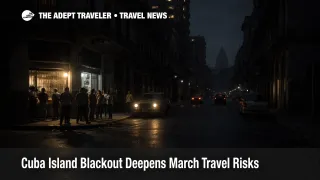
Cuba's latest island wide power failure is no longer just a domestic infrastructure story. It is a travel systems story, because the March 16, 2026 collapse hit an already fuel stressed destination where airports, hotels, road transfers, refrigeration, payments, and communications were already running with little margin. Officials said the national electrical system suffered a complete disconnection, while state utility updates and news coverage spread quickly across X, Facebook, and international media. For travelers, the practical message is simple, trips to Cuba now require assuming that power, transport, and basic services can fail again with little warning.
The Cuba island blackout on March 16 matters because it followed another major outage on March 4, showing that restoration does not mean stability. Travelers with departures, hotel stays, or multi stop itineraries in Cuba should build extra buffer now, avoid tight same day connections, and expect more disruption if fuel shortages and grid weakness continue into the next several days.
Cuba Island Blackout: What Changed
What changed on March 16 is that Cuba moved from chronic rolling outages back into a full national grid collapse. Reuters reported that the national electric grid failed on Monday, leaving around 10 million people without power, and AP said the Ministry of Energy and Mines posted on X that the system had suffered a "complete disconnection" and that officials were investigating. A Facebook update from Unión Eléctrica, or UNE, also circulated quickly, stating that a total disconnection had occurred and that restoration protocols were being activated. That mix matters because the first confirmation did not come through a single formal press conference, it came through the same fast moving social channels that travelers, airlines, hotels, and local residents were already using for day to day grid updates.
The social media layer is important here, but it needs to be read carefully. Official social posts from the utility and ministry are useful for timing and status, while public reposts and breaking news accounts on X and Facebook mostly amplified the headline rather than adding new verified detail. In other words, social media confirmed speed, not clarity. The clearest verified facts still came from official Cuban channels and wire reporting, not from viral posts.
Which Travelers Face the Most Disruption
The most exposed travelers are people already inside Cuba, especially those relying on domestic transport, independent cashless payments, refrigerated food access, mobile connectivity, and airport to hotel transfers. AP quoted Havana residents describing food spoilage and hardship for older family members, which is not just local color, it is a clue to what fails first when outages stretch on. Travelers staying in properties without robust backup generation should assume weaker air conditioning, food service, water pressure, and communications resilience.
International travelers are exposed in a different way. Cuba was already dealing with severe fuel stress before the March 16 collapse. Reuters reported that Cuba has received only two small oil carrying vessels this year, with no Venezuelan fuel arriving in 2026, while AP noted that this was the third major blackout in four months. That means a restored grid can still remain fragile, because the underlying fuel and generation picture has not materially improved. For air travelers, the main risk is not just one blackout night, it is a brittle operating environment where airports, ground handling, hotel turnover, and onward transfers all have less slack than normal.
Travelers heading to Cuba should also read this new outage together with Adept's earlier reporting on Cuba Fuel Shortages Hit Airport Operations, Tourism and Cuba Travel Crisis Adds Protests, Paris Flight Cut. Those earlier warnings were about a system under strain. The March 16 blackout is evidence that the strain is still converting into nationwide failure.
What Travelers Should Do Now
Travelers already in Cuba should prioritize redundancy. Keep devices charged whenever power is available, carry cash, confirm airport transport early, and ask hotels directly whether they have generator backed water, cooling, and food service. If your itinerary depends on a domestic connection, a late night arrival, or a long road transfer after landing, this is the moment to simplify it. The right tradeoff is usually reliability over efficiency.
For travelers not yet departed, the decision threshold is whether your trip can absorb service instability without wrecking the itinerary. Rebook or defer if your plan depends on precise domestic timing, limited medication refrigeration, reliable internet for work, or properties that cannot clearly explain backup power. Waiting may still make sense for flexible travelers staying in well provisioned resorts or higher end city hotels with contingency plans, but only if flight operations and ground transport remain intact close to departure.
Over the next 24 to 72 hours, watch for three things. First, whether Cuban officials move from restoration language to stable generation figures. Second, whether airlines, embassies, or foreign ministries issue new operational alerts. Third, whether another collapse follows partial restoration, because the March 16 outage came less than two weeks after the March 4 blackout was restored. If those signals worsen, Cuba stops being a difficult destination and starts becoming a poor near term planning choice for many travelers.
Why the Blackout Keeps Spreading Through Travel
A "complete disconnection" means the national grid stops functioning as a connected system. That matters for travelers because once the grid fails at national scale, the damage is not limited to lights going out. Airports lose stable terminal systems, hotels fall back to generators if they have them, payment systems and refrigeration become unreliable, road traffic slows when signals fail, and mobile or internet access can degrade. The first order effect is the outage itself. The second order effect is that every trip element built on routine electricity becomes conditional.
The mechanism behind the latest collapse appears broader than one isolated breakdown. AP reported that the ministry said there were no failures in the units that were operating when the system disconnected, while Reuters tied the wider crisis to obsolete infrastructure and severe fuel shortages. UNE's daily update, reflected in reporting that cited its Facebook posts, showed the grid was already deeply short of supply earlier on March 16, with demand far above available generation. That is why social media mattered in this story, but also why it was not enough on its own. Social posts showed the system had fallen apart again. The harder truth, confirmed by news reporting, is that Cuba's power system appears to be running with so little margin that another nationwide outage was always plausible.
Sources
- Cuba's national electric grid collapses, leaving millions without power, Reuters
- Island-wide blackout hits Cuba as island struggles with energy crisis, AP News
- Another week begins with massive blackouts in Cuba, CiberCuba
- Cuba says power grid back online, blames US oil blockade for blackout, Reuters
- Unión Eléctrica UNE Facebook post snippet for March 16 update