

Atlanta Delta Ground Stop Adds Hub Delay Risk
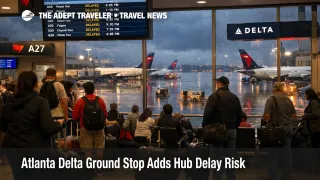
A brief Delta requested ground stop at Hartsfield-Jackson Atlanta International Airport (ATL) on Monday night, March 16, 2026, has already been lifted, but the traveler signal matters. Delta told WSB that it asked for a short Air Traffic Control management program to meter inbound flights to its Atlanta hub for operational purposes, while the carrier was also warning of severe weather disruption across eastern North America and offering a weather waiver for March 16 to 17 travel. For travelers, that means the immediate stop is over, but late arriving aircraft, crews, and connections can stay out of position after the formal restriction ends.
The Atlanta Delta ground stop matters because it shows the hub moved from general storm risk into active flow control, even if only briefly. Travelers with overnight misconnect risk, early Tuesday departures, or tight onward plans should treat this as a recovery story, not just a one hour FAA notice.
Atlanta Delta Ground Stop: What Changed
What changed late on March 16 is that the disruption at Atlanta was no longer just a broad weather advisory or a high delay count on a tracking board. Delta confirmed it asked for inbound metering at its main hub, and WSB reported the FAA issued the ground stop for Delta flights before lifting it later that night. That is a more specific operational signal than a general storm warning because it means the carrier needed a short pause to manage the flow of aircraft coming into ATL.
This also lands on top of a day that was already rough across the U.S. system. AP reported more than 4,400 U.S. flights canceled and about 10,400 delayed on Monday, with more than 430 cancellations at Atlanta alone. Reuters separately reported that about 57 percent of Atlanta flights were delayed or canceled as of Monday afternoon. In other words, the late night Delta specific stop was not the whole problem, it was one control measure inside a much larger day of weather driven disruption.
Adept has already covered the earlier systemwide side of this in U.S. Storm Flight Delays Hit Hubs March 16 and the preemptive carrier move in Delta East Coast Weather Waiver Opens March 16 To 17. The new fact here is that Atlanta's flow pressure was serious enough for Delta to ask for a brief inbound pause later in the day.
Which Atlanta Itineraries Face the Most Risk
The most exposed travelers are not just people whose flights were directly held during the short stop. The bigger risk falls on Delta passengers using Atlanta as a same day connection point, especially on late evening inbound banks and first wave departures the next morning. When inbound aircraft are metered into a hub, some planes arrive late, some crews time out or fall behind schedule, and some passengers miss the last practical onward option of the night. That pushes disruption into hotel needs, baggage recovery, and thinner seat availability the following morning.
Travelers beginning in Atlanta also face a separate pressure point, security processing. AP reported that TSA staffing has been strained during the partial federal shutdown, with union leaders in Atlanta warning that checkpoint waits could worsen as officers work without pay and attrition rises. That does not mean every traveler will face a severe screening delay, but it does mean airport arrival timing matters more than usual when flight operations are already unstable.
The least flexible trips are the ones with another fixed clock at the far end, a cruise embarkation, a long haul international departure from another hub, or a final short regional segment with few later backups. Those travelers should think less about whether the ground stop itself is still active, and more about whether their overall itinerary still has enough slack to absorb recovery lag. For background on how U.S. network constraints turn local problems into wider flow issues, U.S. Air Traffic Control Privatization: Reality Check is useful context.
What Travelers Should Do Now
For travel touching Atlanta in the next 24 hours, the first move is simple. Check whether your Delta flight is still covered by the airline's Eastern North America weather waiver for March 16 to 17, 2026, because that can give you flexibility to move travel through March 24, 2026, under Delta's published rules. If your trip is still discretionary or your onward plans are fragile, using the waiver now can be safer than waiting for day of recovery to fully normalize.
If your itinerary includes a tight Atlanta connection, the decision threshold is whether a delay of one to two hours would break the trip. If the answer is yes, rebooking to a longer connection or a nonstop option is usually the better play. If your trip can tolerate a late arrival and you still have multiple later backup flights, waiting may be reasonable, but you should monitor aircraft inbound status and not just the scheduled departure time.
Travelers departing Atlanta should also build extra airport buffer because the airside problem and the landside problem can stack. Weather can slow flight flow, while TSA staffing stress can slow checkpoint movement. Arriving early does not fix a delayed airplane, but it does reduce the chance that a recoverable trip becomes a missed departure for two different reasons.
How Weather and Staffing Pressure Spread Delays
A ground stop is an FAA traffic management tool that temporarily halts departures bound for a specific airport or airport group. In practice, it helps prevent more aircraft from arriving into a hub than the operation can safely absorb at that moment. In Atlanta on March 16, the brief Delta specific stop sat inside a broader severe weather event that Delta itself had already flagged across eastern North America.
The first order effect is obvious, fewer inbound Delta flights reach Atlanta during the stop window. The second order effects are what travelers usually feel longer: missed connections, aircraft and crew rotations slipping out of sequence, overnighting in the wrong city, and reduced resilience for the next morning's departures. At a fortress hub like Atlanta, even a short flow restriction matters because the bank structure is dense and a high share of passengers are connecting rather than simply starting or ending their trip there.
The other multiplier is staffing pressure at security checkpoints. AP's reporting from Atlanta shows the shutdown is not the direct cause of the FAA stop, but it does make the travel day less forgiving. That is the key mechanism travelers should understand. Weather can disrupt the flight network, and staffing strain can then make recovery harder on the terminal side at the same time.
Sources
- Second ground stop for Delta flights to Atlanta lifted
- Eastern North America Weather, Delta Air Lines
- Delta offers flexible options for customers booked to, from and through Atlanta & Northeast hubs Monday
- Storms add to thousands of canceled US flights during partial government shutdown, AP News
- More than 12,500 US flights delayed or canceled due to major storms, Reuters