

U.S. Storm Flight Delays Hit Hubs March 16
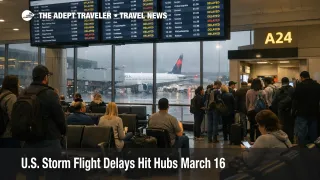
U.S. storm flight delays on Monday, March 16, 2026, have moved past the waiver stage and into a real same day network management story. The Federal Aviation Administration's current operations plan says rain, wind, and thunderstorms are constraining Boston, the New York area, Philadelphia, Potomac, Atlanta, and Charlotte, while Delta says customers flying to, from, or through Atlanta and Northeast hubs should expect delays and possible cancellations and consider moving travel before or after the storm impact.
What changed since prior coverage is the operational posture. On March 15, the main traveler decision was whether to use a weather waiver early, as covered in Delta East Coast Weather Waiver Opens March 16 To 17 and Flight Delays and Airport Impacts: March 15. On March 16, the FAA is now explicitly planning probable or possible ground stop and delay programs at Chicago O'Hare International Airport (ORD), LaGuardia Airport (LGA), Ronald Reagan Washington National Airport (DCA), John F. Kennedy International Airport (JFK), General Edward Lawrence Logan International Airport (BOS), Charlotte Douglas International Airport (CLT), Orlando International Airport (MCO), Tampa International Airport (TPA), Newark Liberty International Airport (EWR), Philadelphia International Airport (PHL), and several South Florida airports later in the day.
U.S. Storm Flight Delays: What Changed
The clearest change is that the FAA is no longer just sketching a broad weather footprint. Its March 16 operations plan shows active initiatives already in place earlier in the day at Hartsfield Jackson Atlanta International Airport (ATL), including an ATL ground stop through 1230 UTC and an ATL ground delay program for Delta mainline and Delta Connection feed through 1459 UTC. The same advisory says ORD faces possible ground stop or delay programs after 1200 UTC, LGA after 1400 UTC, DCA after 1600 UTC, JFK after 1700 UTC, and BOS, EWR, and PHL after 1800 UTC, with MCO and TPA also in possible ground stop or delay territory after 1600 UTC.
That matters because the network can still look deceptively manageable before the worst compression hits. As of the FAA's airport status updates available during reporting, JFK, BOS, ORD, CLT, MCO, EWR, and PHL were each still showing only general departure delays of 15 minutes or less, while LGA had already deteriorated to 16 to 30 minute gate hold and taxi delays because of low ceilings.
That split is exactly why travelers get caught out on storm days. Local airport conditions may still look mild when you check in the morning, but the command center is already planning for later flow restrictions across the densest hub banks in the country. Delta's public warning points to the same pattern, severe thunderstorms at ATL in the morning, followed by broader weather pressure across Southeast and Northeast airports, with customers encouraged to shift itineraries before or after the impact window.
Which Travelers Face the Most Disruption
The most exposed travelers are not just people starting in the storm zone. They are people whose itineraries depend on hub timing. That means ATL connections in the morning, New York and Washington area connections later in the day, and Northeast to Florida or Florida to Northeast flows that rely on one clean aircraft turn and one clean crew connection.
Spring break style itineraries are especially fragile in this setup. The FAA advisory flags thunderstorms not only in the Northeast and Southeast terminal areas, but also across central and south Florida, while en route constraints stretch across Boston, New York, Washington, Atlanta, Jacksonville, Miami, Cleveland, Indianapolis, and Memphis center airspace. That means even travelers whose local airport avoids the worst weather can still get pulled into downstream holding, reroutes, missed inbound aircraft, and thinner same day reaccommodation options.
Transatlantic and Caribbean passengers should also read this as a bank integrity problem, not just a local thunderstorm story. New York, Boston, Atlanta, Charlotte, Orlando, Tampa, and South Florida are all major gateways or feeders into long haul and leisure flows. Once ground delay programs start layering in across those banks, the knock on effects usually show up as late inbound aircraft, broken legal rest windows for crews, misconnects on the back half of the trip, and last minute hotel demand in the wrong city. Delta's waiver remains useful here because it still gives eligible customers a way to move out of the risk window before the system gets more crowded.
What Travelers Should Do Now
For travelers who have not left yet, voluntary rebooking still beats waiting if the trip runs through ATL, LGA, JFK, BOS, DCA, CLT, MCO, TPA, EWR, or PHL and the itinerary depends on a same day connection. Delta's current advisory covers travel on March 16 and March 17, with reissue by March 24 and rebooked travel beginning by March 24, which preserves a real decision window for eligible passengers before irregular operations get worse.
For travelers already committed to flying today, the smarter move is to separate local weather risk from system risk. A departure airport that still shows only minor delays does not mean your aircraft, crew, or onward bank is safe later. Check whether your incoming aircraft is already late, watch the FAA status page for your connection airport, and treat short hub connects as disposable rather than protected. If you are flying to Europe or the Caribbean through the East Coast, or to Florida through Atlanta or Charlotte, the tradeoff is simple, a slower but earlier reroute may save the itinerary, while waiting for a formal cancellation may save the fare rules but lose the trip.
Over the next 24 hours, watch three thresholds. First, whether the FAA converts more of its planned programs into active ground stops or ground delay programs. Second, whether New York and Washington area constraints start stacking into the evening transatlantic departure banks. Third, whether Florida airports move from possible programs to active initiatives, because that is where same day family, cruise, and resort itineraries often become expensive overnight problems. For March 16, U.S. storm flight delays are no longer just a forecast issue, they are a rolling network risk issue.
How the Disruption Spreads Through Travel
A ground stop is the bluntest tool in the system. It temporarily prevents certain departures from leaving for a specific airport or group of airports, usually because weather, congestion, or airspace limits make safe arrival sequencing impossible. A ground delay program is less absolute, but it still meters traffic by assigning later departure times so arrivals do not overwhelm the constrained airport. For travelers, the practical difference is small, both tools break the clean timing that hub networks need to function.
That timing break spreads in layers. First order, flights depart late, arrive late, or cancel outright at the constrained airport. Second order, the aircraft that was supposed to turn to another city is now late, the crew assigned to a later bank may time out, and the passengers who miss one connection compete for a shrinking pool of remaining seats. When that happens at ATL, New York, Boston, Charlotte, or Florida gateways during a busy March demand period, the disruption spreads well beyond the rain line itself.
That is why same day local weather and system risk are not the same thing. LGA already showed a more visible deterioration during reporting, with 16 to 30 minute departure delays and increasing because of low ceilings, while several other hubs were still officially in the 15 minute or less bucket. Yet the FAA's national plan already pointed to a much wider afternoon and evening cascade. In plain language, the network is vulnerable before the public airport pages look terrible everywhere at once.
Sources
- FAA Current Operations Plan Advisory, March 16, 2026
- Delta Offers Flexible Options for Customers Booked to, from and through Atlanta & Northeast Hubs Monday
- Delta Eastern North America Weather Advisory
- LaGuardia Airport Real-time Status
- John F. Kennedy International Airport Real-time Status
- Boston Logan International Airport Real-time Status
- Chicago O'Hare International Airport Real-time Status
- Charlotte Douglas International Airport Real-time Status
- Orlando International Airport Real-time Status
- Flight Delays and Airport Impacts: March 15
- Delta East Coast Weather Waiver Opens March 16 To 17