

Cuba Earthquake Adds Risk to Blackout Travel Crisis
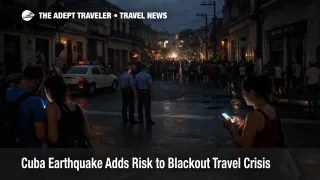
A new earthquake has landed on top of Cuba's already unstable travel environment. Seismic agencies said a magnitude 5.8 to 6.0 quake struck near eastern Cuba on March 17, 2026, after the island's national grid collapse on March 16 and days after rare blackout related protests in Morón. For travelers, this is not mainly a building damage story yet, because early reporting did not point to major confirmed destruction. It is a reliability and safety story, because an earthquake in an already dark, fuel stressed, protest strained destination makes transport, communications, medical access, and nighttime movement less predictable. Travelers already in Cuba should simplify plans, avoid nonessential night travel, and build more buffer around any airport, intercity, or resort transfer decisions.
The Cuba earthquake travel risk is rising because the shock did not happen in isolation. It hit while millions were still dealing with partial restoration after the nationwide blackout, and while official advisories were already warning that power outages and fuel shortages were affecting transport, medical care, communications, and basic services across the island.
Cuba Earthquake Travel Risk: What Changed
What changed on March 17 is that Cuba's travel problem widened from an infrastructure failure and civil unrest story into a multi hazard one. Reuters, citing the European Mediterranean Seismological Centre, reported a magnitude 6 quake at a depth of 15 kilometers, while other reporting citing the U.S. Geological Survey put the event at magnitude 5.8 off eastern Cuba. That magnitude gap is normal in early earthquake reporting, but both versions point to the same traveler conclusion, eastern Cuba just took a fresh shock while the country was already operating with thin margin. Tsunami warning data indicated no tsunami danger from the event.
That matters even without confirmed large scale damage, because Cuba was already struggling to reconnect power after the March 16 national grid collapse that Reuters said plunged roughly 10 million people into darkness. By March 17, much of the grid had been reconnected from Pinar del Río to Holguín, but some areas, including Santiago de Cuba, still remained offline or under severe supply strain. In practice, that means travelers in the east face the highest uncertainty, because the earthquake exposure and the weakest power recovery overlap geographically.
Which Travelers Face the Most Exposure
The most exposed travelers are those in eastern Cuba, especially around Santiago de Cuba, Cuba, and anyone depending on intercity moves, regional flights, or road transfers after dark. Travelers in Havana, Cuba, Varadero, Cuba, and resort zones farther west may not feel the same direct earthquake impact, but they are still exposed to the wider blackout system, because fuel shortages and weak grid recovery can degrade hotel backup power, card payments, refrigeration, traffic signals, mobile charging, and water pumping far beyond the epicenter area.
Safety exposure is also higher than a normal outage period because protests have already turned disruptive. Reuters and AP reported that blackout frustration in Morón escalated into a rare attack on a local Communist Party office on March 14, ending in arrests. That does not mean travelers should assume island wide unrest everywhere at once, but it does mean shortages and darkness are no longer just service annoyances. They can create fast changing local security conditions, blocked movement, police activity, and harder access to routine help if a transfer, check in, or medical need goes wrong.
Official travel advice was already moving in that direction before the earthquake. The U.S. State Department keeps Cuba at Level 2, Exercise Increased Caution, specifically citing unreliable electrical power, and the U.K. Foreign Office says severe and worsening power outages and fuel shortages are significantly affecting transport, medical care, communications, and basic services.
What Travelers Should Do Now
Travelers already in Cuba should shift from normal sightseeing logic to resilience logic. Keep phones, battery packs, cash, drinking water, medicines, paper booking details, and offline maps ready at all times. If your lodging cannot clearly explain generator coverage, water reliability, and front desk contact procedures during outages, you should consider moving to a better resourced property while transport is still functioning.
For movement, the main threshold is simple. Avoid tight same day connections, avoid discretionary intercity hops, and avoid nonessential road travel after dark, especially in eastern Cuba. If your itinerary depends on a precise airport transfer, a private tour pickup, or an onward domestic segment, reworking the plan now is safer than assuming services will normalize quickly. Travelers considering new Cuba bookings for the next several days should wait for clearer reporting on quake damage in the east and on whether power restoration holds.
Over the next 24 to 72 hours, watch three things. First, whether Cuban authorities or seismic agencies report structural damage, airport impacts, or aftershock concerns in the east. Second, whether blackouts ease or widen again after the fragile grid reconnection. Third, whether more protest flashpoints emerge in places already hit by long outages and shortages. Those signals matter more than broad reassurance, because they will determine whether Cuba remains difficult but workable, or shifts into a trip where reliability and personal safety margins are no longer acceptable.
Why the Disruption Keeps Compounding
The mechanism here is straightforward. An earthquake does not need to cause mass visible damage to worsen travel conditions when the system underneath is already failing. Cuba's grid had only begun reconnecting after the March 16 collapse, and official advice already warned that transport, communications, and medical access were under strain from power and fuel shortages. Add a fresh seismic event, and the risk rises that weak infrastructure, patchy service, and limited emergency capacity will fail unevenly rather than all at once.
First order, travelers can face darker streets, intermittent service, slower hotel operations, harder payment processing, and less reliable transport. Second order, those same failures make protest management, airport access, rebooking, and emergency response slower and more chaotic at the exact moment travelers need them to work. That is why this story is bigger than an earthquake bulletin. Cuba was already a fragile destination for March travel, and the March 17 quake adds another layer of uncertainty to a country already dealing with blackouts, shortages, and localized unrest. For many travelers, especially anyone headed to eastern Cuba, the smarter play is no longer to optimize the itinerary, but to protect the exit options.
Sources
- Magnitude 6 earthquake strikes Cuba, EMSC says
- Cuba reconnects electrical grid but millions still without power
- Cuba's national electric grid collapses, leaving millions without power
- Protesters in Cuba attack Communist Party office in rare riot over blackouts
- Protest in central Cuba at local communist headquarters ends in 5 arrests
- Cuba Travel Advisory, U.S. Department of State
- Cuba travel advice, GOV.UK
- Security Alert - U.S. Embassy Havana, Cuba March 16, 2026
- Cuba Island Blackout Deepens March Travel Risks
- Cuba Travel Crisis Adds Protests, Paris Flight Cut