

Italy March 18 Strike Hits easyJet, Milan Ops
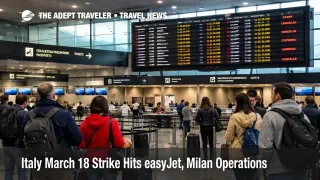
Italy's March 18 air disruption risk has tightened, and the picture is narrower than it looked a few days ago. The national easyJet crew strike from 100 p.m. to 500 p.m. on Wednesday, March 18, remains on Italy's official transport strike calendar, and several Italian airports have warned passengers to expect delays or cancellations. What changed since Adept's March 14 coverage is that the Milan handling story now looks less like a full two airport passenger shutdown and more like a split risk, with reports on March 17 saying the Malpensa and Linate handling mobilization tied to Dnata, formerly Airport Handling, was postponed, while the separate ALHA action at Milan Malpensa Airport (MXP) remains confirmed and is described as cargo focused. Travelers should treat easyJet's afternoon bank as the clearest passenger facing threat, while keeping a closer watch on Malpensa than Milan Linate Airport (LIN).
The immediate decision is practical, not theoretical. If you are booked on easyJet to, from, or within Italy on March 18, especially through Milan, Naples, Venice, Catania, or other easyJet heavy stations, midday departures and inbound rotations are the most exposed. If you are flying another carrier through Milan, the risk is lower than some early reports suggested, but it is not zero because even a deferred handling protest can leave staffing fragile, and Malpensa still has a same day ALHA walkout on the official list. That makes short same day onward rail or resort transfers a weaker bet than normal.
Italy's March 18 strike means different things depending on which part of the system your itinerary touches. For easyJet passengers, the exposure is national and concentrated in the 100 p.m. to 500 p.m. local window because the official action covers the carrier's flight personnel across Italy. ENAC's standing strike rules still require protected service windows from 700 a.m. to 1000 a.m. and 600 p.m. to 900 p.m., so early morning and evening flights should have a better chance of operating, though not a guarantee of running on time if aircraft or crews are already out of position.
For Milan airport users, the exposure is now more uneven. Italian reporting and union sourced updates on March 17 say the planned Dnata, formerly Airport Handling, mobilization affecting Malpensa and Linate was postponed while talks continue, which cuts the odds of an all day passenger handling crunch at both airports. But the official transport ministry calendar still shows a 24 hour ALHA strike at Malpensa, and Adnkronos reporting says that action remains in place and is focused on cargo, which matters less directly for most passenger itineraries but still leaves room for localized operational friction at Malpensa. Put plainly, Malpensa remains the sharper Milan watchpoint, while Linate now looks materially safer than it did in earlier warnings.
The itineraries most likely to break are midday easyJet flights, self connections that rely on an on time easyJet arrival, and same day moves from Milan airports to Lake Como, the Alps, Liguria, or cruise and ferry links that do not have much slack. First order, a crew strike can cancel or delay flights in the affected hours. Second order, those disruptions compress demand into the protected morning and evening bands, which can tighten seats on later flights and crowd rail alternatives out of Milan. That spillover matters even if your own flight is outside the formal strike window.
Italy March 18 Strike: What Travelers Should Do Now
The cleanest move is to separate airline risk from airport risk. If you are on easyJet and your flight is scheduled between late morning and early evening, check the airline app and booking page repeatedly before leaving for the airport, and be ready to accept a same day move into the protected evening band or a next day reroute. If you are traveling on another carrier through Milan, keep the booking unless your itinerary depends on a very tight turn, because the broader Malpensa and Linate passenger handling threat appears to have eased.
Rebook early if your trip includes a self transfer, a final flight of the day, or prepaid ground arrangements that become expensive when missed. Wait if your flight is outside the 100 p.m. to 500 p.m. easyJet window, is protected by the ENAC service bands, or you are on a non easyJet carrier at Linate with no tight onward commitments. That tradeoff matters because the cheapest move is often to wait for the airline to cancel, but the smartest move for a time sensitive itinerary is often to grab remaining space before the disrupted passengers do.
Know what passenger rights do, and do not, cover. Under EU air passenger rights rules, passengers are entitled to care, rerouting, or a refund when flights are canceled or heavily delayed within scope, and internal airline staff strikes do not automatically free the carrier from compensation obligations. But that logic is different for disruptions caused by airport staff or air traffic control, which may count as extraordinary circumstances. In practice, that means easyJet passengers may have a stronger compensation argument than travelers hit only by airport side disruption, while all affected passengers should still expect rebooking or refunds where required.
Why Milan Risk Looks Different Now
The reason this story changed is that "airport strike" is not one thing. Airline crew, airport handling, cargo handling, and air traffic control each hit different parts of the chain. A flight crew strike directly threatens whether the airplane can legally operate. A ground handling strike threatens baggage, check in, ramp work, and aircraft turns. A cargo focused action can still create friction, but it does not carry the same immediate passenger side consequences as a full handling stoppage across both Milan airports.
That distinction is why the traveler takeaway is sharper than the headline noise. The national easyJet action is confirmed in official sources and sits squarely in the middle of the day, so it is the most decision useful risk. The broader Malpensa and Linate handling warning that circulated earlier now appears partly overtaken by events after union and wire service reports said the Dnata, formerly Airport Handling, action was postponed pending talks. The official strike list still matters, but for passenger planning on the evening of March 17, the best reading is easyJet first, Malpensa second, Linate lower.
The disruption can still spread beyond the formal strike hours because aircraft and crews do not reset instantly. A canceled midday easyJet sector can remove the aircraft that was supposed to operate an evening flight, and crowded protected bands can push travelers onto rival carriers or rail. That is the real system effect behind this Italy March 18 strike, it is not just about four hours of labor action, but about how midday disruption squeezes the rest of the day's recovery window. Travelers making same day alpine, lake, or Ligurian transfers should leave more buffer than usual, and travelers with flexible plans should favor later protected departures over thin midday bets.
Sources
- Scioperi, MIT public strike calendar
- Voli garantiti in caso di sciopero, ENAC
- Wednesday 18 March 2026, National strike of easyJet Company Limited flight personnel, Aeroporti di Napoli
- Latest travel information, easyJet
- Air passenger rights, Your Europe, European Union
- Air passenger rights FAQ, strike compensation, Your Europe, European Union
- Scioperi: sindacati, "rinviata mobilitazione Malpensa e Linate", Adnkronos via La Nuova Sardegna
- Which flights will be affected by Italy's strikes on Wednesday, The Local Italy