

Kilauea Hawaii Closures Hit Park and Highway
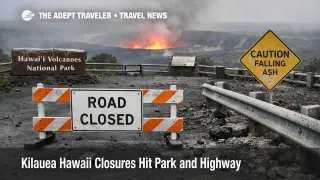
Kīlauea's latest summit episode turned from a viewing event into a short, sharp access problem on March 10, 2026, when lava fountains rose above 1,000 feet and tephra, volcanic rock, ash, and glass fragments, forced temporary closures at Hawaiʻi Volcanoes National Park and along Highway 11 near the park. For Big Island travelers, the main risk is not islandwide evacuation or widespread flight shutdowns, it is sudden loss of park access, road disruption, and ash exposure on a day that may have looked manageable only hours earlier. Official updates now show episode 43 is over, but the eruption remains episodic, which means similar closures can return quickly when the next fountaining phase begins.
The Kilauea Hawaii closures story matters because this eruption is staying inside the summit caldera while still creating traveler consequences outside it. That changes the decision from "Should I cancel my Hawaii trip?" to "How much flexibility do I need around a Hawaiʻi Volcanoes National Park day, a Highway 11 drive, or a same day airport transfer?" USGS said on March 15 that the summit eruption was paused, with preliminary modeling pointing to a possible episode 44 window between March 30 and April 8, 2026.
Kilauea Hawaii Closures: What Changed
What changed last week was the severity of fallout, not just the fountain height. Hawaiʻi Volcanoes National Park said on March 10 that hazardous tephra falling over the summit forced a temporary closure of the summit area, while Highway 11 closed between mile markers 24 and 40 because road conditions had become dangerous. At the time, the park said lava fountains had reached as high as 1,300 feet and that light, variable winds were dropping material onto the summit, the highway, and nearby communities.
USGS later confirmed that episode 43 began at 917 a.m. HST on March 10 and ended at 621 p.m. HST the same day, after roughly nine hours of sustained fountaining. More detailed post eruption measurements were even higher than the first estimates, with the south fountain reaching 1,770 feet and the north fountain topping 1,400 feet, both records for this eruption cycle.
The immediate traveler relevance is that closures did not last indefinitely, but they were serious enough to interrupt the core visitor zone around the summit and a critical road segment around the park. By March 11, the park had reopened Crater Rim Drive West from the entrance to Kilauea Military Camp, while crews continued clearing major amounts of ash, rock, and glass from roads and overlooks. By March 13, the park said key summit visitor facilities remained open, but some western access remained closed because of continued cleanup.
Which Big Island Trips Are Most Exposed
The most exposed travelers are people whose Hawaii Island itinerary depends on a precisely timed summit visit, especially anyone combining Hawaiʻi Volcanoes National Park with hotel check in, a guided lava tour, or a same day drive to Hilo International Airport (ITO) or Ellison Onizuka Kona International Airport at Keahole (KOA). When tephra starts falling, the problem is not subtle degradation, it is that overlooks, roads, and traffic patterns can change quickly enough to break the rest of the day.
Travelers staying near Volcano Village, moving between Hilo and the Kona side by way of the south part of the island, or relying on Highway 11 as a clean through route also face more risk than casual readers might assume. USGS said Highway 11 closed at about 11:10 a.m. HST on March 10, and tephra was reported outside the park into adjacent communities, with fine ash and Pele's hair reported as far as Hilo. That does not mean the whole island stops working, but it does mean a summit episode can spill far enough beyond the crater to complicate road movements and outdoor plans.
There is also a difference between this week's reality and the earlier watch-window coverage in Kilauea Forecast Window March 8 to 15, Park, Air Risk. That earlier story correctly framed the hazard as access volatility. What March 10 proved is that volatility can harden into actual closures and debris cleanup, not just crowding and haze. The air quality angle also remains relevant from Kilauea Eruption Hawaii Air Quality and Flight Impacts, because even when the lava stays inside the caldera, ash, tephra, and gas can still degrade conditions around the park and downwind communities.
What Travelers Should Do Now
For trips already booked in late March or early April, the practical move is not to avoid Hawaii Island altogether. It is to stop treating a Kīlauea day as a fixed appointment. Keep your volcano visit on a day that can move, avoid placing it right before a flight or inter island transfer, and do not assume Highway 11 will remain friction free just because the eruption is confined to the summit. If the volcano enters another fountaining phase, a late morning park stop can turn into a reroute and cleanup problem by midday.
Use a simple decision threshold for park visits. Go ahead if USGS is showing a paused phase, the park is open, and winds are not pushing fallout toward visitor zones. Rebuild the day if USGS posts a new episode start, if the park announces summit closures, or if local conditions suggest ash and tephra are crossing the road network again. Waiting a day can be smarter than forcing the visit, because these summit episodes tend to be short but operationally disruptive.
Over the next 24 to 72 hours, and especially as the March 30 to April 8 forecast window approaches, monitor the inputs that actually change outcomes. Those are USGS daily updates, Hawaiʻi Volcanoes National Park alerts, and any renewed ashfall or road warnings. Travelers with asthma, other respiratory sensitivity, or open-air activities planned near the park should treat tephra and ash advisories as a hard planning constraint, not a minor inconvenience. Kilauea Hawaii closures are usually localized, but they can still ruin a tightly stacked Big Island day if you wait too long to adjust.
Why This Eruption Disrupts Travel Even Without Threatening Homes
The mechanism here is important. USGS says the eruption remains within Hawaiʻi Volcanoes National Park and that lava flows are contained to the caldera, so this is not a repeat of the kind of residential lava emergency travelers may remember from past Kīlauea events. But the same official USGS guidance also says fallout from lava fountains can affect communities downwind, which is exactly what happened during episode 43.
That matters because tephra is a transport and public health problem even when lava is not marching toward houses. The park said tephra covered road markings and caused vehicles to skid and slide, while USGS reported several inches of accumulation in and around the summit area, plus ash and Pele's hair in communities beyond the park. First order, that closes viewpoints, reduces safe road access, and makes outdoor viewing less viable. Second order, it ripples into hotel arrival timing, tour schedules, airport runs, and any itinerary that assumed the south side of the island would function normally all day.
The other reason this is a travel story, not just a geology story, is that Kīlauea is now behaving episodically. One burst ends, cleanup begins, conditions improve, and then the next window starts building. That pattern means travelers should plan for recurrence, not just recovery. The operational lesson is simple, the volcano may be contained geographically, but the traveler risk is time based. Your trip is fine until it lands inside the wrong nine hour window.
Sources
- Kīlauea summit temporarily closed due to volcanic hazards
- Sections of Kīlauea Summit Reopen Following Eruption
- Hawaiʻi Volcanoes National Park enacts temporary safety closures ahead of severe weather
- USGS Volcano Notice, March 15, 2026 Daily Update for Kīlauea
- USGS Volcano Notice, March 10, 2026 Status Report for Episode 43
- Photo & Video Chronology, March 10 and 11, 2026, Kīlauea episode 43 eruption and fallout
- Hawaiian Volcano Observatory
- NWS Ashfall Warning Issued by Honolulu Forecast Office