

U.S. Shutdown Threatens Smaller Airport Closures
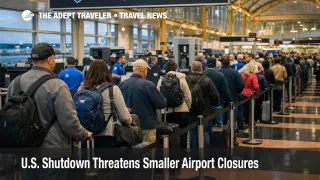
The U.S. shutdown airport closures story has moved from abstract warning to a practical airport planning risk. Reuters reported on March 17, 2026, that a senior Trump administration official said some smaller U.S. airports may have to shut down in the coming weeks if Transportation Security Administration staffing worsens, after just over 10 percent of TSA airport security officers failed to report for duty on Sunday. For travelers, the immediate takeaway is not that the whole system stops. It is that checkpoint performance is getting less predictable, and smaller airports with thinner staffing margins could become the first places where service breaks.
The dispute sits inside a partial Department of Homeland Security shutdown that began after funding lapsed on February 13. TSA officers are still working without pay, major airline CEOs have publicly urged Congress to end the standoff, and airports have already reported unusually long screening lines and some checkpoint closures as spring break demand builds. Travelers should treat this as a live operations problem now, not a hypothetical Washington story for later.
U.S. Shutdown Airport Closures: What Changed
What changed on March 17 is the warning threshold. Reuters had already reported that more than 10 percent of TSA officers missed work on March 16, far above the normal rate of under 2 percent. The new development is that Acting Deputy TSA Administrator Adam Stahl said the government may have to shut down some smaller airports if callout rates keep rising, which turns a staffing squeeze into a possible access problem for communities that depend on lightly staffed commercial airports.
Reuters also reported that 366 TSA officers have left during the shutdown, with especially severe absence spikes recently in Houston, New Orleans, and Atlanta. That matters because the issue is no longer only long lines at a few big hubs. It now points to a broader staffing erosion problem that can hit different airports in different ways, depending on how many officers they can lose before screening lanes, checkpoint hours, or whole operations become unsustainable.
Which Travelers and Airports Are Most Exposed
The most exposed travelers are not necessarily the ones flying through the biggest airports. Large hubs can be miserable when staffing falls, but they also have more infrastructure, more lanes, more flights, and more rebooking options. Smaller airports are more fragile because they often run with less slack. Lose enough screeners at a large hub, and lines get ugly. Lose enough at a small airport, and the airport may not be able to operate its checkpoint schedule at all. Reuters has not identified which airports are at greatest closure risk yet.
Travelers using regional feeders into larger hubs should pay especially close attention. First order, a security staffing failure at a smaller origin airport can wipe out the first leg of the trip. Second order, that missed feeder can break the rest of the itinerary, including long haul flights, cruise embarkations, prepaid tours, and nonrefundable hotel nights. This is why the shutdown matters even for people who are not flying through the worst checkpoint lines themselves.
The political mechanism matters only to the extent it explains why this is dragging on. Reuters and AP both report that the shutdown stems from a standoff over immigration enforcement reforms sought by Democrats, while Republicans have resisted those demands. The details of that fight matter in Washington, but the traveler facing result is simpler: the longer the funding lapse continues, the more airport operations depend on unpaid frontline staff continuing to show up anyway.
What Travelers Should Do Now
Anyone flying in the next several days should add more airport buffer than usual, especially at regional airports, spring break gateways, and airports with limited alternate flights. If you are departing from a smaller airport, check the airport's website and your airline app the night before and again before leaving home. If your trip depends on a same day connection, this is the wrong week to cut timing close.
If you have a discretionary trip booked from a smaller airport and there is a practical alternative from a larger nearby airport, the tradeoff is now worth evaluating. Driving farther may be annoying, but it can be safer than relying on a station with little staffing cushion and only a handful of departures. For international returns, the picture is slightly better because U.S. Global Entry Restarts as Shutdown Drags On confirmed the March 11 restart of Global Entry, but that only fixes one choke point. It does not solve outbound checkpoint strain.
For broader context on the airport side of this story, U.S. Shutdown Pressure Grows on TSA as Airlines Warn and How a government shutdown could affect travel remain the most useful related reads. In the next 24 to 72 hours, watch for three things: airport specific advisories about long waits, additional reports of checkpoint closures or reduced hours, and any congressional movement that would restore pay before absenteeism climbs further.
Why the Shutdown Risk Is Spreading Through Travel
The mechanism is straightforward. TSA screening is a federally staffed process with hard minimums for safe operation. When enough officers call out, airports cannot simply improvise with local workers or ask airlines to cover the gap. At first, the disruption shows up as longer lines and fewer open lanes. If staffing keeps thinning, the problem can escalate into reduced checkpoint hours, terminal bottlenecks, delayed departures, and in the worst case, airport closures at facilities with no staffing redundancy.
That is also why the damage can outlast the political deal. Reuters says hundreds of TSA officers have already left during the shutdown. Even if Congress resolves the funding fight quickly, replacing trained screening staff is not instant. So the main travel lesson is blunt: the shutdown is no longer just creating inconvenience, it is eating into the system's staffing margin, and smaller airports are where that margin can disappear first.
Sources
- US says it may be forced to shut down some airports over funding standoff, Reuters
- US says 10% of airport security officers did not work Sunday amid shutdown, Reuters
- US Senate fails to end standoff over funding Homeland Security, airport screening, Reuters
- Top Border Patrol official and other federal agents being investigated by Minneapolis prosecutors office, Reuters
- Lawmakers vent frustration over DHS shutdown as lines grow at nation's airports, AP News
- Global Entry resumes after travelers faced long airport lines, AP News
- A4A Statement on TSA's $0 Paychecks, Airlines for America