

Cathay Pacific Dubai Suspension Runs Through April 30
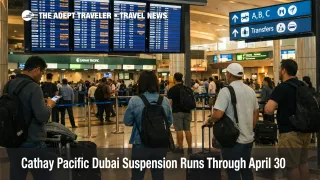
Cathay Pacific Dubai suspension now runs through April 30, 2026, cutting another long haul booking path into Dubai, United Arab Emirates, just as the airport remains under a travel advisory that tells passengers not to go unless their airline has given them a confirmed departure time. Cathay says all flights to and from Dubai are canceled through that date, while customers booked between Hong Kong and Dubai through May 31 can rebook, reroute, or refund without the usual fees. For travelers, this is not just one more cancellation notice. It removes another intercontinental option from a hub that is still open, but not operating with normal confidence or normal redundancy.
The new wrinkle versus our earlier Gulf hub coverage is that this is an Asia based carrier stepping back, not another European extension. Cathay's own notice also matters because it gives a longer planning window than the suspension itself. The flight cancellations currently run through Wednesday, April 30, 2026, but the waiver flexibility runs through Saturday, May 31, 2026, which gives some passengers room to salvage later spring plans before the airline decides whether to restore the route or extend the pause again.
Cathay Pacific Dubai Suspension, What Changed
Cathay's March 18 update is straightforward. All flights to and from Dubai are canceled up to and including April 30, 2026. Customers who booked directly with Cathay can use Manage Booking, request a refund there, or contact Customer Care to arrange a new flight. Customers who booked through a travel agent or third party site have to go back through that seller, which matters because agency response times can now become part of the disruption.
This change lands in a market that was already thinning. Dubai Airports says flights resumed after the mid March disruption, but the airport is still warning passengers not to travel to the terminal unless they have a confirmed departure time from their airline. British Airways has already pushed its own Dubai suspension to May 31, 2026, which means Cathay is not withdrawing into a healthy market that can easily absorb displaced passengers. It is stepping out of a hub where backup capacity is already weaker than usual.
Which Travelers Are Most Exposed Now
The most exposed group is simple, Hong Kong to Dubai nonstop passengers, especially anyone who chose Cathay because they wanted to avoid a second connection or because Dubai was only one leg of a longer itinerary. The first order effect is the loss of a direct option for another six weeks. The second order effect is that a rebuilt itinerary may now require a different Gulf gateway, a longer layover, or an extra overnight, which can unravel carefully built connections into Europe, Africa, or onward Middle East markets.
Travelers with self built tickets are in a worse position than passengers on one protected booking. If Dubai was only the transfer point before a separately ticketed flight, cruise embarkation, hotel stay, or tour start, the problem is no longer just Cathay's cancellation. It becomes a chain risk. One change in the first long haul leg can force new hotel nights, separate ticket losses, and ground transfer changes at the far end. That same logic is why Adept has already warned readers that Doha remains usable only in a limited way, not as a normal replacement hub you can trust without extra buffer. See Doha Hamad Airport Pulls Back as Flights Stay Limited and British Airways Extends Gulf Flight Cuts to May 31.
What Travelers Should Do Before Rebooking
Start with the waiver window, not with a speculative replacement fare. If your original Cathay itinerary was booked between Hong Kong and Dubai for travel up to May 31, 2026, Cathay says you can rebook, reroute, or refund without the usual fees. That does not guarantee your preferred replacement will be available, but it does mean you should work the protected option first before buying a fresh ticket at peak disruption prices. If your booking is through an agency or online travel site, push them for the exact reissue choices now, because third party handling can be slower than direct airline servicing.
Rebook quickly if Dubai is only one piece of a larger itinerary with hard dates, such as a cruise embarkation, fixed hotel package, or event. Wait a little longer only if Dubai itself is the destination, your dates are flexible, and you can tolerate a different carrier or a shift deeper into May. The tradeoff is simple. Waiting may preserve more routing options if conditions improve, but early action may save the broader trip if alternative long haul seats keep disappearing.
For the next 24 to 72 hours, monitor three things in this order, Cathay's Dubai service page, Dubai Airports' advisory language, and the broader Gulf hub picture. If DXB keeps telling passengers not to come without confirmed departure times, that is your signal that the airport may be open but still fragile in operational terms. If more long haul carriers extend suspensions, expect reaccommodation pressure to rise again.
Why Dubai Rerouting Is Getting Harder
Dubai's importance is bigger than origin and destination demand. Dubai International Airport (DXB) is one of the world's biggest long haul connection hubs, so each carrier withdrawal removes more than a point to point seat. It strips away schedule choice, reaccommodation capacity, and connection resilience. In a normal market, one suspended airline can be absorbed by nearby timings or alliance alternatives. In the current market, several carriers have already stepped back or reduced service, which means replacement paths are more likely to be longer, more expensive, or operationally thinner.
That is also why Cathay's move matters beyond its own customers. Dubai Airports is still advising passengers to wait for direct airline confirmation before going to the airport, and Adept's earlier reporting has already shown that open does not mean normal at DXB. The Cathay Pacific Dubai suspension widens the gap between technical reopening and dependable hub utility. Travelers can still move through the region, but they should build around confirmed tickets, longer buffers, and fewer assumptions about same day recovery if another carrier or airport update changes the plan.