

Cuba Protest Warning Adds New Travel Friction
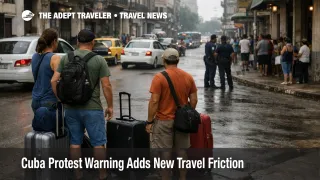
Cuba's travel picture has shifted again, and this time the new problem is not just power. The U.K. Foreign, Commonwealth & Development Office says its March 16, 2026 update added information on protests, while still advising against all but essential travel to Cuba and warning that recent protests have so far been mostly peaceful but can escalate. For travelers, that matters because Cuba was already operating in a brittle post blackout environment where transport, communications, fuel, and basic services were under strain. The practical consequence is that movement risk now sits on top of infrastructure risk, so airport transfers, day tours, and same day overland plans deserve more margin than they did even a few days ago.
The Cuba protest travel risk matters because it changes how travelers should read the island's recovery. Power restoration after the March 16 grid collapse did not return Cuba to normal operations, and the new FCDO protest language makes that clearer. This is an update story, not a duplicate of Cuba Power Restored, But Travel Still Looks Fragile. What changed is that public order and movement disruption now deserve equal weight alongside outages and shortages when travelers decide whether a Cuba itinerary is still workable.
Cuba Protest Travel Risk: What Changed
What changed on March 16 is that the FCDO moved protest risk into the current traveler warning, not as a historical footnote, but as active planning advice. Its live Cuba page says recent protests have occurred, says most have remained peaceful so far, but warns they can escalate and tells travelers to avoid large gatherings, monitor media, and follow local authority advice. That language matters because the same advisory still says Cuba should be visited only for essential reasons, which means the U.K. view is that the operating environment remains materially degraded, not merely inconvenient.
The timing also matters. Reuters reported that Cuba reconnected its power grid on March 17 after a blackout lasting more than 29 hours, but officials also said shortages would continue because generation remained below demand. In other words, the island moved out of full darkness, but not out of systemic stress. That makes protest language more operationally relevant for visitors, because even a localized gathering or police response can have wider travel effects when transport, cash access, and communications are already fragile.
Which Travelers Face The Most Disruption
The travelers with the highest exposure are people already in Cuba, especially those relying on hotel to airport transfers, provincial road moves, independent day tours, or apartment stays outside the most resilient tourism zones. A visitor sleeping in Havana but flying out the next morning can absorb only so much friction before a peaceful protest, road diversion, fuel constraint, or mobile outage starts to break the plan. That is the real traveler issue here, not whether every protest becomes violent, but whether a thin margin itinerary can survive another layer of unpredictability.
Travelers in larger hotels or resort compounds with simpler schedules have a bit more protection, but not immunity. Cuba's broader operating environment is still fragile enough that support services can degrade unevenly, especially outside Havana. Reuters and AP have tied the wider crisis to fuel shortages, repeated blackouts, and strain on daily life, while AP also reported a protest in Morón that ended in arrests after turning destructive. That does not prove islandwide unrest, and travelers should not overread it that way. It does show that shortages and outages can spill into public order problems fast enough to matter for visitor movement. Earlier Adept coverage, including Cuba Collapse Risk: Blackouts, Fuel, Travel Limits, remains relevant because the underlying weakness did not disappear when the grid came back.
What Travelers Should Do Now
Travelers already in Cuba should simplify movement and widen every handoff. That means leaving earlier for airport transfers, avoiding large gatherings, keeping excursions flexible, and treating any same day connection between a long road move and a flight as a weak plan unless there is ample buffer. The safer approach right now is a shorter chain of dependencies, fewer timed commitments, and a backup route back to the hotel or airport if a district becomes harder to cross.
Cash planning also deserves more attention than it would in a normal advisory story. In a system still dealing with fuel shortages, outages, and service interruptions, cards, ATMs, transport apps, and small vendor operations can all become less reliable at once. Travelers should carry more working cash than they normally would for transfers, food, tips, and short notice changes, while also keeping phones charged, offline maps saved, and booking details stored locally in case connectivity slips. That is not panic advice. It is a rational response to a destination where power restored does not mean systems restored.
The main decision threshold is whether your itinerary can absorb delay without cascading failure. Waiting may still be reasonable for travelers staying in one place, using hotel arranged transport, and avoiding tight schedules. Postponing or reworking the trip makes more sense for travelers depending on independent overland movement, fixed tours, scarce support services, or a tightly timed airport departure. Over the next 24 to 72 hours, watch for harder official protest language, fresh transport interruptions, or new reports of outages and shortages widening again.
Why Cuba's Travel Risk Keeps Spreading
The mechanism is straightforward. Cuba's current travel problem is not one isolated disruption. It is a stacked systems problem in which fuel shortages weaken electricity generation, weak electricity degrades transport and communications, and service stress makes even small public order incidents more disruptive for travelers than they would be in a stable destination. First order, a protest or police response can complicate one corridor or neighborhood. Second order, that can delay an airport transfer, compress a tour window, reduce access to cash or fuel, and leave travelers with fewer reliable alternatives when something slips.
That is why this advisory update matters now. The FCDO did not say Cuba was in general disorder, and the current wording explicitly notes that recent protests have mostly been peaceful so far. But in a destination already flagged for essential travel only, peaceful but escalatory protest risk is enough to change behavior. Travelers should read the March 16 update as a signal that Cuba's post blackout phase is still unstable, and that movement resilience, not just hotel power, should now drive trip decisions.
Sources
- Cuba travel advice, GOV.UK
- Cuba reconnects electrical grid after millions left without power, Reuters, March 17, 2026
- Islandwide blackout hits Cuba as it struggles with deepening energy crisis, AP News, March 17, 2026
- Protest in central Cuba at local communist headquarters ends in 5 arrests, AP News, March 14, 2026
- German foreign ministry strongly discourages travel to Cuba, Reuters, March 18, 2026
- Cuba Power Restored, But Travel Still Looks Fragile
- Cuba Collapse Risk: Blackouts, Fuel, Travel Limits