

Cuba Power Restored, But Travel Still Looks Fragile
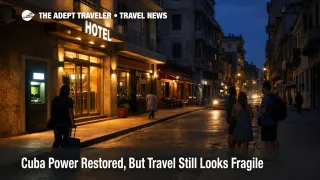
Cuba's latest grid story has shifted from total collapse to fragile recovery, and that is the part travelers need to understand now. Reuters reported that the national grid came back online by 6:11 p.m. on Tuesday, March 17, 2026, after a blackout lasting more than 29 hours, but officials also said shortages would continue because generation is still too weak to cover demand. That means Cuba power outage travel risk is no longer mainly about whether the island is dark everywhere at once. It is about whether core services work consistently enough for a trip to stay manageable.
What changed since our March 16 coverage is not the existence of the outage, it is the recovery phase. The traveler question has shifted from "is the grid down?" to "how uneven will the recovery be, and where?" For most travelers, that means treating Cuba as operational but structurally unreliable for now, especially if the itinerary depends on same day transfers, independent lodging, mobile payments, or moving outside major tourist infrastructure. Related Adept coverage already live includes Cuba Island Blackout Deepens March Travel Risks and Cuba Travel Crisis Adds Protests, Paris Flight Cut.
Cuba Power Outage Travel Risk: What Changed
The immediate change is that Cuba is no longer in a nationwide blackout, but it is also not in a normal operating state. Reuters said the grid was fully reconnected by Tuesday evening, yet also reported that power shortages may continue because the country still is not generating enough electricity to meet demand. AP separately reported that many towns only had partial restoration and that repeated outages remain tied to the broader fuel and grid crisis.
For travelers, this matters because "power restored" and "trip reliability restored" are not the same thing. A grid reconnection can bring airports, hotels, and transport back online in principle, while leaving real world operations patchy in practice. Refrigeration, card acceptance, elevator service, water pressure, phone charging, and cellular data can all remain uneven during a weak recovery, especially when backup systems depend on scarce fuel. The U.S. State Department's Cuba information page says the island's electrical supply is unreliable, that outages in Havana can last up to 12 hours daily, that longer cuts occur outside the capital, and that even hotels and institutions with generators can struggle to keep them running during long outages because fuel is inconsistent and scarce.
Where The Recovery Still Looks Weakest For Travelers
Havana, Cuba, is likely to remain the most functional part of the system, but not a reliably smooth one. Reuters said most Cubans, including many in Havana, were already seeing 16 or more hours of blackout daily even before the latest collapse, and the State Department says scheduled and unscheduled cuts in the capital can still last up to 12 hours. In practical terms, Havana travelers should expect the widest choice of transport and lodging, but not dependable continuity across a full day.
Large resort properties and major hotels are better positioned than private homes or small guesthouses because some have generators and more hardened operating systems. That is the relative advantage, not a guarantee. The State Department explicitly warns that hotels and other large institutions may still have trouble keeping generators running during long outages because fuel availability is inconsistent. So a resort zone can stay more workable than an independent itinerary while still delivering patchy air conditioning, weaker food service, slower check in, or interruptions to payments and internet.
Provincial cities and road based independent travel look like the weakest part of the recovery picture. The same State Department guidance says outages last longer outside Havana, and AP has tied repeated outages, food spoilage, and unrest to the broader power and fuel crisis. That means the risk outside major tourist infrastructure is not just inconvenience. It is a compound reliability problem, because rolling outages can also disrupt transport timing, cash access, and movement through areas where frustration is already high. Adept's earlier backgrounder, Cuba Collapse Risk: Blackouts, Fuel, Travel Limits, remains relevant on that point.
What Travelers Should Do Now
Travelers with near term Cuba departures should build buffer into every handoff. The safest version of a trip right now is a simpler one, direct arrival when possible, fewer same day transfers, more cash than usual, offline copies of bookings, charged battery packs, and lodging that can clearly explain what stays powered during an outage. This is not the moment for tightly stitched city hopping or assumption driven itineraries built around perfect timing.
The main decision threshold is whether your trip can absorb uneven service without breaking. Waiting may still be reasonable for travelers staying in larger hotels or resort properties with flexible schedules and limited internal movement. Rebooking or postponing makes more sense for travelers depending on private rentals, provincial overland transfers, unstable mobile service, or fixed tours that fall apart if transport or power slips for half a day. The tradeoff is simple, the more independent your trip design, the more exposed you are to a fragile recovery.
Over the next 24 to 72 hours, watch for three signals. A stabilizing system would show fewer reports of daily outage hours, fewer towns stuck in partial restoration, and less protest activity tied to shortages. A worsening system would look like renewed rolling cuts after the reconnection, widening transport friction, more food and fuel scarcity, and fresh unrest. Reuters and AP both support the key point here, the island has moved out of a full blackout, but not out of systemic electrical stress.
Why Cuba's Recovery Still Looks Structurally Unstable
The mechanism is straightforward. Cuba restored the grid, but it has not solved the underlying mismatch between demand, generation, and fuel supply. Reuters reported that the country brought its largest oil fired plant back online, yet generation still remained far below what was needed to cover demand. That keeps the system fragile, because a technically restored grid can still fail again when available power is thin and major plants are old.
This also explains why the travel problem spreads beyond electricity itself. First order, outages disrupt lighting, refrigeration, communications, transport coordination, and payment systems. Second order, that feeds missed transfers, slower airport processing, last minute hotel service cuts, and more protest risk in places already strained by shortages. AP has reported repeated unrest tied to the energy and food crisis, while U.S. travel guidance says prolonged outages and fuel shortages already affect core services across the island.
The hard truth for travelers is that Cuba has not crossed back into a stable planning window yet. It has crossed into a narrow middle ground, not islandwide failure at this moment, but not a destination where restored power should be mistaken for dependable operations. Until outage hours shrink materially and backup systems stop depending on scarce fuel, the working assumption should be that Cuba remains travelable only with extra margin and lower expectations around reliability.