

Mexico City CNTE Strike Hits Centro And Reforma
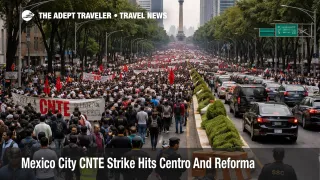
The Mexico City CNTE strike is no longer just a planning alert. It is live on the ground, with Reuters images confirming teachers marching in Mexico City, Mexico, on March 18, 2026, and city authorities listing a 9:00 a.m. march from the Angel of Independence to Palacio Nacional, with a projected sit in at the Zócalo as part of a 72 hour national strike running March 18 through March 20. For travelers, that means central road movement is now the main problem, especially around Paseo de la Reforma, Centro Histórico, the Zócalo, and government corridors that often affect hotel pickups, tours, and airport runs.
The practical change since pre-event chatter is that the disruption is now visible and operational. El Economista reported affected zones including Reforma, Centro, and the Zócalo, while Reuters and El País both showed the protest footprint in the historic core on March 18. Travelers staying in Centro, Reforma, Juárez, and parts of Polanco should assume slower car service during march windows and renewed friction whenever the sit in expands, compresses lanes, or triggers police diversions.
Mexico City CNTE Strike, What Changed For Travelers
What changed is that the city now has both a moving protest route and a static occupation footprint. Mexico City's official social mobilization agenda set the CNTE march for 9:00 a.m. from the Angel of Independence to Palacio Nacional, and it explicitly warned that protesters were expected to install a camp in the Zócalo. That matters because a moving march disrupts traffic in waves, while a sit in can keep parts of the historic core constrained even after the main procession passes.
The strike demands are broad, which raises the risk that this does not resolve quickly inside the announced window. The official city agenda says the CNTE is demanding renewed federal tripartite talks, repeal of the 2007 ISSSTE law and the 2019 education reform, a return to pensions without Afores, better labor conditions, a 100 percent salary increase to base pay, and larger education, health, and social security budgets. President Claudia Sheinbaum said education officials would meet with the teachers during the 72 hour strike, but that does not yet equal a settlement.
Which Travelers Face The Most Disruption
The most exposed travelers are the ones whose day depends on road timing rather than just destination choice. That includes visitors with airport transfers between central hotel districts and Mexico City International Airport (MEX), travelers heading to timed museum or historic center tours, and anyone relying on car service between Reforma, Juárez, Centro, Polanco, and government zones near the Zócalo. The first order effect is slower or rerouted ground transport. The second order effect is missed tour starts, tighter check in windows, and higher rideshare pricing when capacity gets pulled into longer, slower trips.
Centro guests face the clearest friction because the sit in footprint is concentrated in the historic core. Reforma guests are next because the march origin at the Angel pushes disruption along one of the city's main visitor and hotel corridors. Polanco is less central to this specific action, but prior Mexico City protest coverage shows how rerouting around closures can spill delays into broader north west traffic patterns once drivers and police start pushing flows off their usual paths. That is why a protest that is not at the airport can still distort airport transfer timing.
What Travelers Should Do Now
Travelers in Centro or Reforma should treat March 19 and March 20 as delay days, not normal city movement days. If you have a flight, a long distance bus, or a paid tour with a fixed start time, leave earlier than usual and avoid assuming your driver can take the most direct route through the historic core. A sensible planning threshold is to add at least 60 minutes to airport or intercity departures from central districts, and more if your route would normally touch Reforma, the Zócalo, or nearby government streets. That is a recommendation based on the live protest route, the sit in footprint, and standard official advice to avoid demonstrations and expect road disruption in Mexico City.
For short cross town movements, Metro and Metrobús can be more reliable than cars when the surface street grid is partially blocked, though station exits nearest the protest core can still be slower. Hotel guests should ask front desks where drivers are actually picking up today, not where they usually pick up, because perimeter streets often become the real loading points during demonstrations. If you are booked in the historic center, walking a few blocks away from the densest closure zone before requesting a ride can improve wait times and reduce cancellation risk. Those are not glamorous workarounds, but they are often more effective than waiting curbside inside a closure ring.
Over the next 24 to 72 hours, watch for three decision signals. First, whether the Zócalo encampment shrinks or hardens. Second, whether talks between federal officials and CNTE produce a pause before March 20 ends. Third, whether related actions spread into additional boroughs or toward higher impact transport corridors. If those signals worsen, travelers with flexible central hotel stays may find it worth shifting activity toward neighborhoods less dependent on Centro road access until the strike window closes.
Why The Disruption Spreads Beyond The Protest Route
The mechanism is straightforward. Reforma is a primary east west movement spine for visitors, and the Zócalo area sits inside one of the capital's densest political, tourist, and traffic zones. When a large march moves from the Angel of Independence toward Palacio Nacional, traffic does not merely stop on the exact route. It gets displaced onto parallel corridors, drivers get rerouted in real time, pickups move outward, and journey times become less predictable than the distance suggests. That is why the travel impact often shows up first in transfers, not in headline closure maps.
This also matters because Mexico City already has a history of protest related spillover into airport access and major visitor districts. The UK government's Mexico travel advice warns that demonstrations in Mexico City are common, can become tense, and should be avoided, and recent airport related protests in the capital showed how a disruption well away from a traveler's hotel can still turn into a same day transport problem. In practical terms, travelers should think less about whether a protest is "near me" and more about whether it sits on the corridor their day depends on.
For readers who want broader context, see Mexico City Anti Tourism Protests Warn World Cup Fans, Protests Near Mexico City U.S. Embassy, Polanco Delays, and the destination page Mexico City, Mexico - Travel News and Guides from The Adept Traveler.
Sources
- Agenda de Movilizaciones Sociales, SSC CDMX, March 18, 2026
- Reuters, Protest of National Coordination of Education Workers (CNTE) in Mexico City, March 18, 2026
- El Economista, CNTE inicia paro nacional de 72 horas y marcha en CDMX: Reforma, Centro y Zócalo, zonas más afectadas
- El País, Los maestros regresan al Zócalo al grito de "una jubilación digna"
- UK Government, Mexico Travel Advice, Safety and Security
- Aeropuerto Internacional de la Ciudad de México, official site
Visual asset
image_theme: protest image_place: Angel of Independence to Zócalo corridor, Mexico City, Mexico image_people: allowed image_lut: SoftTerminal image_prompt: Photorealistic 1920 by 1080 street level editorial scene along Paseo de la Reforma in Mexico City during the CNTE strike, viewed from a slightly elevated sidewalk angle looking toward a broad march moving away from the Angel of Independence, with dense but orderly crowds, police traffic diversions, slow moving cars on adjacent lanes, central city office towers and historic streetscape cues, overcast afternoon light, realistic urban signage, and clear travel disruption context rather than dramatic confrontation
ALT text
Tags
Destinations: Mexico City, Mexico Suppliers: Mexico City International Airport Topics: Protests, Strikes, Road Closures, Airport Transfers, Travel Delays Airports: Mexico City International Airport (MEX)
: https://www.ssc.cdmx.gob.mx/storage/app/media/Movilizaciones/Agenda%20de%20Movilizaciones%20Sociales.pdf "Presentación de PowerPoint" : https://www.reutersconnect.com/item/protest-of-national-coordination-of-education-workers-cnte-in-mexico-city/dGFnOnJldXRlcnMuY29tLDIwMjY6bmV3c21sX1JDMjQ3S0FBWkE4Ng?lastViewed=dGFnOnJldXRlcnMuY29tLDIwMjY6bmV3c21sX1JDMjQ3S0FRRDlKNw&position=2&utm_source=chatgpt.com "Protest of National Coordination of Education Workers..." : https://www.eleconomista.com.mx/politica/cnte-inicia-paro-nacional-72-horas-marcha-cdmx-reforma-centro-zocalo-zonas-afectadas-20260318-804746.html?utm_source=chatgpt.com "CNTE inicia paro nacional de 72 horas y marcha en CDMX" : https://www.gov.uk/foreign-travel-advice/mexico/safety-and-security?utm_source=chatgpt.com "Safety and security - Mexico travel advice" : https://mexicosolidarity.com/cntes-72-hour-national-strike-begins-vows-world-cup-protests-if-demands-not-met/?utm_source=chatgpt.com "CNTE's 72 Hour National Strike Begins, Vows World Cup..." : https://adept.travel/news/2026-03-10-mexico-city-anti-tourism-protests-world-cup?utm_source=chatgpt.com "Mexico City Anti Tourism Protests Warn World Cup Fans"