

Philippines Transport Strike Hits Manila Airport Access
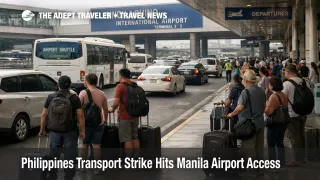
The Philippines transport strike on March 19, 2026, matters to travelers for a simple reason, the weakest link is not necessarily the flight, it is the road trip that gets you to the terminal, your hotel, or your next land or sea connection. Transport groups launched the nationwide action on Thursday, while police, local authorities, and other agencies prepared traffic management and free ride support in Metro Manila. By late day, officials were saying they had not seen stranded commuters on a large scale, but that does not turn this into a non story for travelers with tight airport runs or stacked same day connections. It means the disruption was more uneven than absolute, which is exactly the kind of transport risk that breaks itineraries quietly.
The change from earlier Manila coverage is that this is now a live transport action, not just a warning about possible disruption. For travelers, the practical move is to leave earlier for Ninoy Aquino International Airport (MNL), avoid thin buffers between terminals or onward ferries, and let hotels or drivers confirm route conditions before departure. That is especially important in a city where surface access already carries much of the trip risk on normal days, and where Adept's earlier Metro Manila Protests Raise Airport Timing Risk showed how road friction can damage an otherwise valid departure plan.
Manila Airport Access: What Changed
What changed on March 19 is that the strike moved from announced threat to active operating condition. ABS-CBN reported the nationwide action was launched on Thursday by transport groups protesting soaring fuel costs, while the Philippine National Police and Metro Manila agencies put response measures in place. Government support was not symbolic only, authorities rolled out free rides on selected Metro Manila routes, and Philippine News Agency later reported that traffic and road conditions were being monitored closely from the MMDA command center in Pasig City.
That matters because traveler exposure in Manila is usually not a clean airport open, airport closed question. Airports can keep operating while the trip still fails at the curbside layer. A delayed ride from Makati, Pasay, Manila, or Quezon City can still mean a missed baggage cutoff, a broken domestic connection, or a lost cruise, ferry, or tour handoff later in the day. When officials answer a strike with road monitoring, police deployment, and commuter bus support, they are acknowledging that the real pressure point is urban movement.
Which Travelers Face the Most Disruption
The most exposed travelers are not necessarily those taking the longest flights. They are the ones depending on normal Metro Manila road behavior. That includes passengers heading to MNL from hotel districts in Makati, Bay Area, Ermita, and BGC, travelers making same day transfers between terminals, and anyone connecting an airport arrival to a bus terminal, ferry departure, embassy appointment, or fixed time tour. Even when a strike is described as manageable, patchier jeepney and public utility vehicle coverage can still slow feeder trips and push more demand into private cars, buses, rideshares, and hotel arranged transfers.
Travelers outside Metro Manila should not ignore the story either. The strike was framed as nationwide, not just a capital city protest, but the clearest confirmed operational detail remains the government response in Metro Manila, where free rides, police deployments, and command center traffic monitoring were concentrated in reporting. That means the cleanest traveler takeaway is not that the whole country shut down, because it did not, but that urban access reliability worsened enough to justify mitigation. For visitors moving between Manila and domestic destinations, that is already enough reason to widen buffers.
Travelers already juggling other Philippines disruption stories should treat this as a multiplier, not a separate minor issue. Someone using the country's overstay relief window still needs to physically reach the airport on time, which is why Philippines Overstay Relief Runs Through April 1 connects directly to the new strike story.
What Travelers Should Do Now
The immediate move is simple. If you are flying out of Manila on March 19 or the morning after, leave earlier than you normally would, and treat the road segment as the fragile part of the trip. For international departures, that means building extra time before check in, not just before scheduled departure. For domestic trips, it means avoiding tight same day connections that depend on one clean highway run between hotel, terminal, and gate.
The next decision threshold is whether your itinerary has backup. If a missed terminal transfer, ferry boarding, or bus departure would collapse the rest of the trip, it is smarter to move earlier, stay closer to the airport, or pay for a more controlled transfer than to assume a strike labeled limited will stay limited on your exact corridor. On the other hand, travelers with flexible city plans and no hard same day connection can usually manage this kind of disruption by trimming plans and keeping extra road time in reserve.
Over the next 24 to 72 hours, watch for two different signals. First, local updates on road conditions and commuter support, which tell you whether surface transport is stabilizing or worsening. Second, airline or terminal notices that mention access timing rather than flight status alone. That distinction matters because a trip can fail long before the plane itself is delayed. The main risk is still Manila airport access, not a nationwide airport shutdown.
Why the Disruption Spreads Beyond the Strike Itself
The mechanism is straightforward. Manila is a road dependent travel system. When jeepney and other public transport coverage becomes less reliable, demand does not disappear, it shifts. More people compete for buses, police or government shuttle capacity, private vehicles, taxis, and app based rides. As a result, the first order effect is slower local movement. The second order effect is harder itinerary math, missed timed handoffs, and more expensive fallback choices once travelers start buying their way around uncertainty.
That is why official messaging about no large scale stranding should be read carefully, not lazily. It is useful because it suggests the system did not collapse. It is not proof that traveler timing risk disappeared. Authorities deployed nearly 10,000 police personnel in the National Capital Region, offered free rides, and actively monitored roads for a reason. Those are not the actions of a system expecting zero transport friction.
For travelers, the right conclusion is calm but practical. Airports can stay open and the day can still go wrong on the road. In Manila, that means protecting transfer time first, then protecting the flight. When Manila airport access is the weak point, earlier departures and fewer same day dependencies are the cheapest form of insurance.
Sources
- Free rides deployed, no stranded passengers amid transport strike
- PNP deploys 10K cops in NCR for transport strike
- Transport groups launch nationwide strike to protest soaring fuel costs
- Gov't aids commuters with free rides amid nationwide strike
- Metro Manila Protests Raise Airport Timing Risk
- Philippines Overstay Relief Runs Through April 1