

Türkiye Protest Alert Hits Airport Transfer Plans
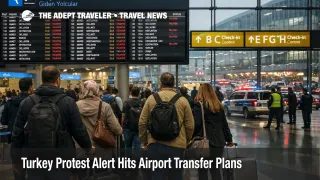
Türkiye protest travel risk widened on March 18, 2026, when an OSAC posted embassy alert warned of ongoing potential for demonstrations throughout Türkiye and explicitly said large gatherings can bring enhanced police presence, road closures, and traffic disruptions. That matters because the problem is no longer just whether you are near one diplomatic district in Istanbul, Türkiye, or Ankara, Türkiye. It means travelers across major visitor cities should treat same day airport runs, rail station arrivals, and fixed time tours as less reliable, especially around civic cores and protest prone dates. The practical move is simple, add buffer, avoid tight transfer chains, and check local conditions before you leave the hotel.
The Türkiye protest travel risk story is now broader than earlier city focused warnings because the new March 18 alert applies nationwide, not just to a few known flashpoints. For travelers, that changes the planning question from "Is my district affected?" to "How much slack do I have if one corridor closes?"
Türkiye Protest Travel Risk: What Changed
What changed since earlier Istanbul and Ankara focused warnings is scope. The March 18 OSAC carried embassy message says demonstrations are possible throughout Türkiye and warns that even gatherings intended to be peaceful can escalate, while also tying them directly to enhanced police presence, road closures, and traffic disruption. That is more operationally useful than a generic caution because it tells travelers what is most likely to break first, surface movement.
The wider advisory picture points the same way. The U.K. Foreign, Commonwealth and Development Office says regular demonstrations are currently taking place in Istanbul and other cities across Türkiye, warns they may become violent, and notes that local transport routes may be disrupted. Australia's Smartraveller says large protests have occurred across Türkiye, says a protest ban is in effect, and flags major cities including Istanbul, Ankara, Adana, Antalya, Hatay, and Izmir, while also warning that mass rallies can occur around March 20 to 21 and again on May 1.
Which Travelers Face the Most Disruption
The most exposed travelers are not necessarily the ones attending protests. They are the ones depending on road timing to hold. That includes passengers heading to Istanbul Airport (IST) or Sabiha Gökçen International Airport (SAW), rail users trying to reach stations from central districts, cruise or coach passengers on fixed pickup windows, and travelers stacking museum entries or onward bus departures onto the same day as a cross city transfer.
Istanbul remains the obvious pinch point because official travel advice identifies repeated protest activity around Taksim Square, Istiklal Street, Galata to Karaköy, Beşiktaş, Okmeydanı, and Kadıköy. In Ankara, official guidance points to Kızılay and Tunali, plus diplomatic mission areas. Those locations matter because they sit close to dense visitor neighborhoods, hotel clusters, commercial arteries, and the kinds of roads taxis and private transfers use when trying to make up time. Izmir and Antalya matter less for nonstop citywide paralysis and more because even a localized march or police cordon can turn a normal hotel to station or hotel to airport run into a detour heavy trip.
A useful internal comparison is Türkiye Protests Slow Istanbul, Ankara Transfers, which covered the narrower city centered version of this problem. For the transfer logic itself, Amman Protests And Airport Transfers Risk Guide remains a good structural read because the failure mode is similar, the protest is not always the direct problem, the missed flight after a reroute is.
What Travelers Should Do Now
For airport departures, the clean threshold is buffer. On normal days, travelers often try to squeeze one last city stop or late hotel checkout before leaving for the terminal. That is the wrong play here. For departures from Istanbul or Ankara on higher risk days, especially around Friday gatherings, March 20 to 21, or other politically charged dates, leave earlier than you usually would and do not build a tight same day sequence around a single driver ETA. If you are on separate tickets, be more conservative, because a protest related delay that causes a misconnect is usually your problem, not the airline's.
For rail, coach, and tour pickups, assume the weakest point is the approach road, not the platform or terminal itself. Confirm with your hotel or operator before departure, ask whether pickup points have been moved, and favor main roads and official transport over improvised curbside arrangements that may try to shortcut through protest prone districts. If you must cross a city on a high risk afternoon or evening, plan around the possibility that navigation apps will lag real police closures.
Over the next 24 to 72 hours, monitor embassy alerts, local media, and official carrier or operator notices rather than relying on one morning snapshot. The main decision point is not whether Türkiye is open to travel. It is whether your itinerary can absorb a 30 to 90 minute surface delay without breaking the rest of the trip. If the answer is no, simplify the day.
Why the Disruption Spreads Beyond Protest Sites
The mechanism is straightforward. A protest does not need to block an airport to affect airport travel. Once authorities push traffic away from a diplomatic mission, square, mosque area, or civic artery, the pressure shifts outward into alternate routes. That creates second order effects that travelers feel fast, slower taxi approach times, missed hotel pickups, rail station rushes, and weaker recovery options if you are already close to check in or boarding cutoffs.
That is why countrywide demonstration language matters more than it first appears to. It does not mean every tourist district is shut down. It means uncertainty is distributed more widely, and uncertainty is what breaks tightly timed travel days. In practice, a traveler in Istanbul may feel this first through a slower airport run, while someone in Ankara may hit it as a rerouted hotel transfer, and a visitor in Izmir or Antalya may mostly see knock on congestion or last minute pickup changes. The first order effect is slower movement near protest zones. The second order effect is that the rest of the day becomes fragile, especially when flights, trains, tours, or onward intercity links leave little room for error.