

Bali Flights Resume, but Nyepi Backlog Hits Transfers
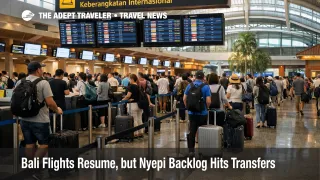
Flights are moving again through I Gusti Ngurah Rai International Airport (DPS) in Denpasar, Indonesia, after Bali's 24 hour Nyepi shutdown ended at 600 a.m. local time on March 20, 2026. But the practical traveler problem has shifted from closure to compression. The first scheduled domestic departure was not until 700 a.m., the first international departure was not until 815 a.m., and the first international and domestic arrivals were scheduled for 705 a.m. and 8:20 a.m. respectively, which means Bali Nyepi transfer backlog is now the more useful planning frame for March 20 and early March 21. Travelers with same day onward flights, ferry handoffs, hotel checkouts, or driver pickups should treat today as a recovery bank, not a normal operating day.
In an earlier Adept Traveler article, Bali Nyepi Closure Suspends 440 Flights March 19 mapped the shutdown itself. What changed since then is that the transport system is open again, but not all at once. That matters because Bali's airport, ferry crossings, hotel transfer patterns, and island hopping itineraries do not restart in a single wave. They restart in staggered banks, which is exactly how queues, missed handoffs, and expensive same day fixes begin.
Bali Nyepi Transfer Backlog: What Changed
The airport reopened at 600 a.m. on March 20 after the full commercial shutdown ordered for Nyepi. Airport management had already published the first scheduled restart times, with domestic departures starting at 700 a.m., international departures at 815 a.m., international arrivals at 705 a.m., and domestic arrivals at 8:20 a.m. That one to two hour gap after reopening is not trivial. It creates a concentrated first wave for check in counters, baggage drop, arrivals pickup, airport road access, and airline re-accommodation for anyone whose trip slipped around the closure window.
The ferry side reopened on a different rhythm. The Ketapang, Java, to Gilimanuk, Bali, crossing and the reverse Gilimanuk closure both ran through 600 a.m. on March 20. Lembar, Lombok, reopened earlier, at 130 a.m. on March 20. Padang Bai, Bali, the key crossing point for Lombok-bound ferry traffic, stays closed the longest, until 11:30 a.m. on March 20. For travelers, that means the headline "Bali is moving again" is only partly true. Air reopened at dawn, Bali Strait ferries resumed at dawn, Lombok side ferry service resumed overnight, but Padang Bai remained out of the system until late morning.
Which Travelers Face the Most Friction
The most exposed travelers are not only people flying into or out of Bali today. They are the travelers stacking modes, airport to ferry, hotel to airport, Bali to Lombok, Bali to the Gilis, or Java to Bali by road and sea. A traveler landing at DPS on the first international arrivals bank can still lose hours if the onward ground or sea leg depends on Padang Bai before late morning. A traveler reaching Bali from Java by ferry at dawn can also hit a second queue when airport, hotel, and tour activity all restart in the same short window.
There is also evidence that backlog risk is not theoretical. In the days before Nyepi, authorities were already managing heavy queues toward Gilimanuk Port during the Eid homecoming period, and local reporting described vehicle lines stretching for kilometers before conditions normalized late on March 18. On March 20, detik reported that once Ketapang reopened after the Nyepi shutdown, thousands of vehicles again queued to cross into Bali. That does not mean every traveler will face a crisis. It does mean Java to Bali and Bali transfer timing are reopening into an already stressed holiday mobility period, not into empty infrastructure.
In an earlier Adept Traveler article, Fastboats Bali to Lombok Suspended, Same Day Canceled we covered how quickly a Bali to Lombok sea disruption spreads into hotel nights, rebooking pressure, and missed onward commitments. The same system logic applies here, even though the trigger is a holiday shutdown rather than weather.
What Travelers Should Do Now
For March 20, build more buffer than you normally would. If your itinerary is airport only, and you are not connecting onward by sea, a minimum extra two hours beyond your usual Bali airport timing is the safer play. If your day includes a ferry, a driver handoff, or a fixed activity after arrival, a half day buffer is more realistic, especially for any plan touching Padang Bai before or just after its 11:30 a.m. reopening. Same day Lombok and Gili connections are possible again, but they are not yet clean.
The decision threshold is simple. Keep same day plans only when missing the connection does not break the trip. If you have an international departure, a liveaboard check in, a wedding, a cruise embarkation, or a nonrefundable tour, protect the itinerary instead of trying to save a few hours. Rebook, overnight, or shift the transfer to March 21 if the trip depends on perfect timing. Waiting may work for flexible leisure plans, but the tradeoff is higher exposure to airport lines, driver delays, ferry boarding queues, and hotel checkout bottlenecks.
Why the Backlog Risk Extends Into March 21
Nyepi creates an island wide stop, not just an airport closure. That is why the recovery pattern is so uneven. Flights do not simply restart, they restart into accumulated demand. Ferries do not simply restart, they reopen on different clocks by route. Hotels do not simply return to normal, they release a wave of checkouts, pickups, and rescheduled excursions at the same time transport links come back online. The first order effect is visible at DPS and the ports. The second order effect is what travelers actually feel, longer lines, slower road transfers, tighter handoff windows, and more expensive rescue options when a same day chain breaks.
What happens next is fairly straightforward. Conditions should improve through March 21 as the first recovery wave clears, but the highest friction remains concentrated in the first post Nyepi operating window and on the Bali Lombok corridor, especially where ferry and air timings meet. That keeps Bali Nyepi transfer backlog relevant through the next operating cycle, not just for the first departing flight of the day. Travelers should keep checking airline status, ferry operator updates, and hotel transfer timing, and avoid designing a March 20 plan that assumes every part of Bali's transport network restarted at full speed the moment silence ended.
Sources
- Bali Airport announces 24-hour operational suspension during Nyepi, ANTARA News
- Bali ferry services closed for Nyepi 2026: Full schedule, ANTARA News
- Bali's Ngurah Rai Airport Resumes Operations After Nyepi, Tempo
- Bali police manage heavy queues toward Gilimanuk Port ahead of Eid, ANTARA News
- Buka Lagi Usai Nyepi, Pelabuhan Ketapang Diserbu Wisatawan ke Bali, detikJatim