

IEA Air Travel Warning Signals Jet Fuel Stress
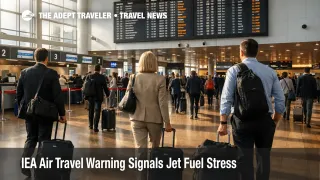
The IEA air travel warning turned the fuel crisis into a direct traveler behavior story on March 20, 2026. The International Energy Agency said governments, businesses, and households should consider short term oil saving steps, and explicitly included avoiding air travel where alternatives exist. That matters beyond energy markets because the agency also said jet fuel markets are especially vulnerable, and its air travel measure is aimed at business flying that can be replaced by virtual meetings. Travelers should now watch not only fares and airline schedules, but also corporate travel policies, public sector travel restrictions, and any new carrier language around capacity discipline.
IEA Air Travel Warning: What Changed
What changed is the IEA's posture. Earlier in the crisis, the focus was on emergency reserve releases and broader supply stabilization. On March 20, the agency added a published demand reduction package that goes further into day to day behavior, including remote work, slower road speeds, and cutting air travel where alternatives exist. In the IEA's own report, the aviation section says travel for work makes up a large share of flying, that a short term reduction of around 40 percent in work related flights is feasible, and that very high participation could reduce jet kerosene demand by 7 percent to 15 percent.
The significance is not that leisure travelers are suddenly facing a blanket ban. It is that the world's main energy watchdog is now treating aviation demand as an active pressure valve in a fuel shock. That gives governments political cover to curb official travel, gives large employers a policy template for trimming discretionary trips, and reinforces an airline message already forming in Europe, where carriers have warned that higher jet fuel costs and supply strain can push fares up and weaken schedule flexibility.
Which Travelers Face the Most Exposure
The first travelers likely to feel this shift are not holidaymakers booking one short break. They are road warriors, public sector travelers, conference attendees, and people on short haul city pairs where rail or virtual substitution is credible. The IEA's aviation note is explicitly aimed at work related flying, and says governments can lead by example by limiting official air travel and moving more meetings online.
For leisure travelers, the effect is more indirect, but still real. If business demand softens on some corridors while fuel costs remain elevated, airlines may not respond by flooding the market with cheap seats. They may keep fares firm, trim marginal frequencies, or protect yields on routes where fuel and rerouting costs are still climbing. Reuters reported on March 19 that European airline chiefs were already warning of higher fares, possible fuel supply risks, and longer term pressure as hedges expire in the coming months. In an earlier Adept Traveler article, Jet Fuel Shortages Spread as Hormuz Risk Deepens, that supply side risk was already visible in Asia. In another, SAS April Flight Cuts Hit Nordic Easter Plans, fare and schedule pressure had already begun showing up at the airline level.
What Travelers Should Do Now
Travelers with work trips in the next 30 to 90 days should separate essential flying from optional flying now, before employer rules tighten. If a trip depends on a short haul flight with a viable rail option, or on a meeting that could move online, the next decision point is no longer just price. It is whether your company or client may change policy after tickets are booked.
For personal travel, the practical move is to avoid assuming weaker demand will automatically mean cheaper tickets. That is not how this fuel cycle is developing. High fuel costs can still push carriers toward tighter schedules and firmer pricing, especially on constrained routes or in markets where alternates are limited. Rebook early if your trip sits on a thin schedule or a connection chain with little backup. Wait only if your route has dense competition, multiple airports, or a credible rail substitute.
Over the next 24 to 72 hours, watch for three signals. One, government or ministry restrictions on official travel. Two, corporate travel advisories that favor rail or remote meetings on short sectors. Three, airline commentary about fuel surcharges, trimmed frequencies, or reduced growth plans. If those signals stack up, the IEA air travel warning will stop being guidance on paper and start shaping real booking behavior.
Why Aviation Was Singled Out, and What Happens Next
Aviation was singled out because jet fuel is one of the tighter parts of the oil system in this shock. The IEA says jet fuel demand accounts for about 7 percent of global oil demand and that jet fuel markets are particularly vulnerable to an extended loss of Middle East production and exports, given limited flexibility elsewhere to increase output. That is why the agency paired its air travel recommendation with a direct claim that reducing business flights can quickly ease pressure on jet fuel markets.
What happens next depends on whether governments and large employers translate the IEA framework into real policy. The agency says several governments have already limited work travel for public officials, and Reuters reported that the IEA's broader message is to combine reserve releases with immediate demand restraint. If that spreads, first order effects could include fewer short notice business trips and softer premium cabin demand on some corridors. Second order effects could include airlines defending yield with capacity discipline rather than chasing volume, which would keep leisure fares sticky even if some business traffic fades. That is the main traveler risk now. The crisis is no longer just about whether fuel is available. It is also about who is asked not to fly, and how airlines reprice the seats that remain.
Sources
- New IEA report highlights options to ease oil price pressures on consumers in response to Middle East supply disruptions
- Sheltering From Oil Shocks, Summary
- Sheltering From Oil Shocks, Air Transport Fuels
- European airlines warn of higher fares, fuel shortages due to Iran war, Reuters
- Work from home, avoid air travel to deal with higher energy prices, IEA says, Reuters