

India Airline Fare Caps Face Fresh Pressure
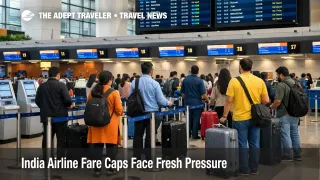
India airline fare caps have moved from a consumer protection measure into a live pricing fight. On March 20, Reuters reported that the Federation of Indian Airlines, representing IndiGo, Air India, and SpiceJet, asked the government to scrap fare caps imposed in December 2025 after IndiGo's cancellation crisis, warning that rising jet fuel prices and longer routings around Pakistan are now squeezing margins hard. For travelers, this is a structural pricing story, not just another fuel headline, because a policy decision in New Delhi could quickly change what domestic and international trips from India cost over the next booking window.
The cap system was introduced after December's disruption wave sent fares sharply higher. Reuters reported the current ceiling tops out at ₹18,000 for a one way journey, depending on route length. Public reporting at the time described the bands as ₹7,500 for sectors up to 500 kilometers, ₹12,000 for 500 to 1,000 kilometers, ₹15,000 for 1,000 to 1,500 kilometers, and ₹18,000 above 1,500 kilometers, with some fees and fare classes outside the cap structure. The exact government order is not easy to verify from a clean public circular, but the existence of the cap, its December 2025 origin, and the ₹18,000 top band are well supported.
What changed now is the industry response. Airlines are no longer just adding fuel surcharges. They are lobbying to remove a rule that limits upside pricing while their costs climb. Reuters also reported that the same airline group has separately asked the government to drop a rule requiring at least 60 percent of seats to be sold without extra seat selection fees, arguing that the rule can force higher fares elsewhere in the ticket.
Which Travelers Are Most Exposed
Domestic travelers inside India are the most immediately exposed if the caps are lifted, especially on shorter notice bookings, high demand metro routes, and dates that already price near the current ceiling. The direct risk is simple. If caps go, fares can move faster in response to fuel, load factors, and operational stress. That matters most for family travel, wedding traffic, business trips booked late, and complex itineraries that depend on domestic positioning flights before an international departure.
Long haul travelers are exposed in a different way. The Pakistan airspace ban has already forced Indian carriers onto longer routings to Europe and North America, while Middle East conflict has narrowed other path options. Reuters reported that Air India and IndiGo have had to fly longer routes, and that IndiGo's Norse leased aircraft have sometimes needed detours via Africa that add up to two hours. First order, that raises fuel burn and crew time. Second order, it weakens schedule recovery when delays hit, because longer sectors leave less slack for onward rotations and same day reaccommodation.
Travelers booking India origin international trips should also treat airline surcharges and the cap debate as related, not separate. IndiGo said on March 13 that it added a fuel charge from March 14, ranging from ₹425 on domestic India and Indian subcontinent routes to ₹2,300 on Europe sectors. Air India said on March 10 that it was expanding fuel surcharges in phases, including ₹399 on domestic India and SAARC flights, $10 on West Asia and Middle East routes, $125 on Europe, and $200 on North America and Australia in later phases. In an earlier Adept Traveler article, Air India Fuel Surcharge Raises India Trip Costs we covered how that surcharge logic was already feeding into booking decisions before this new fare cap push emerged.
What Travelers Should Do Now
If you are pricing India travel for April or later, run a fresh fare search before assuming last week's numbers still hold. That matters most if your trip includes a domestic feeder sector into Delhi, Mumbai, Bengaluru, or another long haul gateway, because even a modest fare move on the domestic leg can change the economics of the whole itinerary.
Rebook early if your travel window is fixed, your connection is tight, or you are traveling on a separate ticket. Wait if your dates are flexible, your destination has multiple airline options, and you can tolerate a short period of pricing volatility while the government decides whether to keep the caps in place. The tradeoff is straightforward, lower current certainty versus the possibility that capped fares survive a bit longer on some routes.
Over the next 24 to 72 hours, watch three signals. First, any public response from India's civil aviation ministry on the fare cap request. Second, whether more carriers widen surcharges or revise fare rules. Third, whether schedule growth slows on the routes you need. If caps stay, airlines have warned they may pull marginal routes or delay expansion. That would not hit every market equally, but it would matter on thinner city pairs and during disruption recovery, when spare seats are what save itineraries. The same capacity fragility shows up more broadly in FAA Delays on Boeing 737 MAX 10 Hit Airline Capacity, where fleet and delivery constraints translate into fewer recovery options.
Why Costs Are Rising, and What Happens Next
The mechanism here is a double cost squeeze. Fuel is rising, and the route map is less efficient. Air India said aviation turbine fuel accounts for nearly 40 percent of airline operating costs and that prices have escalated sharply since early March 2026. IndiGo said IATA's Jet Fuel Monitor showed an 85 percent plus increase in regional fuel prices, and it framed its new charge as only a partial offset rather than a full pass through.
Pakistan's airspace closure to Indian carriers, in place since April 2025, is what makes this harder for India than for some other markets. When Gulf and nearby airspace also become harder to use, Indian airlines lose the most obvious east west corridors at the same time. Reuters reported that this combination has already reduced operations and forced longer routings to Europe and North America. In an earlier Adept Traveler article, Iran And Iraq Airspace Avoidance Extends Flight Times we tracked how those detours were already stretching flight times before this latest fare cap battle surfaced.
What happens next depends on whether the government prioritizes fare restraint or airline balance sheets. If the caps are removed, the most immediate traveler consequence is higher fares on routes that are already pricing against the ceiling. If the caps remain, the likely pressure shifts toward slower route growth, delayed fleet deployment, and less slack during irregular operations, exactly the conditions that make rebooking harder when something breaks. For now, India airline fare caps are still in place, but they now sit in the middle of a wider fight over fuel, detours, and how much pricing pain the market can absorb.
Sources
- Indian airlines seek fare cap removal as Iran crisis hits operations, Reuters
- Iran war deals double blow to Indian airlines already hit by Pakistan airspace ban, Reuters
- Important Update: Phased implementation of fuel surcharge, Air India
- IndiGo Introduces 'Fuel Charge' from 14 March 2026, IndiGo
- India issues directive to all airlines mandating adherence to prescribed fare caps, Reuters
- Indigo meltdown: Details of the govt-imposed cap on airfares, Hindustan Times